Taking Control of One’s Personal Narrative
“You’re not telling the story to change what happened. You’re telling the story to change you.”
“You’re not telling the story to change what happened. You’re telling the story to change you.”
This post is a story… within a story… about a story… becoming another story. It’s about the power of story — and more pointedly storytelling — to change one’s perception of the past and empower individuals to take control of their personal narrative.
The story which is still in the process of becoming begins here:
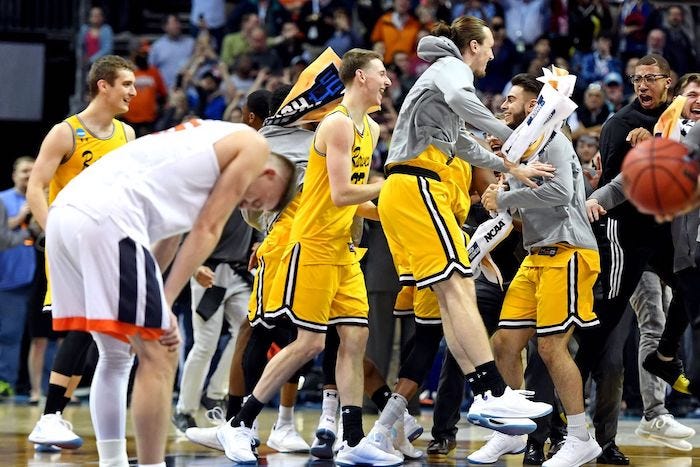
On March 16, 2018, the University of Virginia men’s basketball team became the first #1 seed in the entire history of NCAA men’s basketball tournament to lose to a #16 seed. The University of Maryland, Baltimore County (UMBC) Retrievers not only upset the Virginia Cavaliers, they pounded them by 20 points. It was an utterly shocking sporting event and crushed the spirits of UVA alumni including myself, but the pain of that moment was nowhere felt more emphatically than with the Virginia basketball squad.
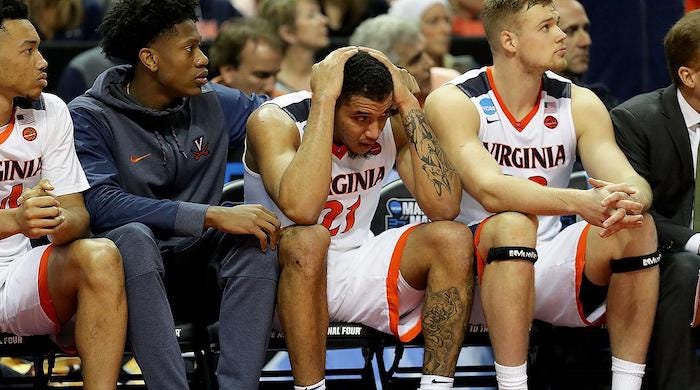
How would this team of young men who entered the tournament as favorites to win it respond to such a devastating loss?
The squad’s coach Tony Bennett immediately took charge of the narrative. Here’s how Bennett recalls what he told the team’s junior guards Ty Jerome and Kyle Guy directly after the end of the game:
When we got beat by UMBC, I said, you two are coming up to the podium. I said two reasons why. We’re going to honor our two seniors in Devon Hall and Isaiah Wilkins. I don’t want them to be up there. We’re going to go up there, and it’s going to be one of the hardest things you ever have to do, how you’re feeling and what you’re going to have to respond to. But it’s going to mark your life, and … this is going to be something we’re going to try to overcome.
Coach Bennett, Jerome, and Guy sat in front of the press taking reporter questions. Watch this video and imagine yourself in their shoes:
Perhaps no UVA player took the loss harder than Guy:
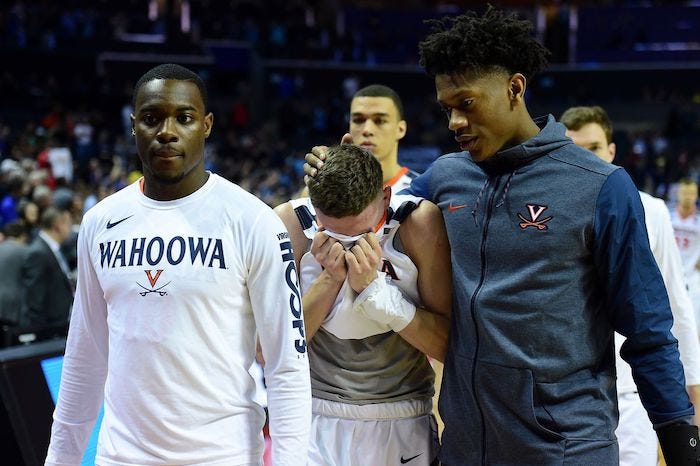
In fact, Guy went public through a series of Facebook posts revealing how he’d had to deal with depression in the first few months after the stunning loss in the NCAA tournament.
Everyone goes through adversity but not everyone lives there. I don’t want this piece to be a pity party, a sermon or preachy, or even a feel-good story. I want this to be REAL. I want this to impact people and I want everyone to understand what my team and I went through.
One of the many things the team did to process what had transpired on that basketball court against UMBC and the ensuing impact on the returning players was watch a TEDx video by storyteller Donald Davis. In it, Davis recounts a story his father told him about how he’d acquired the nickname Cripple Joe from a terrible accident Joe suffered when he was just 5 years old. Do yourself a favor and take 15 minutes to watch this video:
The video was recommended to Tony Bennett by his wife Laurel who had seen the presentation live in Charlottesville and had been moved by it. Neither had any idea how impactful it would become years later in light of the upset sustained by the UVA basketball squad in March 2018. The central message Bennett took away from the talk was this quote:
You must learn that it is never, never tragic when something people think is bad happens to you. Because if you can learn to use it right, it can buy you a ticket to a place you would never have gone any other way.
If you watch the TEDx video, you will see how by telling the story of how he became Cripple Joe over and over again, literally hundreds of times, that process became a big part of what enabled Davis’ father to become a successful businessman known as Banker Joe. As his grandmother told Davis’ father when he was a child recuperating from his injury:
You’re not telling the story to change what happened. You’re telling the story to change you… Because when something happens to you, it sits on top of you like a rock. And if you never tell the story, it sits on you forever. But as you begin to tell the story, you climb out from under that rock, and eventually you sit up on top of it.
A central thematic touchstone for the University of Virginia men’s basketball team this season has been the point Bennett took from the TEDx talk: If you use adversity right, it can help take you to a place you would never have gone any other way.
In other words, take charge of our personal narrative. Others may label us losers. They don’t determine who we are. WE determine who we are.
The challenge for the UVA team has been even more problematic because part of the public perception of Bennett’s coaching philosophy is that the way the team plays basketball — with a pronounced emphasis on defense and a controlled offense — cannot be successful in the NCAA tournament. And in fact, while Virginia has had remarkable success during the regular season, they have under-performed in the post-season.
Cut to the 2019 NCAA tournament. Once again, UVA was a #1 seed after going 29–3 during the regular season and winning the ACC conference championship. And once again, they began the tournament playing a #16 seed squad: Gardner-Webb. I was in Paris, France having dinner with my wife and checked the score: At one point, UVA was down by 14 points.
Would the Virginia Cavaliers repeat history? Or would they change the narrative? They ended up defeating Gardner-Webb: 71–56.
With the weight of history and expectations hanging over them, UVA won the next two tournament games defeating Oklahoma (63–51) and Oregon (53–49) which set up a game with Purdue to see which team would advance to the Final Four. UVA has only been to the Final Four twice, the last time in 1984, thirty-five years ago.
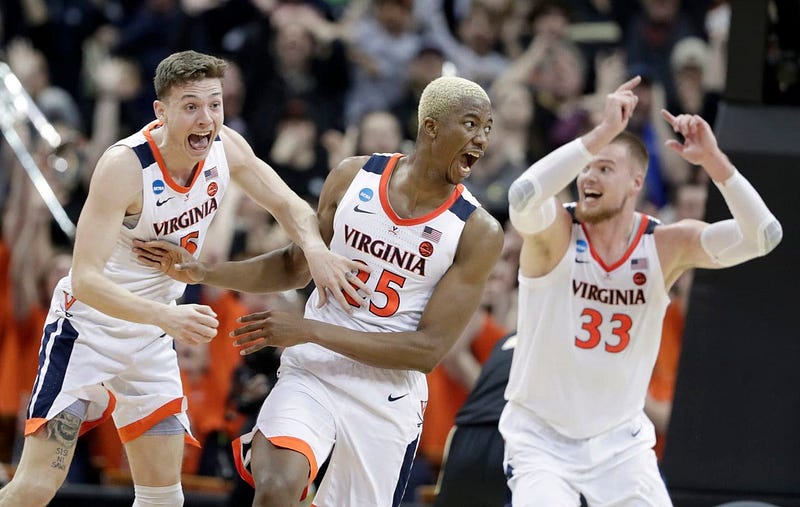
The game with Purdue which took place last Saturday is one of the most memorable Elite Eight games in NCAA history, a pulsating match in which the Boilermkers’ Carson Edwards was virtually unstoppable scoring 42 points. And yet as remarkable as the young’s man performance was, the game will forever be remembered by this moment:
Facing elimination and down two points, that improbable basket took the game to overtime where UVA eventually prevailed 80–75.
What the University of Virginia basketball squad has accomplished this season and especially in their run to the Final Four is a remarkable sports story, but it’s much more than that. It’s about self-identity and who we believe ourselves to be. No college basketball squad has had to confront what these young men have been forced to face, the first #1 seed to lose to a #16 seed. They have had to meet that reality head on through relentless questions from reporters, journalists, and fans, and almost certainly in their private lives each and every day for the last twelve months, confronting existential questions:
Who am I? Who are we as a team? Can we change the narrative of who we are?
The way Coach Bennett and his squad have never ducked the UMBC debacle, but responded to that story with their own story over and over again is eerily similar to what Cripple Joe did… on his way to becoming Banker Joe.
Tomorrow, UVA takes on Auburn in the first NCAA tournament semifinal game, followed by Michigan State versus Texas Tech. The Cavalier’s story will continue to emerge. If they go on to win tomorrow and the championship game on Monday, that would be a storybook ending like something concocted by a Hollywood screenwriter.
But what this coaching staff and these young men have done, both on and off the court, has already taken charge of the narrative. They took a story of a loss… and made it a story of a gain. As Kyle Guy said to a reporter right after the game with Purdue was decided, “We’re making history. Last year, we made bad history. This year, we’re making good history.”
Go Hoos!