Sundays with Stephen King’s “On Writing”
A series featuring reflections on writing from the famed author’s memoir.

A series featuring reflections on writing from the famed author’s memoir.
I had not read Stephen King’s memoir On Writing for several years when it occurred to me to do so again. While at it, why not share reflections from the renowned writer in a weekly Sunday series at Go Into The Story?
King is a prolific author. Fair to say that is an understatement. One need only glance at a roster of his written works to determine that. If any contemporary writer has earned the right to reflect on the craft, it would be King. However, that is not the motivation he had in writing his memoir. This excerpt from the ‘First Foreword’ of On Writing explains the genesis of the book, a fateful exchange with Amy Tan, fellow writer and member of an authors’ charity rock music group The Remainders.
One night while we were eating Chinese before a gig in Miami Beach, I asked Amy if there was any one question she was never asked during the Q-and-A that follows almost every writer’s talk — that question you never get to answer when you’re standing in front of a group of author-struck fans and pretending you don’t put your pants on one leg at a time like everyone else. Amy paused, thinking it over very carefully, and miss said: “No one ever asks about the language.”
I owe an immediate debt of gratitude to her for saying that. I had been playing with the idea of writing a little book about writing for a year or more at that time, but had held back because I didn’t trust my own motivations — why did I want to write about writing? What made me think I had anything worth saying?
The easy answer is that someone who has sold as many books of fiction as I have must have something worthwhile to say about writing it, but the easy answer isn’t always the truth. Colonel Sanders sold a hell of a lot of fried chicken, but I’m not sure anyone wants to know how he made it. If I was going to be presumptuous enough to tell people how to write, I felt there had to be a better reason than my popular success. Put another way, I didn’t want to write a book, even a short one like this, that would leave me feeling like a literary gasbag or a transcendental asshole. There are enough of those books — and those writers — on the market already, thanks.
But Amy was right: nobody ever asks about the language. They ask the DeLillos and the Updikes and the Styrons, but they don’t ask popular novelists. Yet many of us proles also care about the language, in our humble way, and care passionately about the art and craft of telling stories on paper. What follows is an attempt to put down, briefly and simply, how I came to the craft, what I know about it now, and how it’s done. It’s about the day job; it’s about the language.
My intention is similar to the Sundays with Ray Bradbury series: Each week as I re-read King’s memoir, print notable excerpts at Go Into The Story to inspire our creativity and conversation about the craft.
Today: From the twenty-fifth anniversary edition of On Writing, an excerpt from a wonderful chapter titled “Toolbox” (pp. 111–137). King frames the chapter with an anecdote about his Uncle Oren, a carpenter, and a toolbox he had inherited from King’s grandfather Fazza. The toolbox in question is heavy, as King notes weighing “between eighty and hundred and twenty pounds.”
King writes about how as a lad, he accompanied Uncle Oren to fix a broken screen on the backside of the house. He finishes the anecdote with this:
When the screen was secure, Uncle Oren gave me the screwdriver and told me to put it back in the toolbox and “latch her up.” I did, but I was puzzled. I asked him why he’d lugged Fazza’s toolbox all the way around the house, if all he needed was that one screwdriver. He could’ve carried a screwdriver in the back pocket of his khakis.
“Yeah, but Stevie,” he said, bending to grasp the handles, “I didn’t know what else I might find to do once I got out here, did I? It’s best to have your tools with you. If you don’t, you’re apt to find something you didn’t expect and get discouraged.”
This leads King into using a toolbox as a metaphor for writing. Here is an excerpt from pp. 129–135 in which King reflects on the importance of the paragraph.
Before leaving the basic elements of form and style, we ought to think for a moment about the paragraph, the form of organization which comes after the sentence. To that end, grab a novel — preferably one you haven't yet read — down from your shelf … Open the book in the middle and look at any two pages. Observe the pattern — the lines of type, the margins, and most particularly the blocks of white space where paragraphs begin or leave off.
You can tell without even reading if the book you've chosen is apt to be easy or hard, right? Easy books contain lots of short paragraphs — including dialogue paragraphs which may only be a word or two long — and lots of white space. They’re as airy as Dairy Queen ice cream cones. Hard books, ones full of ideas, narration, or description, have a stouter look. A packed look. Paragraphs are almost as important for how they look as for what they say; they are maps of intent.
— —
In fiction, the paragraph is less structured — it's the beat instead of the actual melody. The more fiction you read and write, the more you'll find your paragraphs forming on their own. And that's what you want. When composing it's best not to think too much about where paragraphs begin and end; the trick is to let nature take its course. If you don't like it later on, fix it then. That's what rewrite is all about.
— —
I would argue that the paragraph, not the sentence, is the basic unit of writing — the place where coherence begins and words stand a chance of becoming more than mere words. If the moment of quickening is to come, it comes at the level of the paragraph. It is a marvelous and flexible instrument that can be a single word long or run on for pages… You must learn to use it well if you are to write well. What this means is lots of practice; you have to learn the beat.
While King is referring to novels or short stories, I think his take on paragraphs is nowhere more relevant than with the screenplay.
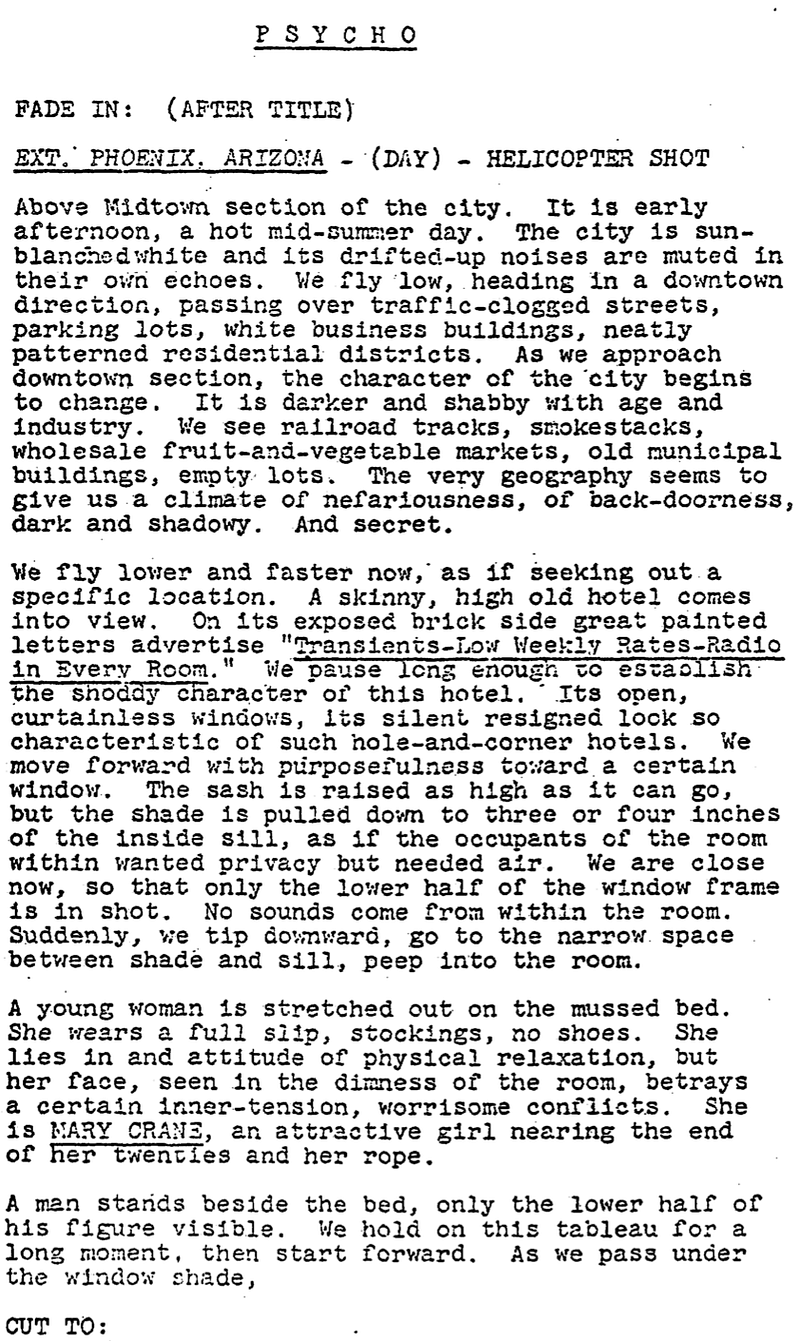
In the first two paragraphs above where King describes opening a book to “observe the pattern… particularly the blocks of white space where paragraphs begin or leave off,” I doubt there is anyone involved in movie or television development — from the studio or network president down to the lowly reader providing coverage — who when cracking open a new screenplay to review does not at first flip through it. How much black ink versus white space? How long or short are the paragraphs? Even a quick perusal will reveal whether the screenplay is likely to be a quick read … or a laborious slog.
Compare this:
To this:
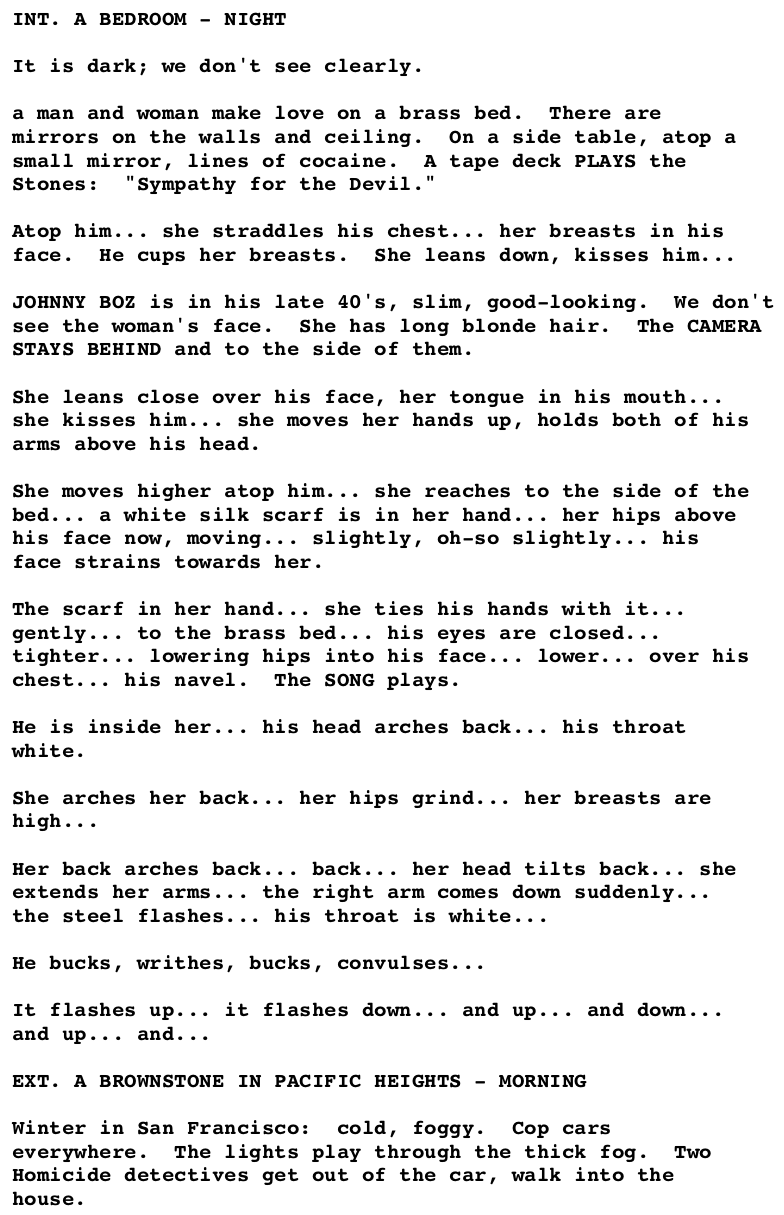
Setting aside the relative merits of the actual written content (obviously, Psycho is brilliant), a screenplay comprised of short paragraphs sets up to be an easy read.
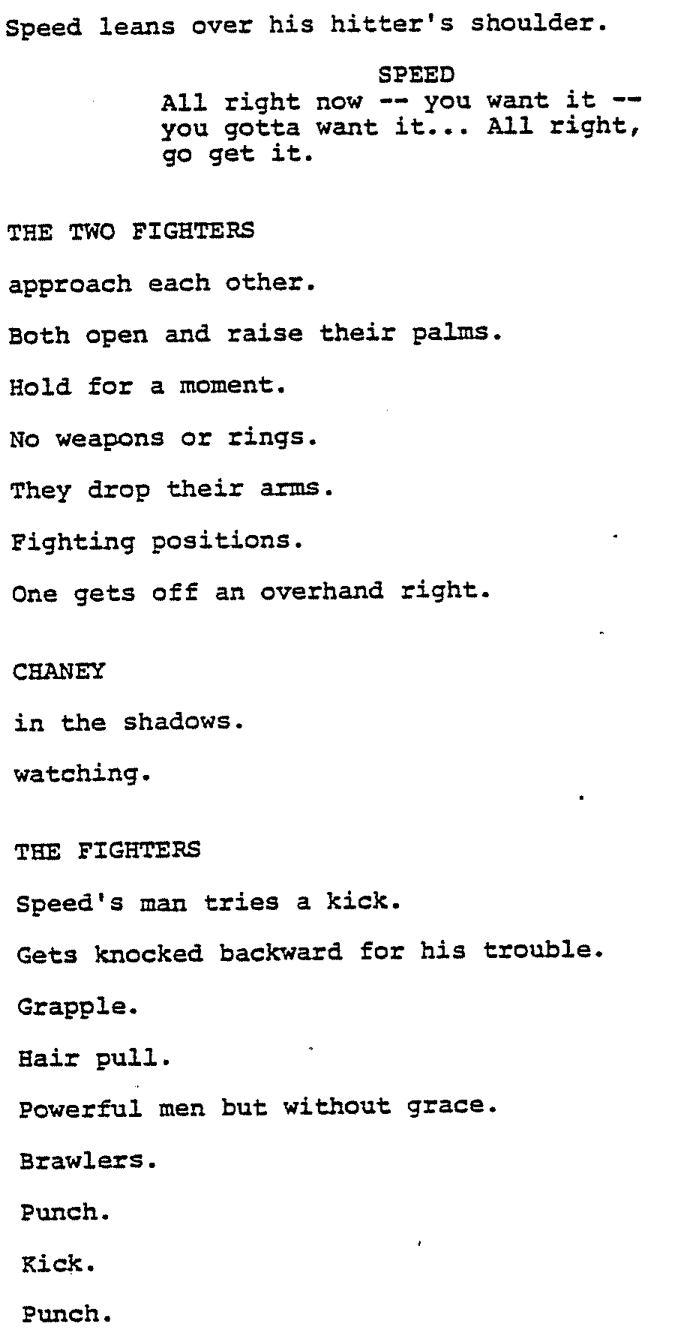
In the next excerpt cited above, King describes a paragraph as a “beat.” This is a term screenwriters often use to describe a scene. Because screenplays are written in the present tense, there is a way in which each page … each paragraph … each sentence unfolds in the moment. There is a rhythm to the action — beat … beat … beat — which the screenwriter can vary depending upon what is transpiring in the here and now.
Moreover, by using the present tense, the screenwriter is invited to let the words flow in the experience writing in the moment. “…the trick is to let nature take its course.” Like this:
But it is perhaps in the final passage of the excerpt above — where King asserts that “the paragraph… is the basic unit of writing” and where “words stand a chance of becoming more than mere words” — which has the most relevance to the contemporary screenplay. For with the emergence of the spec script in the 1980s, as distinct from the shooting script, film directors made it known they did not want screenwriters including specific camera shots in a screenplay. After all, that is their domain. [Insert haughty sniff.]
Well, it took a while, but screenwriters figured out a way to “direct” the action on the script page without resorting to camera lingo or director jargon.
The secret?
Paragraphs.
As in: use paragraphs to suggest individual camera shots.
Check out the action description from the script to The Last Boy Scout:
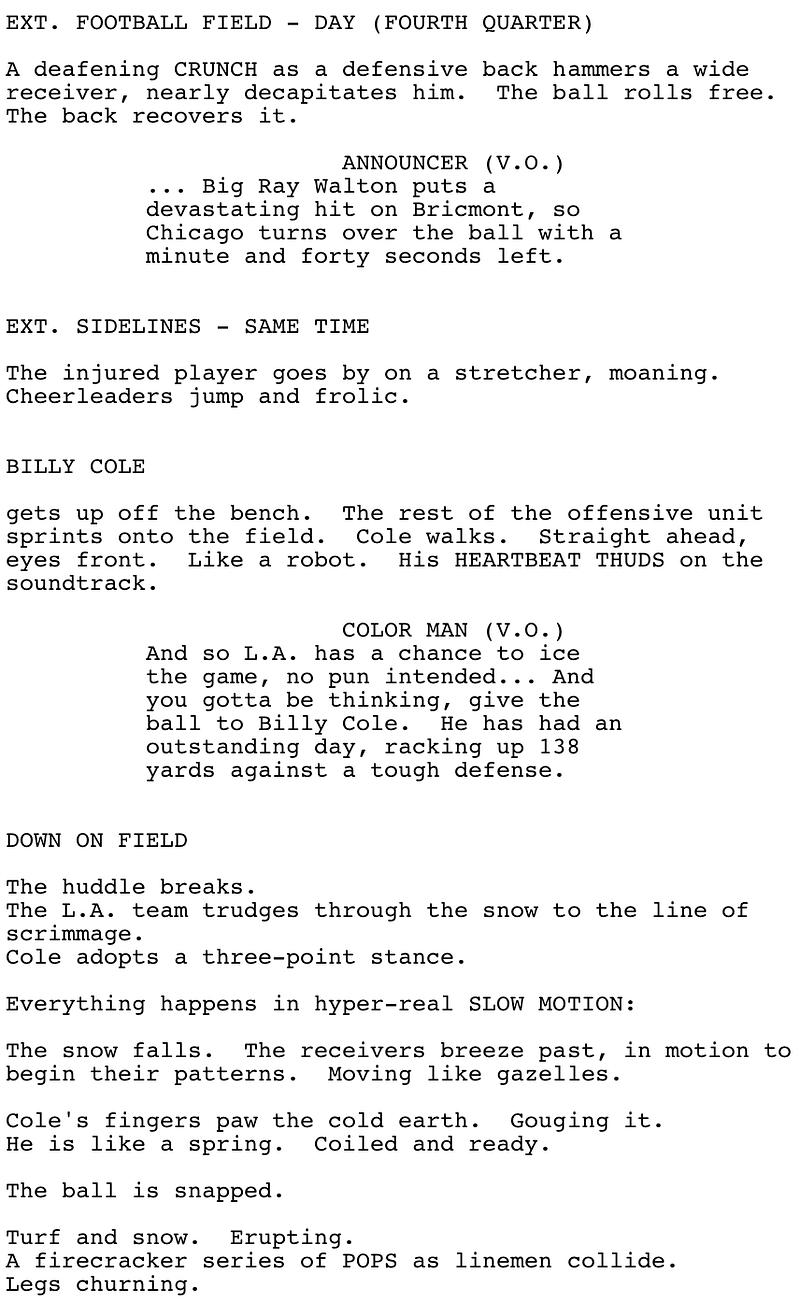
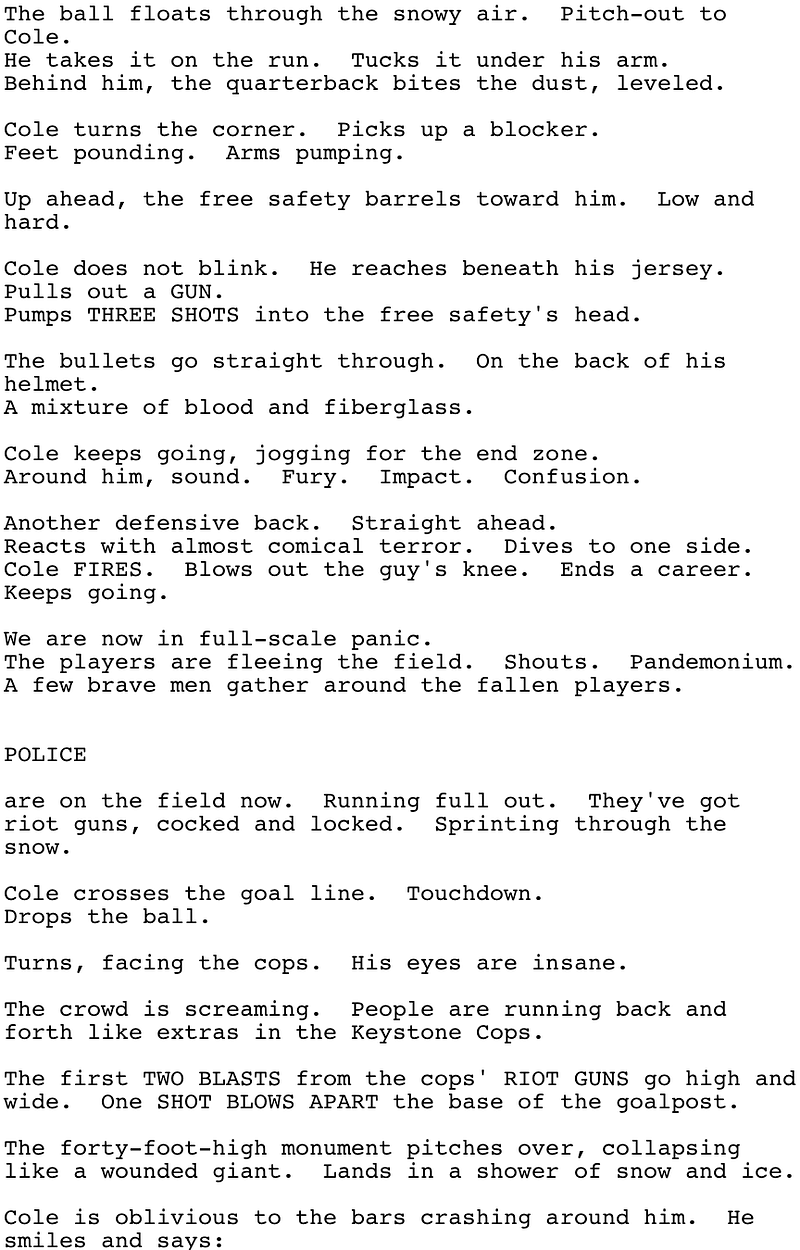

Although not entirely consistent, most of the paragraphs describing the action on the football field suggest individual camera shots.
Thus in a very real way, screenwriters can use paragraphs to become “more than mere words.” They become images, one after the other, cinematic moments which the writer strings together into a scene.
Which is to say that King is onto something with his take on paragraphs. For novels, short stories, and in a unique way … screenplays.
Come back next week and many weeks thereafter for more in the Sundays with Stephen King’s “On Writing” series.
Twitter: @StephenKing