Sundays with Stephen King’s “On Writing”
A new series featuring reflections on writing from the famed writer.
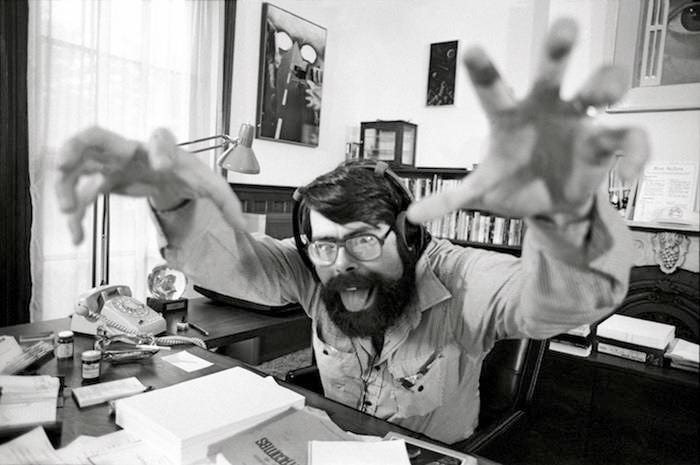
A new series featuring reflections on writing from the famed writer.
I had not read Stephen King’s memoir On Writing for several years when it occurred to me to do so again. While at it, why not share reflections from the renowned writer in a weekly Sunday series at Go Into The Story?
King is a prolific author. Fair to say that is an understatement. One need only glance at a roster of his written works to determine that. If any contemporary writer has earned the right to reflect on the craft, it would be King. However, that is not the motivation he had in writing his memoir. This excerpt from the ‘First Foreword’ of On Writing explains the genesis of the book, a fateful exchange with Amy Tan, fellow writer and member of an authors’ charity rock music group The Remainders.
One night while we were eating Chinese before a gig in Miami Beach, I asked Amy if there was any one question she was never asked during the Q-and-A that follows almost every writer’s talk — that question you never get to answer when you’re standing in front of a group of author-struck fans and pretending you don’t put your pants on one leg at a time like everyone else. Amy paused, thinking it over very carefully, and miss said: “No one ever asks about the language.”
I owe an immediate debt of gratitude to her for saying that. I had been playing with the idea of writing a little book about writing for a year or more at that time, but had held back because I didn’t trust my own motivations — why did I want to write about writing? What made me think I had anything worth saying?
The easy answer is that someone who has sold as many books of fiction as I have must have something worthwhile to say about writing it, but the easy answer isn’t always the truth. Colonel Sanders sold a hell of a lot of fried chicken, but I’m not sure anyone wants to know how he made it. If I was going to be presumptuous enough to tell people how to write, I felt there had to be a better reason than my popular success. Put another way, I didn’t want to write a book, even a short one like this, that would leave me feeling like a literary gasbag or a transcendental asshole. There are enough of those books — and those writers — on the market already, thanks.
But Amy was right: nobody ever asks about the language. They ask the DeLillos and the Updikes and the Styrons, but they don’t ask popular novelists. Yet many of us proles also care about the language, in our humble way, and care passionately about the art and craft of telling stories on paper. What follows is an attempt to put down, briefly and simply, how I came to the craft, what I know about it now, and how it’s done. It’s about the day job; it’s about the language.
My intention is similar to the Sundays with Ray Bradbury series: Each week as I re-read King’s memoir, print notable excerpts at Go Into The Story to inspire our creativity and conversation about the craft.
Today: From the twenty-fifth anniversary edition of On Writing, p. 18:
I don't believe writers can be made, either by circumstances or by self-will (although I did believe those things once). The equipment comes with the original package. Yet it is by no means unusual equipment; I believe large numbers of people have at least some talent as writers and storytellers, and that those talents can be strengthened and sharpened. If I didn't believe that, writing a book like this would be a waste of time.
This is an interesting take on an observation we often see framed like this: You’re either born a writer or you’re not. Or: You either have talent or you don’t? The implication of these takes is that some people have an innate ability as a writer, while others do not. For this latter group, there is little to no point in pursuing the craft because they will never cut it as a writer.
I have always disliked this perspective because it smacks of elitism. Hearkening back to my theological studies background, it reminds me of the concept of predestination, that Fate has somehow determined Person A is a writer while Person B is not, and there is nothing the latter individual can do to change that aspect of their destiny.
Also, this attitude doesn’t jive with my experience as a teacher. For example, several years ago, I participated in a writer’s lab. A few days into the workshop, one of the other mentors pulled me aside to ask, “There’s nobody with real talent here, right?” I disagreed. “I believe they have talent. It’s just raw. They need to work at it … and they need time.” When last I checked, some of those lab participants were working writers with one of them having directed a movie they wrote which played at the Sundance Film Festival.
Then there is my own personal experience. When I sold a spec script and broke into Hollywood, I had no formal training as a screenwriter. I spent the first few years as a screenwriter immersing myself in the craft and working my ass off. What I lacked in terms of professional knowledge, I managed to survive based upon my lifelong passion for movies and an instinct for writing that stretched back to my elementary school days.
Which circles back to King’s basic point: I believe large numbers of people have at least some talent as writers and storytellers, and that those talents can be strengthened and sharpened. My reading on this is it is not King’s role or any other person’s responsibility to determine if someone has the requisite talent to be a writer or not. In fact, the tone of King’s opinion is egalitarian in nature: “Large numbers of people” may have a requisite level of talent to be a writer. The subtext of what he is saying seems to be this: Maybe you have “some talent,” maybe you don’t. That is for YOU to determine.
King’s intention in writing the memoir, at least in part, reminds me of the Biblical story: The Parable of the Sower. Whatever points about the craft King writes about in his book are equivalent to seeds. Some will fall on rocky soil. Some eaten by birds. Some scorched by the sun. But some will land on good soil and will flourish as crops — “a hundred, sixty, or thirty times what was sown.”
King believes “talents can be strengthened and sharpened.” The observations he provides about the craft in his memoir eventually, even inevitably will find good soil, people who have “some talent as writers and storytellers.” From that point on, it’s a matter of working at it … and time.
I am reminded of a quote from novelist Jessamyn West: “Talent is helpful in writing, but guts are absolutely necessary.”
Or as King puts it later in his memoir: “A little talent is a good thing to have if you want to be a writer. But the only real requirement is the ability to remember every scar.”
Come back next week and many weeks thereafter for more in the Sundays with Stephen King’s “On Writing” series.
On Writing: A Memoir on the Craft by Stephen King
Twitter: @StephenKing