Sundays with Stephen King’s “On Writing”
A series featuring reflections on writing from the famed author’s memoir.
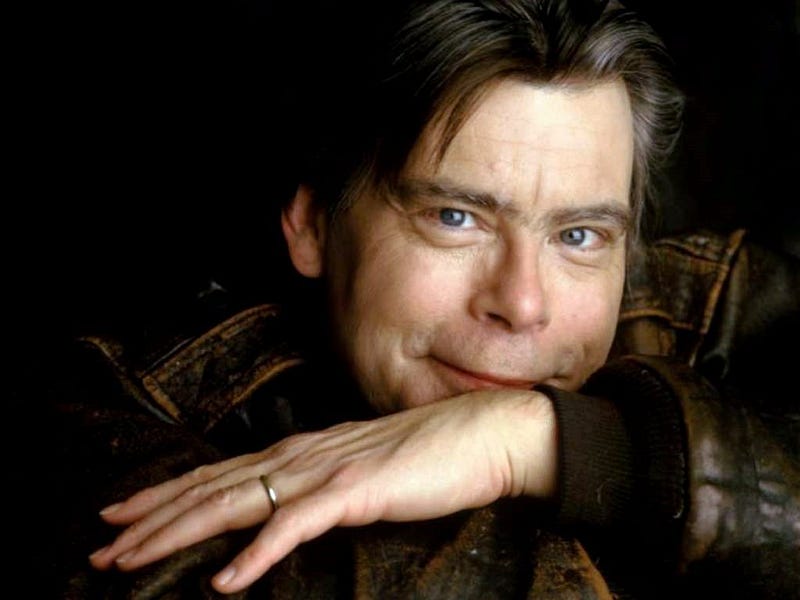
A series featuring reflections on writing from the famed author’s memoir.
I had not read Stephen King’s memoir On Writing for several years when it occurred to me to do so again. While at it, why not share reflections from the renowned writer in a weekly Sunday series at Go Into The Story?
King is a prolific author. Fair to say that is an understatement. One need only glance at a roster of his written works to determine that. If any contemporary writer has earned the right to reflect on the craft, it would be King. However, that is not the motivation he had in writing his memoir. This excerpt from the ‘First Foreword’ of On Writing explains the genesis of the book, a fateful exchange with Amy Tan, fellow writer and member of an authors’ charity rock music group The Remainders.
One night while we were eating Chinese before a gig in Miami Beach, I asked Amy if there was any one question she was never asked during the Q-and-A that follows almost every writer’s talk — that question you never get to answer when you’re standing in front of a group of author-struck fans and pretending you don’t put your pants on one leg at a time like everyone else. Amy paused, thinking it over very carefully, and miss said: “No one ever asks about the language.”
I owe an immediate debt of gratitude to her for saying that. I had been playing with the idea of writing a little book about writing for a year or more at that time, but had held back because I didn’t trust my own motivations — why did I want to write about writing? What made me think I had anything worth saying?
The easy answer is that someone who has sold as many books of fiction as I have must have something worthwhile to say about writing it, but the easy answer isn’t always the truth. Colonel Sanders sold a hell of a lot of fried chicken, but I’m not sure anyone wants to know how he made it. If I was going to be presumptuous enough to tell people how to write, I felt there had to be a better reason than my popular success. Put another way, I didn’t want to write a book, even a short one like this, that would leave me feeling like a literary gasbag or a transcendental asshole. There are enough of those books — and those writers — on the market already, thanks.
But Amy was right: nobody ever asks about the language. They ask the DeLillos and the Updikes and the Styrons, but they don’t ask popular novelists. Yet many of us proles also care about the language, in our humble way, and care passionately about the art and craft of telling stories on paper. What follows is an attempt to put down, briefly and simply, how I came to the craft, what I know about it now, and how it’s done. It’s about the day job; it’s about the language.
My intention is similar to the Sundays with Ray Bradbury series: Each week as I re-read King’s memoir, print notable excerpts at Go Into The Story to inspire our creativity and conversation about the craft.
Today: From the twenty-fifth anniversary edition of On Writing, an excerpt from a wonderful chapter titled “Toolbox” (pp. 111–137). King frames the chapter with an anecdote about his Uncle Oren, a carpenter, and a toolbox he had inherited from King’s grandfather Fazza. The toolbox in question is heavy, as King notes weighing “between eighty and hundred and twenty pounds.”
King writes about how as a lad, he accompanied Uncle Oren to fix a broken screen on the backside of the house. He finishes the anecdote with this:
When the screen was secure, Uncle Oren gave me the screwdriver and told me to put it back in the toolbox and “latch her up.” I did, but I was puzzled. I asked him why he’d lugged Fazza’s toolbox all the way around the house, if all he needed was that one screwdriver. He could’ve carried a screwdriver in the back pocket of his khakis.
“Yeah, but Stevie,” he said, bending to grasp the handles, “I didn’t know what else I might find to do once I got out here, did I? It’s best to have your tools with you. If you don’t, you’re apt to find something you didn’t expect and get discouraged.”
This leads King into using a toolbox as a metaphor for writing. Here is an excerpt from pp. 127–128 in which he provides his theory on what leads to writers using passive voice and adverbs.
I am convinced that fear is at the root of most bad writing. If one is writing for one's own pleasure, that fear may be mild — timidity is the word I've used here. If, however, one is working under deadline — a school paper, a newspaper article, the SAT writing sample — that fear may be intense. Dumbo got airborne with the help of a magic feather; you may feel the urge to grasp a passive verb or one of those nasty adverbs for the same reason. Just remember before you do that Dumbo didn't need the feather; the magic was in him.
You probably do know what you're talking about, and can safely energize your prose with active verbs. And you probably have told your story well enough to believe that when you use he said, the reader will know how he said it — fast or slowly, happily or sadly…
Good writing is often about letting go of fear and affectation. Affectation itself, beginning with the need to define some sort of writing as "good" and other sources "bad," is fearful behavior. Good writing is also about making good choices when it comes to picking the tools you plan to work with.
When it comes to writing a screenplay, today and next week’s excerpt from On Writing provides a critically important perspective: The magic is in you.
You’ve been trained through years of formal education to learn the rules of grammar. That is all well and good. Your life itself has provided a different kind of education, one which has shaped your distinct personality. When you sit down to write fiction, which do you think is more important: grammatical rules or your unique writer’s voice?
Of course, it’s the latter. This is nowhere more true than in a screenplay. I often remind my undergraduate students, “You are not writing a 10th grade essay. Rather, you are telling a story and you must do everything you can to tell that story the best way possible.”
Active verbs … vivid descriptors … one-word paragraphs … sentence fragments … double dashes and ellipses …
Whatever the story requires to be told in the most entertaining way possible, do that. Don’t approach the writing fearful of making some sort of rule-breaking mistake. Instead, approach the writing like a warrior!
This is your story, God damn it! No one knows it better than you! That knowledge … that MAGIC … it resides within you. You KNOW it. Now write it.
As David Mamet says: “Forget every rule Syd Field, Robert McKee or any other screenwriting guru ever taught you. Except one: Never be boring.”
Come back next week and many weeks thereafter for more in the Sundays with Stephen King’s “On Writing” series.
Twitter: @StephenKing