Sundays with Stephen King’s “On Writing”
A series featuring reflections on writing from the famed writer’s memoir.

A series featuring reflections on writing from the famed writer’s memoir.
I had not read Stephen King’s memoir On Writing for several years when it occurred to me to do so again. While at it, why not share reflections from the renowned writer in a weekly Sunday series at Go Into The Story?
King is a prolific author. Fair to say that is an understatement. One need only glance at a roster of his written works to determine that. If any contemporary writer has earned the right to reflect on the craft, it would be King. However, that is not the motivation he had in writing his memoir. This excerpt from the ‘First Foreword’ of On Writing explains the genesis of the book, a fateful exchange with Amy Tan, fellow writer and member of an authors’ charity rock music group The Remainders.
One night while we were eating Chinese before a gig in Miami Beach, I asked Amy if there was any one question she was never asked during the Q-and-A that follows almost every writer’s talk — that question you never get to answer when you’re standing in front of a group of author-struck fans and pretending you don’t put your pants on one leg at a time like everyone else. Amy paused, thinking it over very carefully, and miss said: “No one ever asks about the language.”
I owe an immediate debt of gratitude to her for saying that. I had been playing with the idea of writing a little book about writing for a year or more at that time, but had held back because I didn’t trust my own motivations — why did I want to write about writing? What made me think I had anything worth saying?
The easy answer is that someone who has sold as many books of fiction as I have must have something worthwhile to say about writing it, but the easy answer isn’t always the truth. Colonel Sanders sold a hell of a lot of fried chicken, but I’m not sure anyone wants to know how he made it. If I was going to be presumptuous enough to tell people how to write, I felt there had to be a better reason than my popular success. Put another way, I didn’t want to write a book, even a short one like this, that would leave me feeling like a literary gasbag or a transcendental asshole. There are enough of those books — and those writers — on the market already, thanks.
But Amy was right: nobody ever asks about the language. They ask the DeLillos and the Updikes and the Styrons, but they don’t ask popular novelists. Yet many of us proles also care about the language, in our humble way, and care passionately about the art and craft of telling stories on paper. What follows is an attempt to put down, briefly and simply, how I came to the craft, what I know about it now, and how it’s done. It’s about the day job; it’s about the language.
My intention is similar to the Sundays with Ray Bradbury series: Each week as I re-read King’s memoir, print notable excerpts at Go Into The Story to inspire our creativity and conversation about the craft.
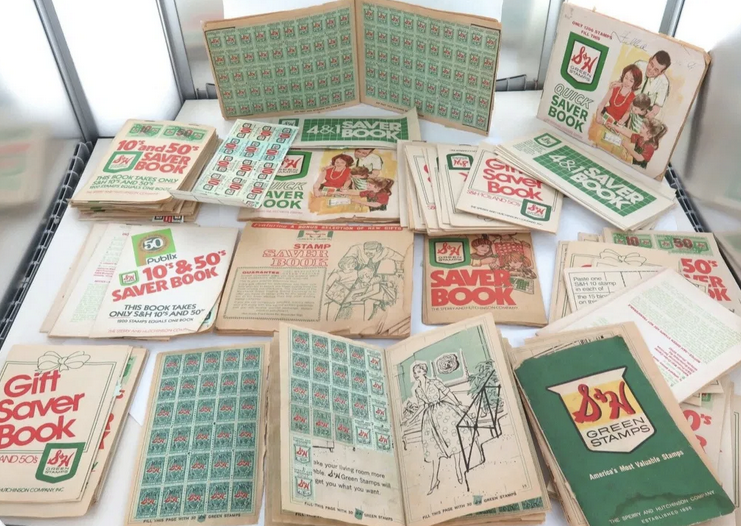
Today: From the twenty-fifth anniversary edition of On Writing, an excerpt from pp. 37–38 in which a confluence of small events involving S&H Green Stamps and King’s mother led to a story idea.
Let's get one thing clear right now, shall we? There is no Idea Dump, no Story Central, no Island of the Buried Best Sellers; good story ideas seem to come quite literally from nowhere, sailing at you right out of the empty sky: two previously unrelated ideas come together and make something new under the sun. Your job isn't to find these ideas but to recognize them when they show up.
On the day this particular idea — the first really good one — came sailing at me, my mother remarked that she needed six more books of stamps to get a lamp she wanted to give her sister Molly for Christmas, and she didn't think she would make it in time. “I guess it will have to be for her birthday, instead,” she said. “These cussed things always look like a lot until you stick them in a book.” Then she crossed her eyes and ran her tongue out at me. When she did, I saw her tongue was S&H green. I thought how nice it would be if you could make those damned stamps in your basement, and in that instant a story called “Happy Stamps” was born. The concept of counterfeiting Green Stamps and the sight of my mother's green tongue created it in an instant.
This dips into an aspect of the creative process which has fascinated me since I began to write screenplays back in 1986: Where do story ideas come from? Or perhaps more practically, how can I go about finding a good story idea?
King suggests there is no “Idea Dump, no Story Central,” that story ideas “seem to come quite literally from nowhere,” and that a writer’s job is to “recognize them when they show up.”
There’s certainly truth to that point-of-view. A moment where you suddenly see “two previously unrelated ideas” and put them together, “something new under the sun” can emerge.
I’m guessing pretty much every writer has had this experience. I did. Back when Rodney Dangerfield was hot after the smash hit movie Back to School, my writing partner and I met with his “people.” Having been a fan of stand-up comedy since my youth, I knew quite well what Rodney’s schtick was: I don’t get no respect.

While half-listening to one of Rodney’s producing team share an off-color anecdote about the comedian, I had this thought: What if Rodney did get people’s respect?
By the time we left the office, I had it: What job provides the most possible respect for the individual holding it?
Rodney Dangerfield: Mr. President.
Put together two previously unrelated things and you get something new. That worked. We sold the Mr. President pitch to Warner Bros. for six-figures.
Just today, I moderated a panel at this year’s ScreenCraft Writers Summit featuring Meg LeFauve (Inside Out), Lang Fisher (The Mindy Show), and Rodney Barnes (The Boondocks). I discussed a graphic novel Rodney had written called Killadelphia: Sins of the Father. He described how as he was attending the musical Hamilton for about “the sixth time,” for some reason, on this particular viewing, when Rodney watched King George make fun of John Adams:
Rodney thought, “What would John Adams have felt if he heard this song? Wouldn’t he be so angry? Wouldn’t he yearn to do something to demonstrate his power?”
And that’s when it dawned on Rodney: John Adams. Vampire.
Talk about two unrelated things!
To be fair, Rodney knew the project Killadelphia was about “cops and vampires,” inspired by his affection for the 70s TV series The Night Stalker, but it wasn’t until this moment during his sixth time seeing Hamilton that he put those two disparate elements together: The second President of the United States is a vampire… and alive in 2021.
Again, what King says rings true, doesn’t it? Often, ideas just spring up seemingly out of nowhere. But isn’t there a way for a writer to be proactive in generating story ideas, not just waiting for them to “sail by?”
In the series I ran some months ago — Sundays with Ray Bradbury — the renowned author wrote this about what he did when he was first starting to get serious about the craft:
Through those years I began to make lists of titles, to put down long lines of nouns. These lists were the provocations, finally, that caused my better stuff to surface. I was feeling my way towards something honest, hidden under the trapdoor on the top of my skull.
The lists ran something like this:
THE LAKE. THE NIGHT. THE CRICKETS. THE RAVINE. THE ATTIC. THE BASEMENT. THE TRAPDOOR. THE BABY. THE CROWD. THE NIGHT TRAIN. THE FOG HORN. THE SCYTHE. THE CARNIVAL. THE CAROUSEL. THE DWARF. THE MIRROR MAZE. THE SKELETON.
I was beginning to see a pattern in the list, in these words that I had simply flung forth on paper, trusting my subconscious to give bread, as it were, to the birds.
Bradbury was intentional in trying to generate story ideas. Or perhaps that’s the wrong word. Not generate, but discover within his “subconscious.” Which brings us back to King’s point: Our job is to “recognize them when they show up.”
For decades, I’ve had a habit of flagging news articles and stashing them into a file marked Story Ideas. In the old days, I literally cut them out from magazines and newspapers, and stuffed them into a thick manila folder. Now, it’s all digital. In fact, I find the seeds for so many possible stories, I’ve run a series every April since 2010: A Story Idea Each Day for a Month. Here are links to 300+ story ideas.
A Story Idea Each Day for a Month (2010)
A Story Idea Each Day for a Month (2011)
A Story Idea Each Day for a Month (2012)
A Story Idea Each Day for a Month (2013)
A Story Idea Each Day for a Month (2014)
A Story Idea Each Day for a Month (2015)
A Story Idea Each Day for a Month (2016)
A Story Idea Each Day for a Month (2017)
A Story Idea Each Day for a Month (2018)
A Story Idea Each Day for a Month (2019)
A Story Idea Each Day for a Month (2020)
I’m hosting the series again this month. These stories are free for the taking. Who knows? Maybe in going through them, “something new under the sun” will sail your way!
By the way, I encourage you to read how King describes the plot to “Happy Stamps,” based on his first really good idea. Written as a pre-adolescent, you can already sense some of the author’s writing instincts at work, particularly with regard to irony.
Come back next week and many weeks thereafter for more in the Sundays with Stephen King’s “On Writing” series.
On Writing: A Memoir on the Craft by Stephen King
Twitter: @StephenKing