Sundays with Stephen King’s “On Writing”
A series featuring reflections on writing from the famed author’s memoir.
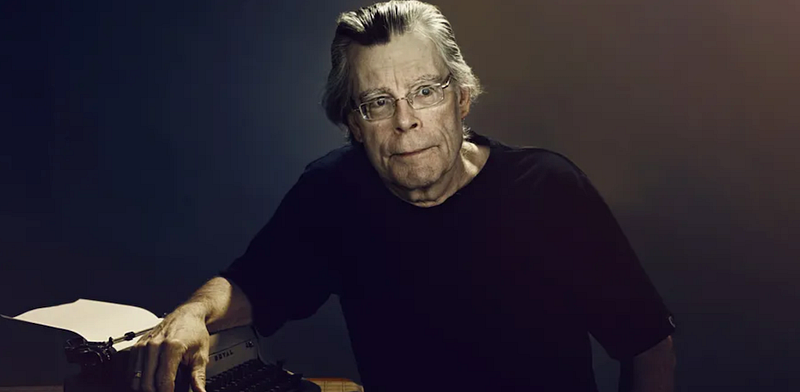
A series featuring reflections on writing from the famed author’s memoir.
I had not read Stephen King’s memoir On Writing for several years when it occurred to me to do so again. While at it, why not share reflections from the renowned writer in a weekly Sunday series at Go Into The Story?
King is a prolific author. Fair to say that is an understatement. One need only glance at a roster of his written works to determine that. If any contemporary writer has earned the right to reflect on the craft, it would be King. However, that is not the motivation he had in writing his memoir. This excerpt from the ‘First Foreword’ of On Writing explains the genesis of the book, a fateful exchange with Amy Tan, fellow writer and member of an authors’ charity rock music group The Remainders.
One night while we were eating Chinese before a gig in Miami Beach, I asked Amy if there was any one question she was never asked during the Q-and-A that follows almost every writer’s talk — that question you never get to answer when you’re standing in front of a group of author-struck fans and pretending you don’t put your pants on one leg at a time like everyone else. Amy paused, thinking it over very carefully, and miss said: “No one ever asks about the language.”
I owe an immediate debt of gratitude to her for saying that. I had been playing with the idea of writing a little book about writing for a year or more at that time, but had held back because I didn’t trust my own motivations — why did I want to write about writing? What made me think I had anything worth saying?
The easy answer is that someone who has sold as many books of fiction as I have must have something worthwhile to say about writing it, but the easy answer isn’t always the truth. Colonel Sanders sold a hell of a lot of fried chicken, but I’m not sure anyone wants to know how he made it. If I was going to be presumptuous enough to tell people how to write, I felt there had to be a better reason than my popular success. Put another way, I didn’t want to write a book, even a short one like this, that would leave me feeling like a literary gasbag or a transcendental asshole. There are enough of those books — and those writers — on the market already, thanks.
But Amy was right: nobody ever asks about the language. They ask the DeLillos and the Updikes and the Styrons, but they don’t ask popular novelists. Yet many of us proles also care about the language, in our humble way, and care passionately about the art and craft of telling stories on paper. What follows is an attempt to put down, briefly and simply, how I came to the craft, what I know about it now, and how it’s done. It’s about the day job; it’s about the language.
My intention is similar to the Sundays with Ray Bradbury series: Each week as I re-read King’s memoir, print notable excerpts at Go Into The Story to inspire our creativity and conversation about the craft.
Today: From the twenty-fifth anniversary edition of On Writing, excerpts from pp. 222–223 on tending to a story’s pace.
Mostly when I think of pacing, I go back to Elmore Leonard, who explained it so perfectly by saying he just left out the boring parts. This suggests cutting to speed the pace, and that's what most of us end up having to do (kill your darlings, kill your darlings, even when it breaks your ego-centric little scribblers heart, kill your darlings).
As a teenager, sending out stories to magazines like Fantasy and Science-Fiction and Ellery Queen's Mystery Magazine, I got used to the sort of rejection note that starts Dear Contributor (might as well start off Dear Chump), and so came to relish any little personal dash on these printed pink-slips. They were few and far between, but when they came they never failed to lighten my day and put a smile on my face.
In the spring of my senior year at Lisbon High — 1966, this would’ve been — I got a scribbled comment that changed the way I rewrote my fiction once and forever. Jotted below the machine-generated signature of the editor was this mot: “Not bad, but PUFFY. You need to revise for length. Formula: 2nd Draft = First Draft -10%. Good luck."
I wish I could remember who wrote that note … Whoever it was did me a hell of a favor. I copied the formula out on a piece of shirt-cardboard and taped it to the wall beside my typewriter. Good things started to happen for me shortly after…
Before the Formula, if I produced a story that was four thousand words or so in the first draft, it was apt to be five thousand in second (some writers are taker-outers; I'm afraid I've always been a natural putter-inner). After the Formula, that changed. Even today I will aim for a second draft length of thirty-six hundred words if the first draft of the story around four thousand … first draft of a novel runs three hundred and fifty thousand words, I’ll try my damndest to produce a second draft of no more than three hundred and fifteen thousand … three hundred, if possible. Usually it is possible. What the Formula taught me is that every story and novel is collapsible to some degree. If you can't get cut ten percent of it while retaining the basic story and flavor, you're not trying very hard. The effect of judicious cutting is immediate and often amazing — literary Viagra.
Obviously, there’s more to a story’s pace than cutting content — King addresses this at the front of this section of the book — but the kind of ruthless efficiency he suggests with his Formula (cut 10%) feels especially relevant to anyone writing a screenplay. Unlike a novel, a movie script or television script exists as part of a zero sum game:
Zero-sum game is a mathematical representation in game theory and economic theory of a situation in which an advantage that is won by one of two sides is lost by the other. If the total gains of the participants are added up, and the total losses are subtracted, they will sum to zero.
A feature length screenplay may run from 80–130 pages. An hour-long episodic TV script may run from 50–60 pages. A half-hour episodic TV script may run from 25–35 pages. There is some wiggle room in terms of length, but the simple fact is, a screenwriter has limited page count in which to tell their story. The longer the script, the more likely it is we will lose the interest of the reader. That doesn’t take into account budget considerations, scheduling, and all the rest that goes into the production of a movie or TV episode.
Thus, the mindset of King’s Formula — cut 10% — ought to feel familiar, if not downright comfortable for a screenwriter.
When it comes to pace, I drum this question into my students’ mind: With every scene … every side of dialogue … every line of scene description … ask yourself, “Is it essential?”
Does this absolutely need to exist in this script in order to best tell this story? If not, cut it. As the great playwright and screenwriter Paddy Chayefsky wrote:
“If it should occur to you to cut, do so. That’s the first basic rule of editing.”
Should we think of this 10% Formula as a rule? No. But as a rule of thumb, a touchstone for the rewrite process between first and second draft? Absolutely! You may not see the “fat” in your script … but it’s there.
I was a mentor for a Black List/Women In Film feature writers lab at which Aline Brosh McKenna was a featured guest. I remember how at one point in discussing this very subject, she looked at each of the writers and said, “I guarantee I could cut fifteen pages from each of your first acts.”
Now THAT is some ruthless efficiency!
King closes this section with this thought about backstory, something often directly tied to a story’s pace:
The most important things to remember about back story are that (a) everyone has a history and (b) most of it isn‘t very interesting. Stick to the parts that are, and don’t get carried away with the rest. Long life stories are best received in bars, and only then an hour or so before closing time, and if you are buying.
Wise words to close out the subject of pacing.
Come back next week and many weeks thereafter for more in the Sundays with Stephen King’s “On Writing” series.
Twitter: @StephenKing