Sundays with Stephen King’s “On Writing”
A series featuring reflections on writing from the famed author’s memoir.
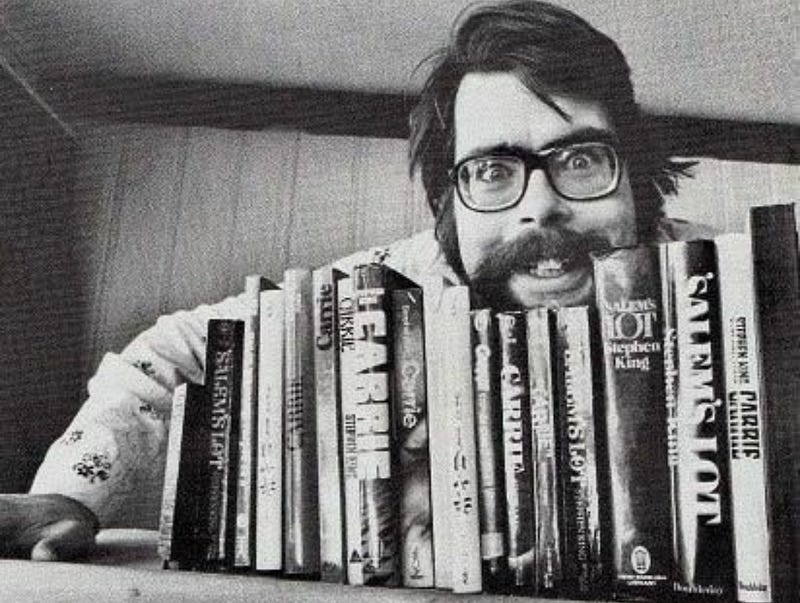
A series featuring reflections on writing from the famed author’s memoir.
I had not read Stephen King’s memoir On Writing for several years when it occurred to me to do so again. While at it, why not share reflections from the renowned writer in a weekly Sunday series at Go Into The Story?
King is a prolific author. Fair to say that is an understatement. One need only glance at a roster of his written works to determine that. If any contemporary writer has earned the right to reflect on the craft, it would be King. However, that is not the motivation he had in writing his memoir. This excerpt from the ‘First Foreword’ of On Writing explains the genesis of the book, a fateful exchange with Amy Tan, fellow writer and member of an authors’ charity rock music group The Remainders.
One night while we were eating Chinese before a gig in Miami Beach, I asked Amy if there was any one question she was never asked during the Q-and-A that follows almost every writer’s talk — that question you never get to answer when you’re standing in front of a group of author-struck fans and pretending you don’t put your pants on one leg at a time like everyone else. Amy paused, thinking it over very carefully, and miss said: “No one ever asks about the language.”
I owe an immediate debt of gratitude to her for saying that. I had been playing with the idea of writing a little book about writing for a year or more at that time, but had held back because I didn’t trust my own motivations — why did I want to write about writing? What made me think I had anything worth saying?
The easy answer is that someone who has sold as many books of fiction as I have must have something worthwhile to say about writing it, but the easy answer isn’t always the truth. Colonel Sanders sold a hell of a lot of fried chicken, but I’m not sure anyone wants to know how he made it. If I was going to be presumptuous enough to tell people how to write, I felt there had to be a better reason than my popular success. Put another way, I didn’t want to write a book, even a short one like this, that would leave me feeling like a literary gasbag or a transcendental asshole. There are enough of those books — and those writers — on the market already, thanks.
But Amy was right: nobody ever asks about the language. They ask the DeLillos and the Updikes and the Styrons, but they don’t ask popular novelists. Yet many of us proles also care about the language, in our humble way, and care passionately about the art and craft of telling stories on paper. What follows is an attempt to put down, briefly and simply, how I came to the craft, what I know about it now, and how it’s done. It’s about the day job; it’s about the language.
My intention is similar to the Sundays with Ray Bradbury series: Each week as I re-read King’s memoir, print notable excerpts at Go Into The Story to inspire our creativity and conversation about the craft.
Today: From the twenty-fifth anniversary edition of On Writing, an excerpt from a wonderful chapter titled “Toolbox” (pp. 111–137). King frames the chapter with an anecdote about his Uncle Oren, a carpenter, and a toolbox he had inherited from King’s grandfather Fazza. The toolbox in question is heavy, as King notes weighing “between eighty and hundred and twenty pounds.”
King writes about how as a lad, he accompanied Uncle Oren to fix a broken screen on the backside of the house. He finishes the anecdote with this:
When the screen was secure, Uncle Oren gave me the screwdriver and told me to put it back in the toolbox and “latch her up.” I did, but I was puzzled. I asked him why he’d lugged Fazza’s toolbox all the way around the house, if all he needed was that one screwdriver. He could’ve carried a screwdriver in the back pocket of his khakis.
“Yeah, but Stevie,” he said, bending to grasp the handles, “I didn’t know what else I might find to do once I got out here, did I? It’s best to have your tools with you. If you don’t, you’re apt to find something you didn’t expect and get discouraged.”
This leads King into using a toolbox as a metaphor for writing. Here is an excerpt from pp. 135–137 in which King hits upon perhaps the single most important word related to the act of writing a story.
Words create sentences; sentences create paragraphs; sometimes paragraphs quicken and begin to breathe. Imagine, if you like, Frankenstein's monster on its slab. Here comes lightning, not from the sky but from a humble paragraph of English words. Maybe it's the first really good paragraph you ever wrote, something so fragile and yet full of possibility that you are frightened. You feel as Victor Frankenstein must have when the dead conglomeration of sewn-together spare parts suddenly opened it's watery yellow eyes. Oh my God, it's breathing, you realize. Maybe it's even thinking. What in the hell's name do I do next?
You go onto the third level, of course, and begin to write real fiction. Why shouldn't you? Why should you fear? Carpenters don't build monsters, after all; they build houses, stores, and banks. They build some of wood a plank at a time and some of brick a brick at a time. You will build a paragraph at a time, constructing these of your vocabulary and your knowledge of grammar and basic style. As long as you stay level-on-the-level and shave every door, you can build whatever you like — whole mansions, if you have the energy.
— —
At its most basic we are only discussing a learned skill, but do we not agree that sometimes the most basic skills can create things far beyond our expectations? We are talking about tools and carpentry, about words and style … but as we move along, you’d do well to remember that we are also talking about magic.
Magic. In my humble opinion, that is the most important word related to the act of creating a story. Many other word associations spring to mind, a host of them discussed by King up to this point in his memoir on writing including inspiration, perseverance, talent, skill, style, even luck. But perhaps the most fundamental truth about bringing a story into existence is this: Magic.
Nowhere is this truth more important for writers to embrace than screenwriting. The simple fact that screenplays are in effect pre-movies lends itself to reducing the craft to formula. As a document passed around the crew — from director to cinematographer to production designer to location manager to actor, and on and on and on — the people involved in actually making the film may tend to have a rather reductionist perception of a screenplay. It’s a guide. A map. A blueprint to make a movie.
Unfortunately, this perception is exacerbated on the creative side by the cottage industry of so-called screenwriting “gurus” who each have their own paradigm for screenplay structure. This needs to happen by page so-and-so. That needs to happen by another page so-and-so.
Indeed, writers desperate the crack the code of how to write a screenplay that will sell all too often buy into the simplification of the craft and seek out those who will provide a formula they can use to pound out one-hundred pages which they dream will result in a million dollar spec script sale.
Nope.
As I tell my students: “Writing a Story = Wrangling Magic.”
As frustrating and confounding as the process of getting from Fade In to Fade Out can be, dealing with characters who veer away from formulas and paradigms, who turn pre-fab story structures on their head, it is precisely the spontaneity and surprise provided by the choices our characters make and the actions they take which can result in the most important magical phenomenon of all: When a reader reads our pages, the story lifts up off the pages and into their imaginations.
This is one of the primary reasons I love On Writing by Stephen King. He is a staunch advocate of knowing your shit as a writer: style, grammar, verbs, sentences, and paragraphs, and then rhythm, flow, tone, atmosphere, and voice. But at the end of the day, it’s about magic.
There is no formula to access that magic. No one path. No key. No secret. What is required is simply a commitment on the part of the writer to engage their characters … and trust they will take you where you need to go in telling their story.
It is the characters who will help you wrangle magic.
Come back next week and many weeks thereafter for more in the Sundays with Stephen King’s “On Writing” series.
Twitter: @StephenKing