Sundays with Stephen King’s “On Writing”
A series featuring reflections on writing from the famed writer’s memoir.

A series featuring reflections on writing from the famed writer’s memoir.
I had not read Stephen King’s memoir On Writing for several years when it occurred to me to do so again. While at it, why not share reflections from the renowned writer in a weekly Sunday series at Go Into The Story?
King is a prolific author. Fair to say that is an understatement. One need only glance at a roster of his written works to determine that. If any contemporary writer has earned the right to reflect on the craft, it would be King. However, that is not the motivation he had in writing his memoir. This excerpt from the ‘First Foreword’ of On Writing explains the genesis of the book, a fateful exchange with Amy Tan, fellow writer and member of an authors’ charity rock music group The Remainders.
One night while we were eating Chinese before a gig in Miami Beach, I asked Amy if there was any one question she was never asked during the Q-and-A that follows almost every writer’s talk — that question you never get to answer when you’re standing in front of a group of author-struck fans and pretending you don’t put your pants on one leg at a time like everyone else. Amy paused, thinking it over very carefully, and miss said: “No one ever asks about the language.”
I owe an immediate debt of gratitude to her for saying that. I had been playing with the idea of writing a little book about writing for a year or more at that time, but had held back because I didn’t trust my own motivations — why did I want to write about writing? What made me think I had anything worth saying?
The easy answer is that someone who has sold as many books of fiction as I have must have something worthwhile to say about writing it, but the easy answer isn’t always the truth. Colonel Sanders sold a hell of a lot of fried chicken, but I’m not sure anyone wants to know how he made it. If I was going to be presumptuous enough to tell people how to write, I felt there had to be a better reason than my popular success. Put another way, I didn’t want to write a book, even a short one like this, that would leave me feeling like a literary gasbag or a transcendental asshole. There are enough of those books — and those writers — on the market already, thanks.
But Amy was right: nobody ever asks about the language. They ask the DeLillos and the Updikes and the Styrons, but they don’t ask popular novelists. Yet many of us proles also care about the language, in our humble way, and care passionately about the art and craft of telling stories on paper. What follows is an attempt to put down, briefly and simply, how I came to the craft, what I know about it now, and how it’s done. It’s about the day job; it’s about the language.
My intention is similar to the Sundays with Ray Bradbury series: Each week as I re-read King’s memoir, print notable excerpts at Go Into The Story to inspire our creativity and conversation about the craft.
Today: From the twenty-fifth anniversary edition of On Writing, an excerpt from pp. 40–41 on what King did after he received his first rejection letter for a short story he’d written “Happy Stamps,” discussed in last week’s post. (Note: AHMM referred to below stands for Alfred Hitchcock’s Mystery Magazine):
When I got the rejection slip from AHMM, I pounded a nail into the wall, wrote “Happy Stamps” on the rejection slip, and poked it onto the nail. Then I sat on my bed and listened to Fats (Domino) sing “I’m Ready.” I felt pretty good actually. When you're still too young to shave, optimism is a perfectly legitimate response to failure.
By the time I was fourteen (and the shaving twice a week whether I needed to or not) the nail in my wall would no longer support the weight of the rejection slips impaled upon it. I replaced the nail with a spike and went on writing. By the time I was sixteen I'd begun to get rejections slips with hand-written notes a little more encouraging than the advice to stop using staples and start using paperclips. The first of these hopeful notes was from Algis Budrys, then the editor of Fantasy and Science Fiction, who read a story of mine called “The Night of the Tiger” (the inspiration was, I think, an episode of The Fugitive in which Dr. Richard Kimble worked as an attendant cleaning out cages in a zoo or a circus) and wrote: “This is good. Not for us, but good. You have talent. Submit again.”
Those four brief sentences, scribbled by a fountain pen that left big ragged blotches in its wake, brightened the dismal winter of my sixteenth year. Ten years or so later, after I sold a couple of novels, I discovered “The Night of the Tiger” in a box of old manuscripts and thought it was still a perfectly respectable tale, albeit one obviously written by a guy who had only begun to learn his chops. I rewrote it and on a whim resubmitted it to F&SF. This time they bought it. One thing I've noticed is that when you’ve had a little success, magazines are a lot less apt to use that phrase, “Not for us.”
Rejection. This experience is something every writer must learn to handle because the times a buyer says “No” far outweigh the times they say “Yes.” As these writers note:
John Scalzi: “Engrave this in your brain: EVERY WRITER GETS REJECTED. You will be no different.”
Dani Shapiro: “The writing life requires courage, patience, persistence, empathy, openness, and the ability to deal with rejection.”
Peter Hyams: “If you’re not prepared to be rejected, don’t try to write films.”
Stephen King’s approach to handling rejection began with the very first time a publication turned down his manuscript: He used it as motivation. Witness the fact he did not stuff the rejection slip in a drawer, rather he nailed it to the wall where he would always see it when sitting down to write. As the stack of rejection letters continued to grow, he replaced the nail with a spike.
As King says, he “went on writing.”
“Rejection has value. It teaches us when our work is not good enough and must be made better… Best ask yourself: What kind of writer are you? The kind who survives? Or the kind who gets asphyxiated by the tentacles of woe?” — Chuck Wendig
I’d like to point out something else which plays as emotional subtext in the passage from King’s memoir excerpted above: He had the courage not only to write, but to put his writing out there. As King is an ardent Red Sox fan, let’s use a baseball analogy: You cannot hit a home run unless you step up to the plate and take a swing.
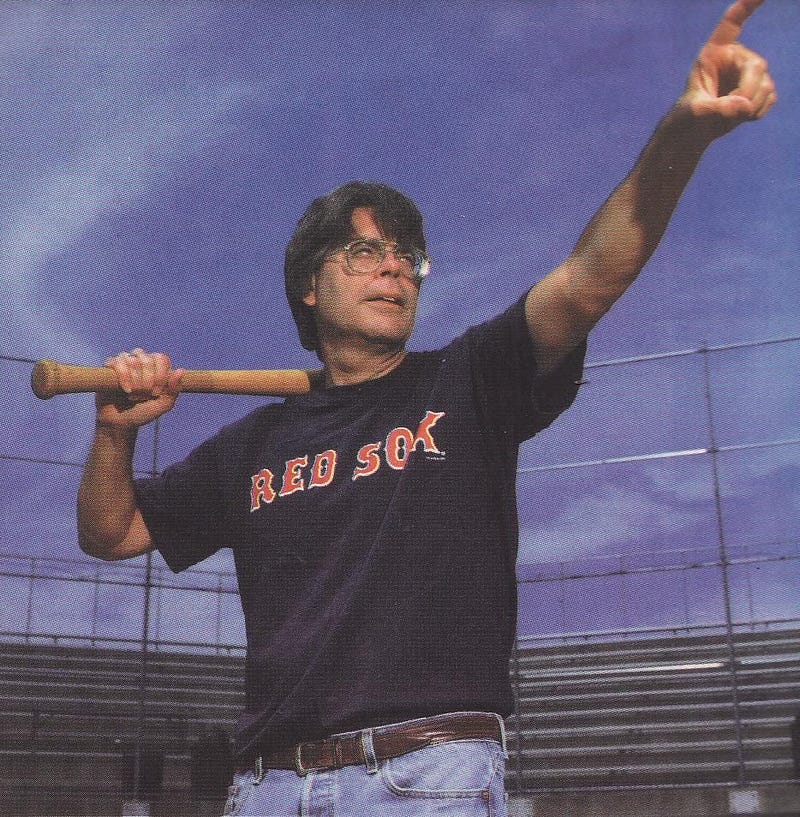
Along with the courage it takes to write something, then send it out into the world where you know chances are it is going to be rejected, there is another layer of emotional subtext to this process: Hope. For if a writer has zero hope someone will respond to their story, what is the point? As screenwriter John Gary writes:
“Screenwriting is an ocean of nos surrounding a handful of yesses. All you need is one yes.”
All you need is one yes. That should be enough to fan the flickering embers of hope smoldering within your creative soul.
Therefore, take a clue from the writing habits of fourteen-year-old Stephen King who used rejection letters to motivate him to write. That is perhaps the single best way for a writer to best the beast of despair when confronted by a world filled with Nos.
Come back next week and many weeks thereafter for more in the Sundays with Stephen King’s “On Writing” series.
On Writing: A Memoir on the Craft by Stephen King
Twitter: @StephenKing