Sundays with Stephen King’s “On Writing”
A series featuring reflections on writing from the famed author’s memoir.
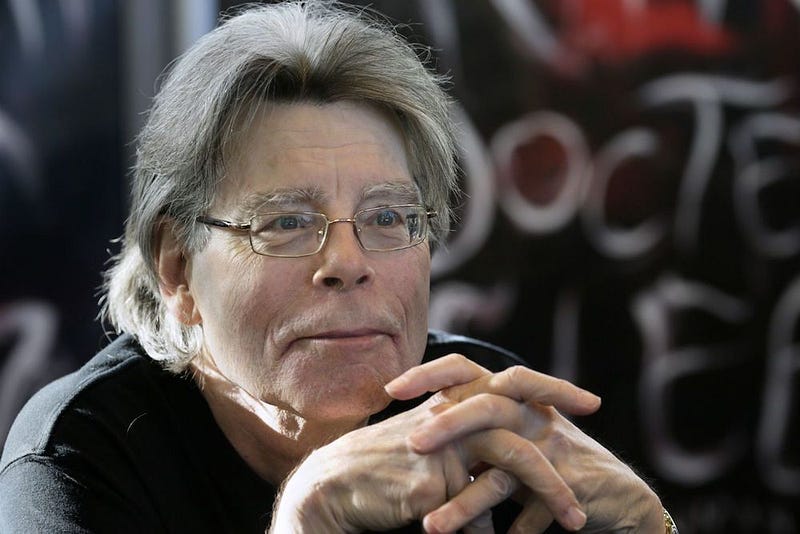
A series featuring reflections on writing from the famed author’s memoir.
I had not read Stephen King’s memoir On Writing for several years when it occurred to me to do so again. While at it, why not share reflections from the renowned writer in a weekly Sunday series at Go Into The Story?
King is a prolific author. Fair to say that is an understatement. One need only glance at a roster of his written works to determine that. If any contemporary writer has earned the right to reflect on the craft, it would be King. However, that is not the motivation he had in writing his memoir. This excerpt from the ‘First Foreword’ of On Writing explains the genesis of the book, a fateful exchange with Amy Tan, fellow writer and member of an authors’ charity rock music group The Remainders.
One night while we were eating Chinese before a gig in Miami Beach, I asked Amy if there was any one question she was never asked during the Q-and-A that follows almost every writer’s talk — that question you never get to answer when you’re standing in front of a group of author-struck fans and pretending you don’t put your pants on one leg at a time like everyone else. Amy paused, thinking it over very carefully, and miss said: “No one ever asks about the language.”
I owe an immediate debt of gratitude to her for saying that. I had been playing with the idea of writing a little book about writing for a year or more at that time, but had held back because I didn’t trust my own motivations — why did I want to write about writing? What made me think I had anything worth saying?
The easy answer is that someone who has sold as many books of fiction as I have must have something worthwhile to say about writing it, but the easy answer isn’t always the truth. Colonel Sanders sold a hell of a lot of fried chicken, but I’m not sure anyone wants to know how he made it. If I was going to be presumptuous enough to tell people how to write, I felt there had to be a better reason than my popular success. Put another way, I didn’t want to write a book, even a short one like this, that would leave me feeling like a literary gasbag or a transcendental asshole. There are enough of those books — and those writers — on the market already, thanks.
But Amy was right: nobody ever asks about the language. They ask the DeLillos and the Updikes and the Styrons, but they don’t ask popular novelists. Yet many of us proles also care about the language, in our humble way, and care passionately about the art and craft of telling stories on paper. What follows is an attempt to put down, briefly and simply, how I came to the craft, what I know about it now, and how it’s done. It’s about the day job; it’s about the language.
My intention is similar to the Sundays with Ray Bradbury series: Each week as I re-read King’s memoir, print notable excerpts at Go Into The Story to inspire our creativity and conversation about the craft.
Today: From the twenty-fifth anniversary edition of On Writing, an excerpt from pp. 145–147.
If you want to be a writer, you must do two things above all others: read a lot and write a lot. There's no way around these two things that I'm aware of, no shortcut.
I'm a slow reader, but I usually get through seventy or eighty books a year, mostly fiction. I don't read in order to study the craft; I read because I like to read. It's what I do at night, kicked back in my blue chair. Similarly, I don't read fiction to study the art of fiction, but simply because I like stories. Yet there is a learning process going on. Every book you pick up has its own lesson or lessons, and quite often the bad books have more to teach than the good ones.
— —
One learns most clearly what not to do by reading bad prose — one novel like Asteroid Miners (or Valley of the Dolls, Flowers in the Attic, and The Bridges of Madison County, to name just a few) is worth a semester at a good writing school, even with the superstar guest lecturers thrown in.
Good writing, on the other hand, teaches the learning writer about style, graceful narration, plot development, the creation of believable characters, and truth–telling. A novel like The Grapes of Wrath may fill a new writer with feelings of despair and good old fashion jealousy — “I’ll never be able to write anything that good, not if I live to be a thousand” — but such feelings can also serve as a spur, goading the writer to work harder and aim higher. Being swept away by a combination of great story and great writing — of being flattened, in fact — is part of every writer’s necessary formation. You cannot hope to sweep someone else away by the force of your writing until it has been done to you.
So we read to experience the mediocre and the outright rotten; such experience helps us to recognize those things when they begin to creep into our own work, and to steer clear of them. We also read in order to measure ourselves against the good and the great, to get a sense of all that can be done. And we read in order to experience different styles.
The first few lines of this excerpt represents one of the most quoted pieces of advice from On Writing. Witness these:

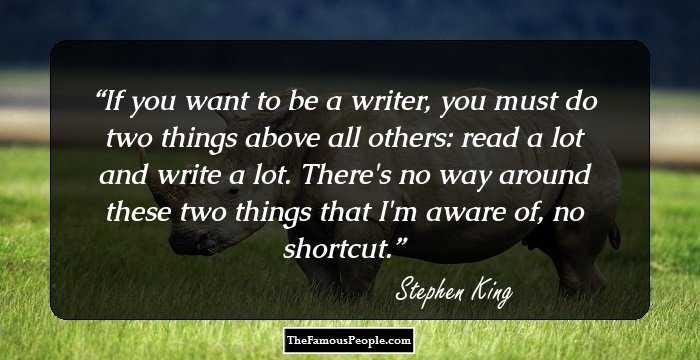

King’s advice is intriguing: reading to focus not so much on studying the craft exhibited in the pages, but, I guess you could say, absorbing it. Part of that would figure to be conscious notes you make in your mind as you hit on a unique style, the way in which the writer manages a story’s pace, and so forth. But it also feels like what King is advocating involves a kind of learning by osmosis. Read in order … to read. Again, absorb knowledge.
I don’t think I had King’s quote in mind when I stumbled upon my own screenwriting mantra over a decade ago, right here on my blog.
Watch movies. Read scripts. Write pages.
But I am certainly willing to ibid King as I most assuredly absorbed his advice when I first read his memoir years before.
An interesting discovery I have made over the years as an educator is that many, if not most budding screenwriters don’t have a problem watching movies (or TV) or writing pages. It’s that middle one — read scripts — which is a stumbling block. And yet, I believe it is a critical piece of the puzzle in figuring out how best to learn the craft.
In fact, I would go so far as to say that a writer’s reluctance to read scripts is a pretty good indicator they don’t have the wherewithal to cut it as a screenwriter. A screenplay is a unique way to tell a story and requires a thorough grasp of its conventions in order to craft a compelling story. You need the kind of discipline to sit down, open a screenplay, bad, good, or excellent, and read it. Day after day. If a writer doesn’t have the consistency and persistence to read scripts on a regular basis … well then, there’s always short stories!
The truly absurd thing is where the seventy or eighty books Stephen King reads each year cost him money — at least the ones not sent to him by publishing companies — there are quite literally thousands of movie screenplays available online for free. No cost. Download the PDF, drop it into a file marked Scripts, then put it on your reading schedule.
Maybe it’s because a screenplay is a different creature than a novel, but I would argue there is significant value in digging into a script when reading it. The first pass? Read without taking any notes, just absorb whatever knowledge emerges, akin to what King advises. But then, go back through it and tear it apart to study the script’s “guts”: Scene-By-Scene Breakdown; Plotline Points and Sequences; Subplots, Relationships, and Character Functions; Metamorphosis; Themes; Style and Language. I wrote a seven-part series detailing this process: LINK.
Whatever you do, embrace what Stephen King says: There is no shortcut. Read. Write. And for screenwriters, I would add… Watch.
Come back next week and many weeks thereafter for more in the Sundays with Stephen King’s “On Writing” series.
Twitter: @StephenKing