Sundays with Stephen King’s “On Writing”
A series featuring reflections on writing from the famed author’s memoir.
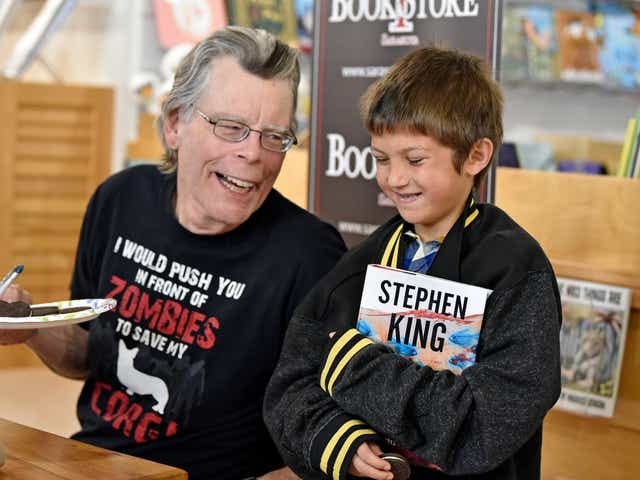
A series featuring reflections on writing from the famed author’s memoir.
I had not read Stephen King’s memoir On Writing for several years when it occurred to me to do so again. While at it, why not share reflections from the renowned writer in a weekly Sunday series at Go Into The Story?
King is a prolific author. Fair to say that is an understatement. One need only glance at a roster of his written works to determine that. If any contemporary writer has earned the right to reflect on the craft, it would be King. However, that is not the motivation he had in writing his memoir. This excerpt from the ‘First Foreword’ of On Writing explains the genesis of the book, a fateful exchange with Amy Tan, fellow writer and member of an authors’ charity rock music group The Remainders.
One night while we were eating Chinese before a gig in Miami Beach, I asked Amy if there was any one question she was never asked during the Q-and-A that follows almost every writer’s talk — that question you never get to answer when you’re standing in front of a group of author-struck fans and pretending you don’t put your pants on one leg at a time like everyone else. Amy paused, thinking it over very carefully, and miss said: “No one ever asks about the language.”
I owe an immediate debt of gratitude to her for saying that. I had been playing with the idea of writing a little book about writing for a year or more at that time, but had held back because I didn’t trust my own motivations — why did I want to write about writing? What made me think I had anything worth saying?
The easy answer is that someone who has sold as many books of fiction as I have must have something worthwhile to say about writing it, but the easy answer isn’t always the truth. Colonel Sanders sold a hell of a lot of fried chicken, but I’m not sure anyone wants to know how he made it. If I was going to be presumptuous enough to tell people how to write, I felt there had to be a better reason than my popular success. Put another way, I didn’t want to write a book, even a short one like this, that would leave me feeling like a literary gasbag or a transcendental asshole. There are enough of those books — and those writers — on the market already, thanks.
But Amy was right: nobody ever asks about the language. They ask the DeLillos and the Updikes and the Styrons, but they don’t ask popular novelists. Yet many of us proles also care about the language, in our humble way, and care passionately about the art and craft of telling stories on paper. What follows is an attempt to put down, briefly and simply, how I came to the craft, what I know about it now, and how it’s done. It’s about the day job; it’s about the language.
My intention is similar to the Sundays with Ray Bradbury series: Each week as I re-read King’s memoir, print notable excerpts at Go Into The Story to inspire our creativity and conversation about the craft.
Today: From the twenty-fifth anniversary edition of On Writing, let’s consider three brief excerpts from the final chapter in the memoir. It is a transcript of King being interviewed by his son Joe Hill, a live appearance at the Somerville Theatre in Somerville, Massachusetts on October 29, 2019.
Joe Hill: I think people probably think you must not have any self doubts. But when you do get stuck, how do you get unstuck?
— —
Stephen King: the important thing is to push through, not to become depressed. I try to remember that we're all amateurs at this, and every time I sit down it's like the first time. I battle doubts all the time about whether or not this thing is working or that things working, whether or not the idea is good. The one thing that I never really doubted is the language, the ability to put the words together. [P. 307]
I reference another version of this quote by King to my students all the time. My point: If a writer as prolific and successful as Stephen King has self-doubts, then by all means, we can — and will! — as well. Embrace that very thing King points out: One’s ability to “put the words together.”
I’m reminded of a quote from novelist Colin Dexter: “The business of getting started is enormously important. Solvitur Ambulando: ‘The solution comes through walking.’”
We walk by putting words together, even if just a handful to break the ice and get going.
This next excerpt is from Joe Hill providing his take on his father’s writing:
Sometimes I think that it's a basic misunderstanding of my dad's work that he sells fear. Politicians sell fear. I've always thought that my dad's stories sold bravery, that they essentially were making an argument that, yeah, things might get really bad. But if you have some faith in a sense of humor, and if you're loyal to your loved ones, sometimes you can kick the darkness until it bleeds daylight. [P. 312]
That’s an insightful observation and we can plug that right back into the previous King comment: If self-doubt leads to fear, then embrace the fact that any time we sit down to create a story, we exhibit bravery. What a great quote to put up at your writer’s desk: Kick the darkness until it bleeds daylight.
The last excerpt is the guys’ responses to one of several “lightning round” audience questions:
Stephen King: If you were trapped on a desert island, which book, movie, and food would you bring? Let's start with book.
Joe Hill: I'd bring How to Escape from a Desert Island in Ten Easy Lessons.
Stephen King: Yeah.
Joe Hill: And food? What food would I bring?
Stephen King: I’d get takeout pizza then go back with the guy. See, thinking all the time, man. That's the imagination at work. [P. 315]
Imagination at work. That pretty much sums up the essence of what we do whenever we deposit our derriere onto chair to write: Imagination. Work.
I hope you have enjoyed this series Sunday’s with Stephen King’s “On Writing.” This is the 45th and final installment in the series which I began on February 28, 2021. Almost an entire year spent delving into the world of Stephen King. This is the second time I’ve read his book. I learned even more this time around. For those of you who have followed the series, I trust that you did, too.
Now go write!
Twitter: @StephenKing