Sundays with Stephen King’s “On Writing”
A series featuring reflections on writing from the famed author’s memoir.
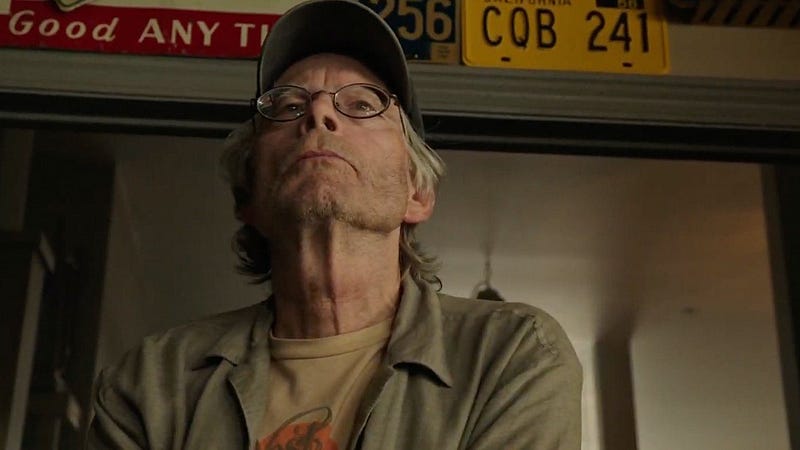
A series featuring reflections on writing from the famed author’s memoir.
I had not read Stephen King’s memoir On Writing for several years when it occurred to me to do so again. While at it, why not share reflections from the renowned writer in a weekly Sunday series at Go Into The Story?
King is a prolific author. Fair to say that is an understatement. One need only glance at a roster of his written works to determine that. If any contemporary writer has earned the right to reflect on the craft, it would be King. However, that is not the motivation he had in writing his memoir. This excerpt from the ‘First Foreword’ of On Writing explains the genesis of the book, a fateful exchange with Amy Tan, fellow writer and member of an authors’ charity rock music group The Remainders.
One night while we were eating Chinese before a gig in Miami Beach, I asked Amy if there was any one question she was never asked during the Q-and-A that follows almost every writer’s talk — that question you never get to answer when you’re standing in front of a group of author-struck fans and pretending you don’t put your pants on one leg at a time like everyone else. Amy paused, thinking it over very carefully, and miss said: “No one ever asks about the language.”
I owe an immediate debt of gratitude to her for saying that. I had been playing with the idea of writing a little book about writing for a year or more at that time, but had held back because I didn’t trust my own motivations — why did I want to write about writing? What made me think I had anything worth saying?
The easy answer is that someone who has sold as many books of fiction as I have must have something worthwhile to say about writing it, but the easy answer isn’t always the truth. Colonel Sanders sold a hell of a lot of fried chicken, but I’m not sure anyone wants to know how he made it. If I was going to be presumptuous enough to tell people how to write, I felt there had to be a better reason than my popular success. Put another way, I didn’t want to write a book, even a short one like this, that would leave me feeling like a literary gasbag or a transcendental asshole. There are enough of those books — and those writers — on the market already, thanks.
But Amy was right: nobody ever asks about the language. They ask the DeLillos and the Updikes and the Styrons, but they don’t ask popular novelists. Yet many of us proles also care about the language, in our humble way, and care passionately about the art and craft of telling stories on paper. What follows is an attempt to put down, briefly and simply, how I came to the craft, what I know about it now, and how it’s done. It’s about the day job; it’s about the language.
My intention is similar to the Sundays with Ray Bradbury series: Each week as I re-read King’s memoir, print notable excerpts at Go Into The Story to inspire our creativity and conversation about the craft.
Today: From the twenty-fifth anniversary edition of On Writing, an excerpt from pp. 56–58 wherein John Gould, editor of the local town’s weekly newspaper which had hired adolescent Stephen King to write sports articles for “half cent a word,” edited one of his stories.
I took my fair share of English Lit classes in my two remaining years at Lisbon, and my fair share of composition, fiction, and poetry classes in college, but John Gould taught me more than any of them, and in no more than ten minutes…
“I only took out the bad parts, you know,” Gould Said. “Most of it’s pretty good.”
“I know,” I said, meaning both things: yes, most of it was good — okay, anyway, serviceable — and yes, he had only taken out the bad part. “I won’t do it again.”
He laughed. “If that's true, you'll never have to work for a living… When you write a story, you're telling yourself the story,” he said. “When you rewrite, your main job is taking out all the things that are not the story.”
Gould said something else that was interesting on the day I turned in my first two pieces: write with the door closed, rewrite with the door open. Your stuff starts out being just for you, but then it goes out. Once you know what the story is and get it right — as right as you can, anyway — it belongs to anyone who wants to read it. Or criticize it. If you're very lucky (this is my idea, not John Gould’s, but I believe he would have subscribed to the notion), more will want to do the former than the latter.
Isn’t it interesting how a brief intersection with a person can influence one’s life in a significant way. Such is the case with John Gould. Of all the people to shape Stephen King as a writer, Gould may have been the most important. Consider this:
- When you write a story, you’re telling yourself the story. When you rewrite, your main job is taking out all the things that are not the story. There’s so much packed into this simple observation. The very idea that you’re “telling yourself the story” when you write it suggests the concept of narrative voice. As I teach it, this is the invisible character who observes the details of your story unfolding in front of their eyes. This character has a specific personality, perspective, and proximity to the events playing out in the plot and conveys their reactions in words describing the action. As I tell my students, “You are writing the story, but who is telling it?” That is narrative voice and it exhibits itself in the style and substance of your story.
- Write with the door closed, rewrite with the door open… Your stuff starts out being just for you, but then it goes out [and] belongs to anyone who wants to read it. This echoes the point Gould made above: In the early drafts, it’s about telling the story you envision [Door Closed], engaging your narrative voice to imbue your pages with personality and flavor. Once you move toward putting it “out there,” you bring your critical thinking to bear, mindful of your audience [Door Open], and edit by “taking out all the things that are not in the story.”
It seems like Gould has in mind something akin to what screenwriter Robin Swicord talked about when I interviewed her several years ago: The importance of receptive writing and executive writing.
What happens… there’s a kind of mystical transference that happens when you’ve done this very deep thinking and feeling about your character. You begin to embody your character. I literally feel like a character enters me sometimes. I don’t worry about writing the dialogue. I just sit at my desk and feel their presence, and then they speak and I write down what they say. Then later I’ll come back to the page, and I’ll go, ‘But I don’t like this scene.’ Or ‘I don’t feel like we need this scene.’ Or ‘I think this goes on too long.’ The writer in the room starts adjusting things, so what’s on the page is not just mental run‑on sentences of dialogue. We have two creative minds. An executive mind, a planning, strategic, putting‑my‑ducks‑in‑a‑row mind. But that’s a different kind of writing than the receptive writing of hearing your characters and embodying them. We need both. One mind where you sit and craft sentences that draw the reader into the scene. Another that allows your characters to come alive.
Door closed. Door open. Receptive writing. Executive writing. However we typify it, as writers we need to be able to do both.
Come back next week and many weeks thereafter for more in the Sundays with Stephen King’s “On Writing” series.
Twitter: @StephenKing