Sundays with Stephen King’s “On Writing”
A series featuring reflections on writing from the famed author’s memoir.
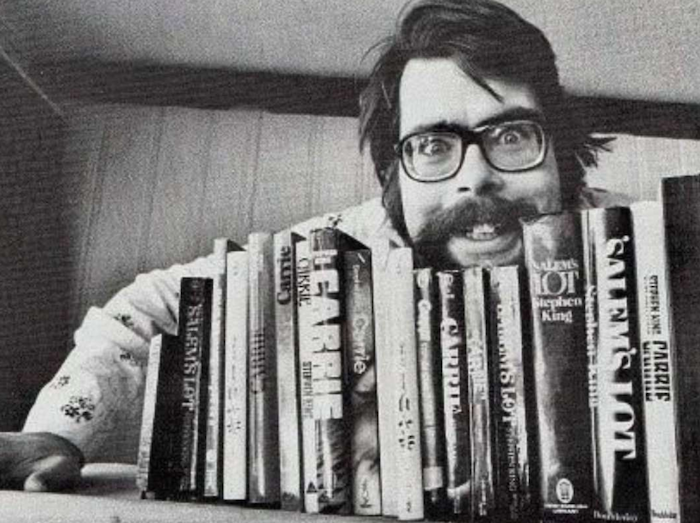
A series featuring reflections on writing from the famed author’s memoir.
I had not read Stephen King’s memoir On Writing for several years when it occurred to me to do so again. While at it, why not share reflections from the renowned writer in a weekly Sunday series at Go Into The Story?
King is a prolific author. Fair to say that is an understatement. One need only glance at a roster of his written works to determine that. If any contemporary writer has earned the right to reflect on the craft, it would be King. However, that is not the motivation he had in writing his memoir. This excerpt from the ‘First Foreword’ of On Writing explains the genesis of the book, a fateful exchange with Amy Tan, fellow writer and member of an authors’ charity rock music group The Remainders.
One night while we were eating Chinese before a gig in Miami Beach, I asked Amy if there was any one question she was never asked during the Q-and-A that follows almost every writer’s talk — that question you never get to answer when you’re standing in front of a group of author-struck fans and pretending you don’t put your pants on one leg at a time like everyone else. Amy paused, thinking it over very carefully, and miss said: “No one ever asks about the language.”
I owe an immediate debt of gratitude to her for saying that. I had been playing with the idea of writing a little book about writing for a year or more at that time, but had held back because I didn’t trust my own motivations — why did I want to write about writing? What made me think I had anything worth saying?
The easy answer is that someone who has sold as many books of fiction as I have must have something worthwhile to say about writing it, but the easy answer isn’t always the truth. Colonel Sanders sold a hell of a lot of fried chicken, but I’m not sure anyone wants to know how he made it. If I was going to be presumptuous enough to tell people how to write, I felt there had to be a better reason than my popular success. Put another way, I didn’t want to write a book, even a short one like this, that would leave me feeling like a literary gasbag or a transcendental asshole. There are enough of those books — and those writers — on the market already, thanks.
But Amy was right: nobody ever asks about the language. They ask the DeLillos and the Updikes and the Styrons, but they don’t ask popular novelists. Yet many of us proles also care about the language, in our humble way, and care passionately about the art and craft of telling stories on paper. What follows is an attempt to put down, briefly and simply, how I came to the craft, what I know about it now, and how it’s done. It’s about the day job; it’s about the language.
My intention is similar to the Sundays with Ray Bradbury series: Each week as I re-read King’s memoir, print notable excerpts at Go Into The Story to inspire our creativity and conversation about the craft.
Today: From the twenty-fifth anniversary edition of On Writing, an excerpt from pp. 98–101. It caps off a section in the book (pp. 87–101) in which King describes his alcohol and drug addiction.
The idea that creative endeavor and mind-altering substances are entwined is one of the great pop-intellectual myths of our time. The four twentieth-century writers whose work is most responsible for it are probably Hemingway, Fitzgerald, Sherwood Anderson, and the poet Dylan Thomas. They are the writers who largely formed our vision of an existential English-speaking waste-land where people have been cut off from one another and live in an atmosphere of emotional strangulation and despair. These concepts are very familiar to most alcoholics, the common reaction to them is amusement. Substance-abusing writers are just substance abusers — common garden-variety drunks and druggies, in other words. Any claims that the drugs and alcohol are necessary to dull a finer sensibility are just the usual self-serving bullshit. I've heard alcoholic snowplow drivers make the same claim, that they drink to still the demons. It doesn't matter if you're James Jones, John Cheever, or a stewbum snoozing in Penn Station; for an addict, the right to the drink or drug of choice must be preserved at all costs. Hemingway and Fitzgerald didn't drink because they were creative, alienated, or morally weak. They drank because it's what alkies are wired up to do. Creative people probably do run a greater risk of alcoholism and addiction than those in some other jobs, but so what? We all look pretty much the same when we’re puking in the gutter
— —
The last thing I want to tell you in this part is about my desk. For years I dreamed of having the sort of massive oak slab that would dominate a room — no more child's desk in a trailer laundry-closet, no more cramped kneehole in a rented house. In 1981 I got the one I wanted and placed it in the middle of a spacious, skylighted study (it's a converted stable loft at the rear of the house). For six years I sat behind the desk either drunk or wrecked out of my mind, like a ship’s captain in charge of a voyage to nowhere.
A year or two after I sobered up, I got rid of that monstrosity and put in a living-room suite where it had been, picking out the pieces and a nice Turkish rug with my wife's help. In the early nineties, before they moved on to their own lives, my kids sometimes came up in the evening to watch a basketball game or a movie and eat pizza. They usually left a boxful of crusts behind when they moved on, but I didn't care. They came, they seem to enjoy being with me, and I know I enjoyed being with them. I got another desk — it's handmade, beautiful, and half the size of the T. rex desk. I put it at the far west end of the office, in a corner under the eave. That eave is very like the one I slept under in Durham, but there are no rats in the walls and no senile grandmother downstairs yelling for someone to feed Duke the horse. I'm sitting under it now, a fifty-three-year-old man with bad eyes, a gimp leg, and no hangover. I'm doing what I know how to do, and as well as I know how to do it. I came through all the stuff I told you about (plenty more that I didn't), and now I'm going to tell you as much as I can about the job. As promised, it won't take long.
It starts with this: put your desk in the corner, and every time you sit down there to write, remind yourself why it isn't in the middle of the room. Life isn't a support system for art. It's the other way around.
The cinematic legacy of alcoholic writers, both real and imagined, is a lengthy one. For example, there is W.P. Mayhew in Barton Fink (1991) inspired by William Faulkner’s liquor-infused days in Hollywood.
Ben Sanderson (Leaving Las Vegas — 1995) whose career as a Hollywood screenwriter crashes and burns due to his drinking.
Hank Moody in the television series Californication.
Or the drug and booze-addled exploits of Hunter S. Thompson as portrayed in Fear and Loathing in Las Vegas (1998).
Perhaps it is true, as Stephen King suggests: “Creative people probably do run a greater risk of alcoholism and addiction than those in some other jobs.” But at what cost?
It’s amazing that King was able to keep on writing and delivering books during a nearly decade-long period in which he not only drank heavily, but also was addicted to cocaine. In 2014 Rolling Stone interview, King said this:
I was usually pretty good about it. I was able to get up and make the kids breakfast and get them off to school. And I was strong; I had a lot of energy. I would’ve killed myself otherwise. But the books start to show it after a while. Misery is a book about cocaine. Annie Wilkes is cocaine. She was my number-one fan.
It took an intervention from his family to get King to finally confront his addictions. He has been sober ever since.
I keep going back to how King wraps up the part of his memoir in which he details his struggles with alcohol and drugs: “It starts with this: put your desk in the corner, and every time you sit down there to write, remind yourself why it isn’t in the middle of the room. Life isn’t a support system for art. It’s the other way around.”
The part about putting “your desk in the corner,” that’s about doing the work, yes? And I’m thinking that’s what links to the part about art being a “support system” for life. That focusing on the work, i.e., the writing, has a transformational power to help us overcome whatever “demons” lurk inside our psyche. Perhaps writing about them is one of the avenues to psychological health and emotional balance.
Or maybe for some writers, it’s like the late, great screenwriter Frank Pierson wrote: “One of the few things I’ve discovered about writing is to form a habit that becomes an addiction.”
One thing is true: As King notes, the link between alcohol or drugs and creativity is “one of the great pop-intellectual myths of our time.”
If you or someone you love has a substance abuse problem, here is a resource to provide help.
Come back next week and many weeks thereafter for more in the Sundays with Stephen King’s “On Writing” series.
Twitter: @StephenKing