Sundays with Stephen King’s “On Writing”
A series featuring reflections on writing from the famed author’s memoir.
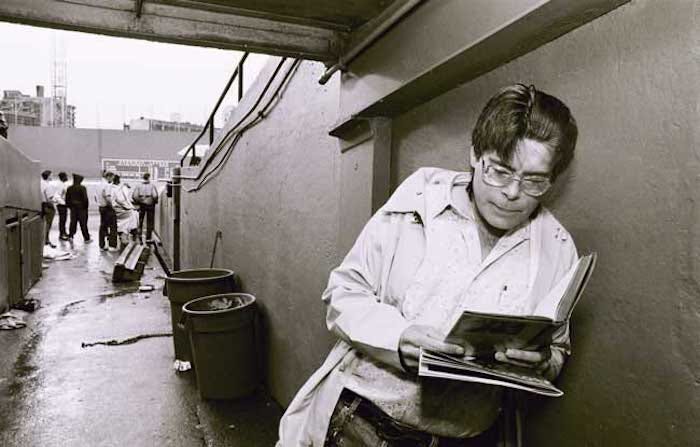
A series featuring reflections on writing from the famed author’s memoir.
I had not read Stephen King’s memoir On Writing for several years when it occurred to me to do so again. While at it, why not share reflections from the renowned writer in a weekly Sunday series at Go Into The Story?
King is a prolific author. Fair to say that is an understatement. One need only glance at a roster of his written works to determine that. If any contemporary writer has earned the right to reflect on the craft, it would be King. However, that is not the motivation he had in writing his memoir. This excerpt from the ‘First Foreword’ of On Writing explains the genesis of the book, a fateful exchange with Amy Tan, fellow writer and member of an authors’ charity rock music group The Remainders.
One night while we were eating Chinese before a gig in Miami Beach, I asked Amy if there was any one question she was never asked during the Q-and-A that follows almost every writer’s talk — that question you never get to answer when you’re standing in front of a group of author-struck fans and pretending you don’t put your pants on one leg at a time like everyone else. Amy paused, thinking it over very carefully, and miss said: “No one ever asks about the language.”
I owe an immediate debt of gratitude to her for saying that. I had been playing with the idea of writing a little book about writing for a year or more at that time, but had held back because I didn’t trust my own motivations — why did I want to write about writing? What made me think I had anything worth saying?
The easy answer is that someone who has sold as many books of fiction as I have must have something worthwhile to say about writing it, but the easy answer isn’t always the truth. Colonel Sanders sold a hell of a lot of fried chicken, but I’m not sure anyone wants to know how he made it. If I was going to be presumptuous enough to tell people how to write, I felt there had to be a better reason than my popular success. Put another way, I didn’t want to write a book, even a short one like this, that would leave me feeling like a literary gasbag or a transcendental asshole. There are enough of those books — and those writers — on the market already, thanks.
But Amy was right: nobody ever asks about the language. They ask the DeLillos and the Updikes and the Styrons, but they don’t ask popular novelists. Yet many of us proles also care about the language, in our humble way, and care passionately about the art and craft of telling stories on paper. What follows is an attempt to put down, briefly and simply, how I came to the craft, what I know about it now, and how it’s done. It’s about the day job; it’s about the language.
My intention is similar to the Sundays with Ray Bradbury series: Each week as I re-read King’s memoir, print notable excerpts at Go Into The Story to inspire our creativity and conversation about the craft.
Today: From the twenty-fifth anniversary edition of On Writing, an excerpt from pp. 105–107. It’s a short chapter titled What Writing Is and I am going to divide it up into two parts, the first this week, the second part next week.
What writing is. Telepathy, of course. It's amusing when you stop to think about it — for years people have argued about whether or not such a thing exists, folks like J. B. Rhein have busted their brains trying to create a valid testing process to isolate it, and all the time it's been right there, lying out in the open like Mr. Poe’s Purloined Letter. All the arts depend upon telepathy to some degree, but I believe that writing offers the purest distillation. Perhaps I am prejudiced, but even if I am we may as well stick with writing, since it's what we came here to think and talk about.
My name is Stephen King. I'm writing the first draft of this part at my desk (the one under the eave) on a snowy morning in December 1997. There are things on my mind. Some are worries (bad eyes, Christmas shopping not even started, wife under the weather with a virus), some are good (our younger son made a surprise visit home from college, I got to play Vince Taylor's “Brand New Cadillac” with The Wallflowers at a concert), right now all that stuff is up top. I am in another place, a basement place where there are lots of bright lights and clear images. This is a place I've built for myself over the years. It's a far-seeing place. I know it's a little strange, a little bit of a contradiction, that a far-seeing place should also be a basement place, but that's how it is with me. If you construct your own far-seeing place, you might put it in a tree top or on the roof of the World Trade Center or on the edge of the Grand Canyon. That's your little red wagon, as Robert McCammon says in one of his novels.
This book is scheduled to be published in the late summer or early fall of 2000. If that's how things work out, then you are somewhere downstream on the timeline from me … but you're quite likely in your own far-seeing place, the one where you go to receive telepathic messages. Not that you have to be there; books are uniquely portable magic. I usually listen to one in the car… and carry another wherever I go. You just never know when you’ll want an escape hatch: mile-long lines at the tollbooth plazas, the fifteen minutes you have to spend in the hall at some boring college building waiting for your advisor (who’s got some yank-off in there threatening to commit suicide because he/she is flunking Custom Kurm-furling 101) to come out so you can get his signature on a drop-card, airport boarding lounges, laundromats on rainy afternoons, and the absolute worst, which is the doctor’s office when the guy is running late and you have to wait half an hour in order to have something sensitive mauled. At such times I find a book vital. If I have to spend time in purgatory before going to one place or the other, I guess I'll be all right as long as there’s a lending library (if there is it's probably stocked with nothing but novels by Danielle Steele and Chicken Soup books, ha ha, joke’s on you, Steve).
So I read where I can, but I have a favorite place and probably you do, too — a place where the light is good and the vibe is usually strong. For me it's the blue chair in my study. For you it might be the couch on the sunporch, the rocker in the kitchen, or maybe it's propped up in your bed — reading in bed can be heaven, assuming you can get just the right amount of light on the page and aren’t prone to spilling your coffee or cognac on the sheets.
So let's assume that you're in your favorite receiving place just as I am in the place where I do my best transmitting. We’ll have to perform our mentalist routine not just over distance but overtime as well, yet that presents no real problem; if we can still read Dickens, Shakespeare, and (with the help of a footnote or two) Herodotus, I think we can manage the gap between 1997 and 2000. And here we go — actual telepathy in action. You'll notice I have nothing up my sleeves and that my lips never move. Neither, most likely, do yours.
Next week, we will consider the thought experiment King creates in the second part of the chapter What Writing Is in which he proves his theory of telepathy. Here, let’s begin by focusing on two pieces of advice King offers:
- Find a favorite place to read, where “the light is good and the vibe usually strong.” Having such a spot maximizes the chance it can function as a “receiving place,” in effect opening you up to telepathic communication generated by a book or screenplay.
- That said, because books are “uniquely portable magic,” read — or listen to audiobooks — wherever and whenever you can. Elsewhere in On Writing, King provides thoughts on why reading is critical to a writer’s ability to write well, but for now, consider this quote from the author:
“If you want to be a writer, you must do two things above all others: read a lot and write a lot. There’s no way around these two things that I’m aware of, no shortcut.”
What intrigues me is that in this chapter, King’s primary point is to prove how writers create a kind of telepathy with their readers by conjuring up images and emotions from their written words. That’s what we’ll focus on next week. However, here we see how telepathy swings both ways because in fact, for a writer to be able to transmit content “telepathically,” they must first be in a position whereby they receive creative inspiration. Hence, the importance of the “far-seeing place.” King refers to his as “a basement place where there are lots of bright lights and clear images” which suggests a mental / creative / spiritual state of being where he “goes” to put himself into a receiving mode.
I find his reference to telepathy interesting because it’s another way to visualize the process of communing with our story’s characters. In the Story Development class I created and teach at DePaul university, one set of exercises I have my students do is what I call direct engagement exercises wherein the student connects directly with characters.
The process? Close the door. Turn off the phone. Get a character in mind. Do some deep breathing. Put fingers on keyboard… and type. Fifteen minutes. Type whatever comes to mind.
The goal, as I typically explain it, is to do a kind of Vulcan mind meld where the writer gets into the mind of the character or vice versa, the character gets into the mind of the writer akin to Spock’s character in the Star Trek series.
The concept of telepathy, specifically as King refers to it in terms of putting ourselves in a psychological space where we “receive telepathic messages,” is another way of describing the goal of these direct engagement exercises.
I’ve logged this (telepathy) to use as a metaphor for the next time I teach Story Development.
Takeaway: Find a comfortable reading place. Read a lot, whenever and wherever. And in order to create stories which convey images and emotions “telepathically” to readers, writers need to find a psychological “place” where we can receive inspiration from our story universe and its characters.
Come back next week and many weeks thereafter for more in the Sundays with Stephen King’s “On Writing” series.
Twitter: @StephenKing