Sundays with Stephen King’s “On Writing”
A series featuring reflections on writing from the famed author’s memoir.
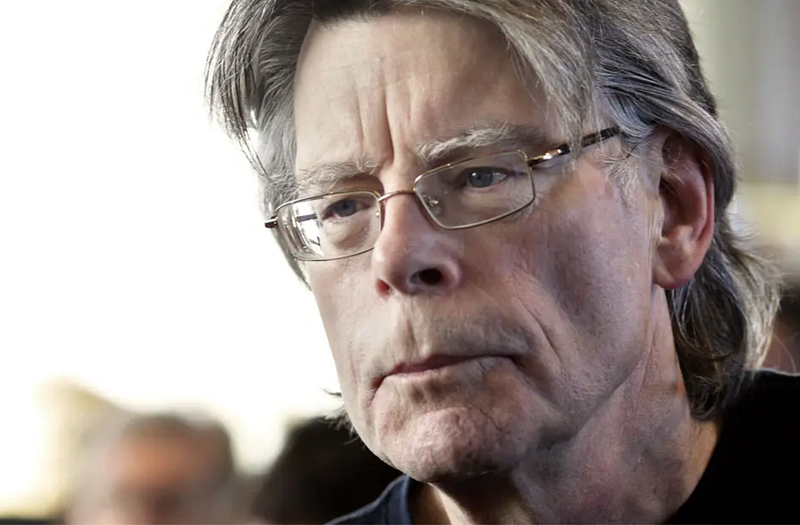
A series featuring reflections on writing from the famed author’s memoir.
I had not read Stephen King’s memoir On Writing for several years when it occurred to me to do so again. While at it, why not share reflections from the renowned writer in a weekly Sunday series at Go Into The Story?
King is a prolific author. Fair to say that is an understatement. One need only glance at a roster of his written works to determine that. If any contemporary writer has earned the right to reflect on the craft, it would be King. However, that is not the motivation he had in writing his memoir. This excerpt from the ‘First Foreword’ of On Writing explains the genesis of the book, a fateful exchange with Amy Tan, fellow writer and member of an authors’ charity rock music group The Remainders.
One night while we were eating Chinese before a gig in Miami Beach, I asked Amy if there was any one question she was never asked during the Q-and-A that follows almost every writer’s talk — that question you never get to answer when you’re standing in front of a group of author-struck fans and pretending you don’t put your pants on one leg at a time like everyone else. Amy paused, thinking it over very carefully, and miss said: “No one ever asks about the language.”
I owe an immediate debt of gratitude to her for saying that. I had been playing with the idea of writing a little book about writing for a year or more at that time, but had held back because I didn’t trust my own motivations — why did I want to write about writing? What made me think I had anything worth saying?
The easy answer is that someone who has sold as many books of fiction as I have must have something worthwhile to say about writing it, but the easy answer isn’t always the truth. Colonel Sanders sold a hell of a lot of fried chicken, but I’m not sure anyone wants to know how he made it. If I was going to be presumptuous enough to tell people how to write, I felt there had to be a better reason than my popular success. Put another way, I didn’t want to write a book, even a short one like this, that would leave me feeling like a literary gasbag or a transcendental asshole. There are enough of those books — and those writers — on the market already, thanks.
But Amy was right: nobody ever asks about the language. They ask the DeLillos and the Updikes and the Styrons, but they don’t ask popular novelists. Yet many of us proles also care about the language, in our humble way, and care passionately about the art and craft of telling stories on paper. What follows is an attempt to put down, briefly and simply, how I came to the craft, what I know about it now, and how it’s done. It’s about the day job; it’s about the language.
My intention is similar to the Sundays with Ray Bradbury series: Each week as I re-read King’s memoir, print notable excerpts at Go Into The Story to inspire our creativity and conversation about the craft.
Today: From the twenty-fifth anniversary edition of On Writing, an excerpt from pp. 105–107. It’s a short chapter titled What Writing Is and I am dividing it up into two parts: the first last week, the second part this week.
Look — here is a table covered with a red cloth. On it is a cage the size of a small fish aquarium. In the cage is a white rabbit with a pink nose and pink-rimmed eyes. In his front paws is a carrot-stub upon which it is contentedly munching. On its back, clearly marked in blue ink, is the numeral 8.
Do we see the same thing? We'd have to get together and compare notes to make absolutely sure, but I think we do. There will be necessary variations, of course: some receivers will see a cloth which is turkey red, some will see one that’s scarlet, while others may see still other shades. (To color-blind receivers, the red tablecloth is the dark gray of cigar ashes). Some may see scalloped edges, some may see straight ones. Decorative souls may add a little lace, and welcome — my tablecloth is your tablecloth, knock yourself out.
Likewise, the matter of the cage leaves quite a lot of room for individual interpretation. For one thing, it is described in terms of rough comparison, which is useful only if you and I see the world and measure the things in it with similar eyes. It's easy to become careless when making rough comparisons, but the alternative is a prissy attention to detail that takes all of the fun out of writing. What am I going to say, “on the table is in cage three feet, six inches in length, two feet in width, and fourteen inches high”? That's not prose, that's an instruction manual. The paragraph also doesn't tell us what sort of material the cage is made of — wire mesh? steel rods? glass? — what does it really matter? We all understand the cage is a see-through medium; beyond that, we don't care. The most interesting thing here isn't even the carrot-munching rabbit in the cage, but the number on its back. Not a six, not a four, not nineteen-point-five. It's an eight. This is what we're looking at, and we all see it. I didn't tell you. You didn't ask me. I never opened my mouth and you never opened yours. We're not even in the same year together, let alone the same room … except we are together. We’re close.
We are having a meeting of the minds. I sent you a table with a red cloth on it, a cage, a rabbit, and the number eight in blue ink. You got them all, especially that blue eight. We've engaged in an act of telepathy. No mythy-mountain shit; real telepathy. I'm not going to belabor the point, but before we go any further you have to understand that I'm not trying to be cute; there is a point to be made.
You can approach the act of writing with nervousness, excitement, hopefulness, or even despair — the sense that you can never completely put on the page what's in your mind and heart. You can come to the act with your fists clenched and your eyes narrowed, ready to kick ass and take down names. You can come to it because you want a girl to marry you or because you want to change the world. Come to it any way but lightly. Let me say it again: you must not come lightly to the blank page.
I'm not asking you to come reverently or unquestioningly; I'm not asking you to be politically correct or cast aside your sense of humor (please God you have one). This isn't a popularity contest, it's not the moral Olympics, and it's not church. But it's writing, dammit, not washing the car or putting on eyeliner. If you can take it seriously, we can do business. If you can't or won't, it's time for you to close the book and do something else.
Wash the car, maybe.
As a writer, we are required to believe things. For example, if we believe our characters exist, we will see and hear them. However, as far as King is concerned, the concept of “writing as telepathy” is not based on belief.
It is a fact.
What we write here — our words — manifests itself there — the reader’s mind. This is a profound fact. That we have a telepathic capability is empowering. Our words create a kind of reality in a reader’s imagination.
Think about that.
The words we write have the capacity to, if not control someone else’s mind, deeply influence it.
Is it any wonder that King has written several stories in which characters have psychic powers: Carrie White in Carrie, Danny Torrance and Dick Hallorann in The Shining, Abra Stone in Doctor Sleep, Bill Denbrough in IT, Jonesy, Pete, Beaver, and Henry in Dreamcatcher, the McGee Family in Firestarter, Louis Creed in Pet Sematary, John Coffey in The Green Mile, Mother Abigail in The Stand, Johnny Smith in The Dead Zone, Jake Chambers in The Dark Tower series, Mike Noonan in Bag of Bones, and Holly Gibney in The Outsider.
Nor is it any wonder King would approach the act of writing with this admonition: You must not come lightly to the blank page.
This goes beyond what we may or may not choose to believe, e.g., our characters exist. This goes to our very approach as writers.
Empowered by the fact of our telepathic power to use words to influence readers, King challenges us to embrace an attitude of emotional vigor.
Now that he has moved past the autobiographical part of On Writing, this is the foundation for everything King subsequently writes in his memoir.
You must not come lightly to the blank page.
Stand firm. Step loudly. Be bold.
Come back next week and many weeks thereafter for more in the Sundays with Stephen King’s “On Writing” series.
Twitter: @StephenKing