Sundays with Stephen King’s “On Writing”
A series featuring reflections on writing from the famed author’s memoir.
A series featuring reflections on writing from the famed author’s memoir.
I had not read Stephen King’s memoir On Writing for several years when it occurred to me to do so again. While at it, why not share reflections from the renowned writer in a weekly Sunday series at Go Into The Story?
King is a prolific author. Fair to say that is an understatement. One need only glance at a roster of his written works to determine that. If any contemporary writer has earned the right to reflect on the craft, it would be King. However, that is not the motivation he had in writing his memoir. This excerpt from the ‘First Foreword’ of On Writing explains the genesis of the book, a fateful exchange with Amy Tan, fellow writer and member of an authors’ charity rock music group The Remainders.
One night while we were eating Chinese before a gig in Miami Beach, I asked Amy if there was any one question she was never asked during the Q-and-A that follows almost every writer’s talk — that question you never get to answer when you’re standing in front of a group of author-struck fans and pretending you don’t put your pants on one leg at a time like everyone else. Amy paused, thinking it over very carefully, and miss said: “No one ever asks about the language.”
I owe an immediate debt of gratitude to her for saying that. I had been playing with the idea of writing a little book about writing for a year or more at that time, but had held back because I didn’t trust my own motivations — why did I want to write about writing? What made me think I had anything worth saying?
The easy answer is that someone who has sold as many books of fiction as I have must have something worthwhile to say about writing it, but the easy answer isn’t always the truth. Colonel Sanders sold a hell of a lot of fried chicken, but I’m not sure anyone wants to know how he made it. If I was going to be presumptuous enough to tell people how to write, I felt there had to be a better reason than my popular success. Put another way, I didn’t want to write a book, even a short one like this, that would leave me feeling like a literary gasbag or a transcendental asshole. There are enough of those books — and those writers — on the market already, thanks.
But Amy was right: nobody ever asks about the language. They ask the DeLillos and the Updikes and the Styrons, but they don’t ask popular novelists. Yet many of us proles also care about the language, in our humble way, and care passionately about the art and craft of telling stories on paper. What follows is an attempt to put down, briefly and simply, how I came to the craft, what I know about it now, and how it’s done. It’s about the day job; it’s about the language.
My intention is similar to the Sundays with Ray Bradbury series: Each week as I re-read King’s memoir, print notable excerpts at Go Into The Story to inspire our creativity and conversation about the craft.
Today: From the twenty-fifth anniversary edition of On Writing, an excerpt from a wonderful chapter titled “Toolbox” (pp. 111–137). King frames the chapter with an anecdote about his Uncle Oren, a carpenter, and a toolbox he had inherited from King’s grandfather Fazza. The toolbox in question is heavy, as King notes weighing “between eighty and hundred and twenty pounds.”
King writes about how as a lad, he accompanied Uncle Oren to fix a broken screen on the backside of the house. He finishes the anecdote with this:
When the screen was secure, Uncle Oren gave me the screwdriver and told me to put it back in the toolbox and “latch her up.” I did, but I was puzzled. I asked him why he’d lugged Fazza’s toolbox all the way around the house, if all he needed was that one screwdriver. He could’ve carried a screwdriver in the back pocket of his khakis.
“Yeah, but Stevie,” he said, bending to grasp the handles, “I didn’t know what else I might find to do once I got out here, did I? It’s best to have your tools with you. If you don’t, you’re apt to find something you didn’t expect and get discouraged.”
This leads King into using a toolbox as a metaphor for writing. Here is an excerpt from pp. 120–122 about the subject of grammar.
Nouns and verbs are the two indispensable parts of writing. Without one of each, no group of words can be a sentence, since a sentence is, by definition, a group of words containing a subject (noun) and a predicate (verb); these strings of words begin with a capital letter, end with a period, and combine to make a complete thought which starts in the writer's head and then leaps to the reader’s.
Must you write complete sentences each time, every time? Perish the thought. If your work consists only of fragments and floating clauses, the Grammar Police aren't going to come and take you away. Even William Strunk, that Mussolini of rhetoric, recognized the delicious pliability of language. "It is an old observation,” he writes, "that the best writers sometimes disregard the rules of rhetoric." Yet he goes on to add this thought, which I urge you to consider: "Unless he is certain of doing well, [the writer] will probably do best to follow the rules."
The telling clause here is Unless he is certain of doing well. If you don't have a rudimentary grasp of how the parts of speech translate into coherent sentences, how can you be certain that you are doing well? How will you know if you're doing ill, for that matter? The answer, of course, is that you can't, you won't. One who does grasp the rudiments of grammar finds a comforting simplicity at its heart, where there need be only nouns, the words that name, and verbs, the words that act.
Take any noun, put it with any verb, and you have a sentence. It never fails. Rocks explode. Jane transmits. Mountains float. These are all perfect sentences. Mini such thoughts make a little rational sense, but even the stranger ones (Plums deify!) have a kind of poetic weight that's nice. The simplicity of noun-verb construction is useful — at the very least it can provide a safety net for your writing. Strunk and White caution against too many simple sentences in a row, but simple sentences provide a path you can follow when you fear getting lost in the tangles of rhetoric — all those restrictive and nonrestrictive clauses, those modifying phrases, those appositives and compound-complex sentences. If you start to freak out at the sight of such unmapped territory (unmapped by you, at least), just remind yourself that rocks explode, Jane transmits, mountains float, and plums deify. Grammar is not just a pain in the ass; it's the pole you grab to get your thoughts up on their feet and walking. Besides, all those simple sentences worked for Hemingway, didn't they? Even when he was drunk on his ass, he was a fucking genius.
One of the many reasons I enjoy On Writing is King’s down to earth take on the craft. While he makes sure to get across the point that we should know our stuff, including the basics of grammar, we don’t have to think of writing a story as if we were perched on high in some ivy-covered tower with sneering overseers squinting through their bifocals at the sentences we compose, poised to crack our knuckles with a ruler if we stray from convention. We can write a story the way the story speaks to us.
King’s approach is especially refreshing — and relevant — for those of us who write screenplays. Given the limitations of page count and that often half of what we put onto the page is dialogue, when it comes to scene description, this screenwriting mantra conveys an essential truth: Minimum words. Maximum impact. Depending upon the story’s genre and the writer’s choice of narrative voice, simple sentences may be the default form of communication on the page. In fact, sometimes a single word does the trick.
Here are some examples from notable movie scripts:
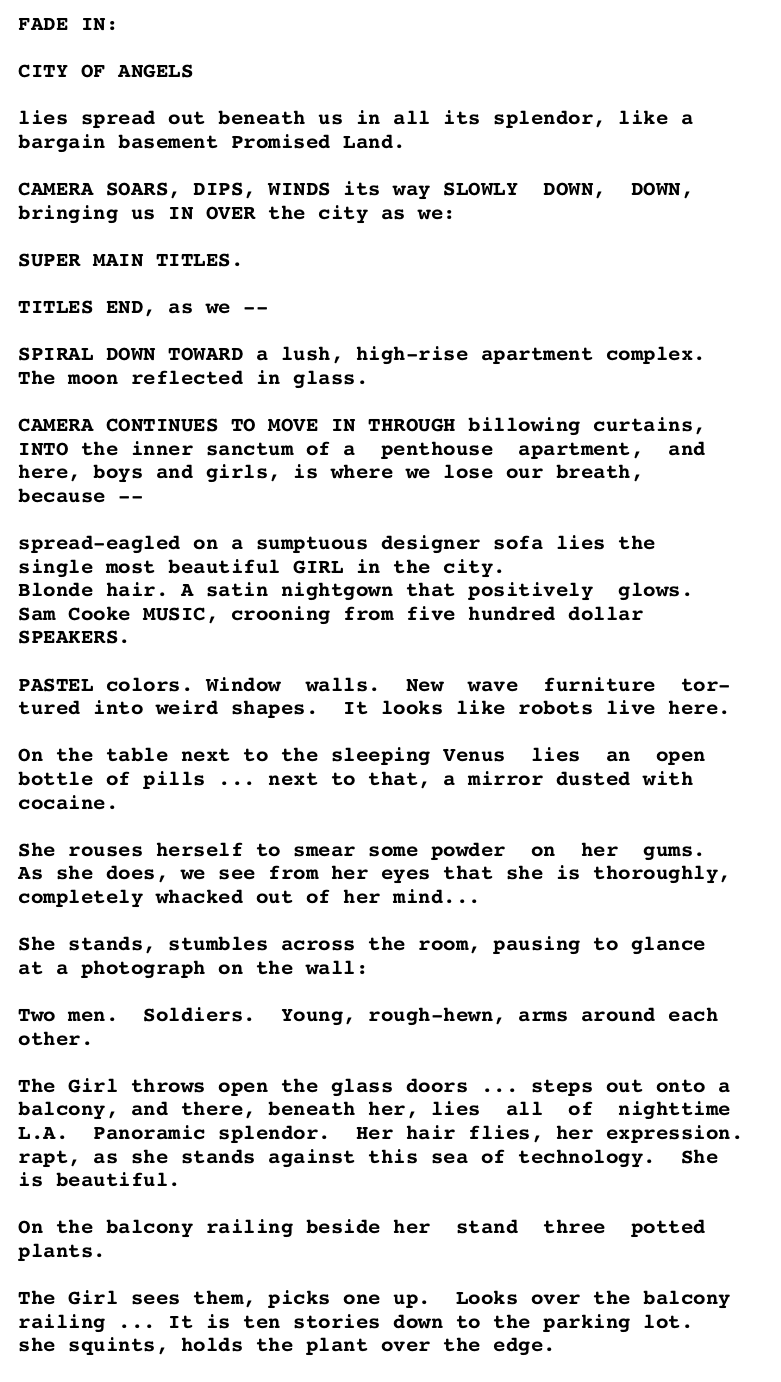
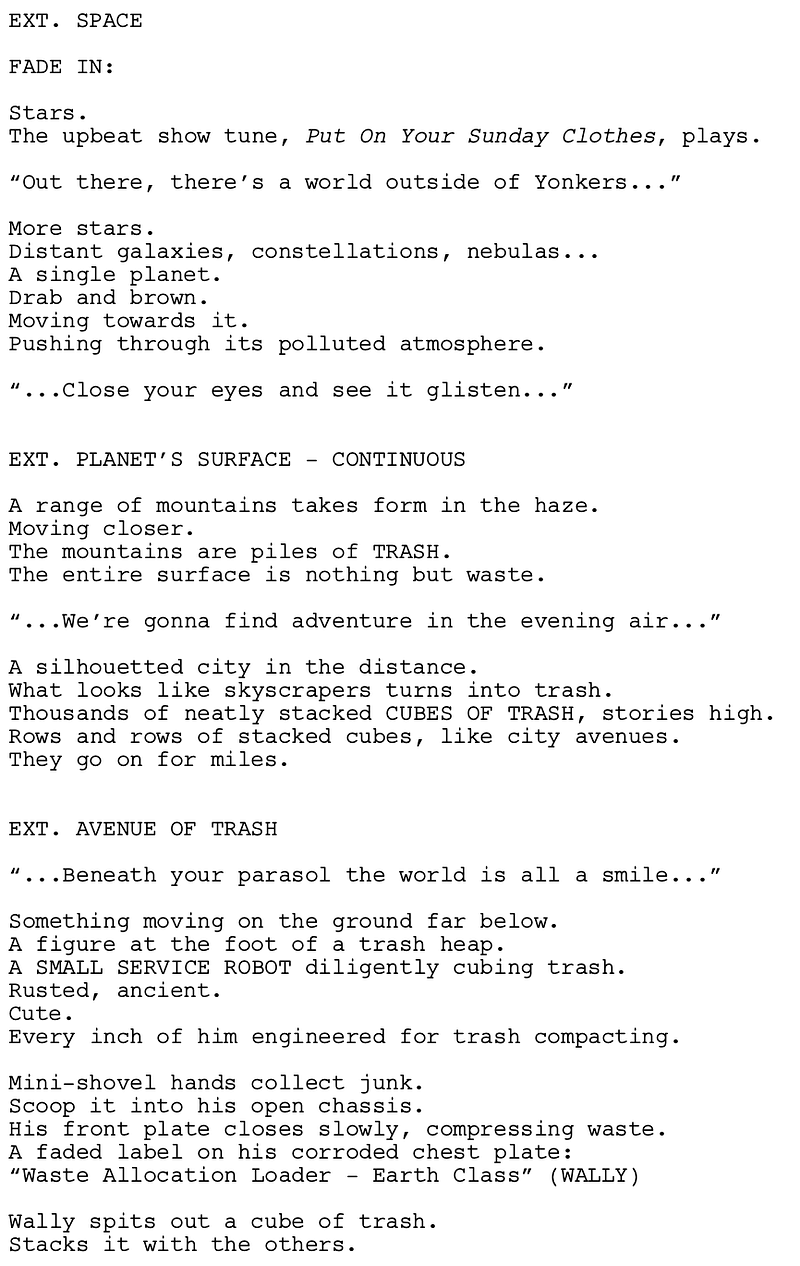
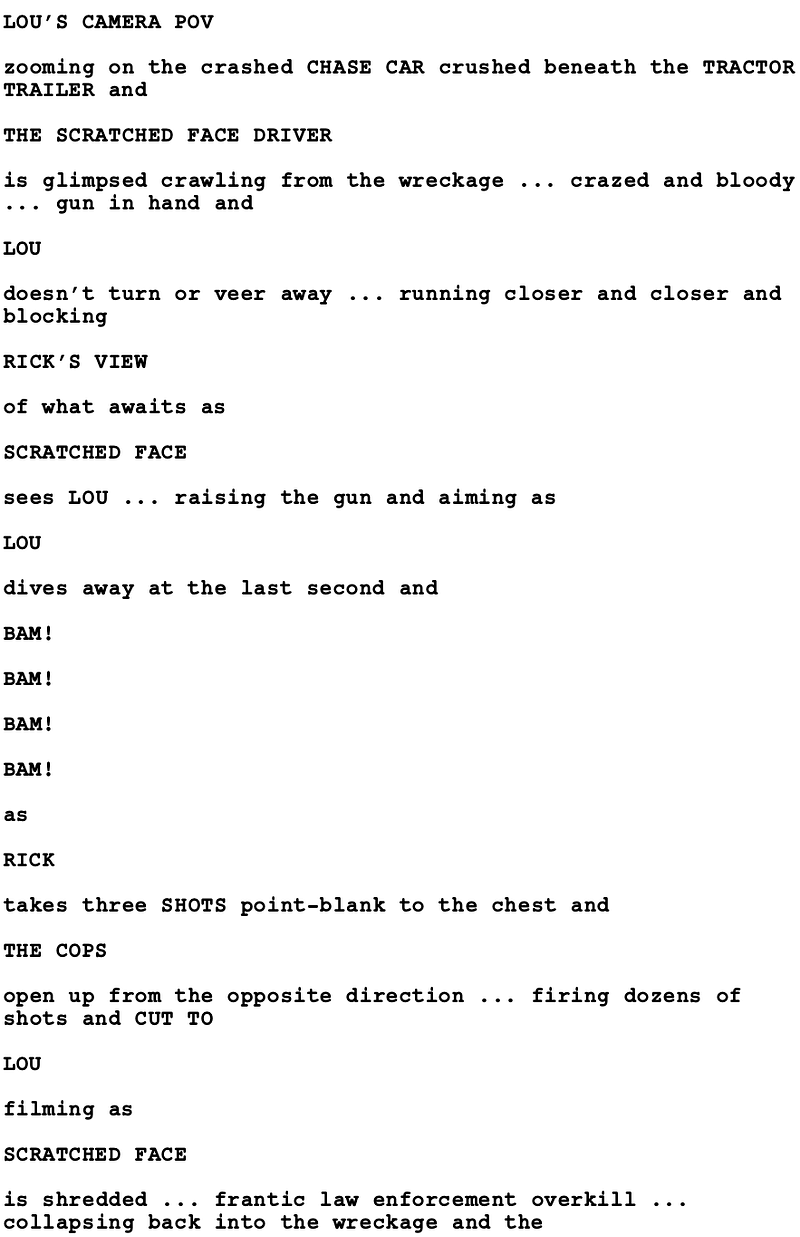
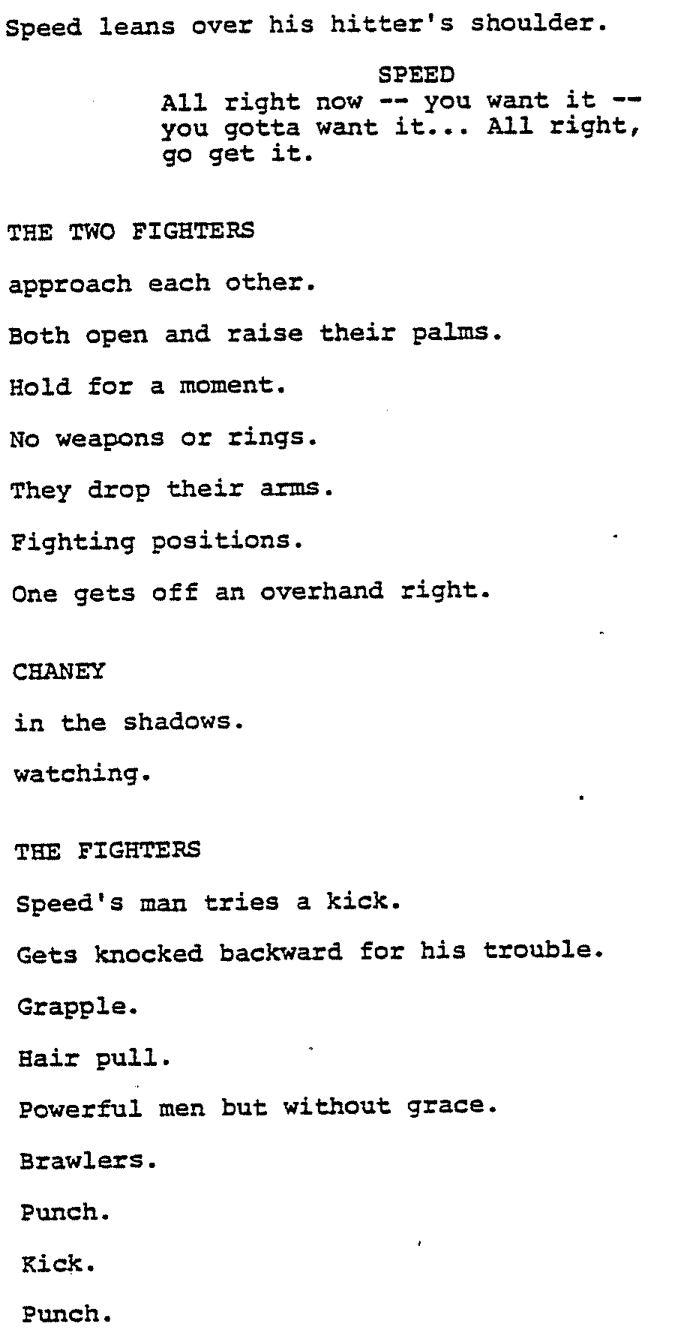
Since movies are primarily a visual medium, when writing a screenplay, there is a premium on well-chosen nouns and verbs. As King notes, “One who does grasp the rudiments of grammar finds a comforting simplicity at its heart, where there need be only nouns, the words that name, and verbs, the words that act.”
Words that name. Words that act.
Yes, we should know the fundamentals of grammar. But in screenwriting, where efficiency meets entertainment, telling the story the best way possible is the golden rule which trumps all grammatical rules.
Come back next week and many weeks thereafter for more in the Sundays with Stephen King’s “On Writing” series.
Twitter: @StephenKing