Sundays with Stephen King’s “On Writing”
A series featuring reflections on writing from the famed author’s memoir.
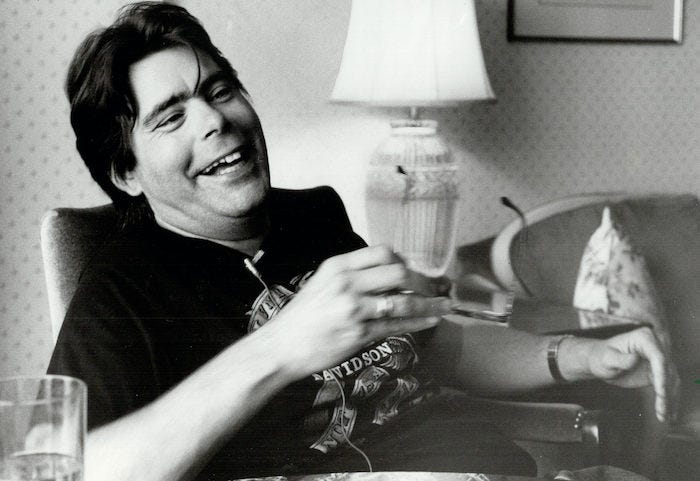
A series featuring reflections on writing from the famed author’s memoir.
I had not read Stephen King’s memoir On Writing for several years when it occurred to me to do so again. While at it, why not share reflections from the renowned writer in a weekly Sunday series at Go Into The Story?
King is a prolific author. Fair to say that is an understatement. One need only glance at a roster of his written works to determine that. If any contemporary writer has earned the right to reflect on the craft, it would be King. However, that is not the motivation he had in writing his memoir. This excerpt from the ‘First Foreword’ of On Writing explains the genesis of the book, a fateful exchange with Amy Tan, fellow writer and member of an authors’ charity rock music group The Remainders.
One night while we were eating Chinese before a gig in Miami Beach, I asked Amy if there was any one question she was never asked during the Q-and-A that follows almost every writer’s talk — that question you never get to answer when you’re standing in front of a group of author-struck fans and pretending you don’t put your pants on one leg at a time like everyone else. Amy paused, thinking it over very carefully, and miss said: “No one ever asks about the language.”
I owe an immediate debt of gratitude to her for saying that. I had been playing with the idea of writing a little book about writing for a year or more at that time, but had held back because I didn’t trust my own motivations — why did I want to write about writing? What made me think I had anything worth saying?
The easy answer is that someone who has sold as many books of fiction as I have must have something worthwhile to say about writing it, but the easy answer isn’t always the truth. Colonel Sanders sold a hell of a lot of fried chicken, but I’m not sure anyone wants to know how he made it. If I was going to be presumptuous enough to tell people how to write, I felt there had to be a better reason than my popular success. Put another way, I didn’t want to write a book, even a short one like this, that would leave me feeling like a literary gasbag or a transcendental asshole. There are enough of those books — and those writers — on the market already, thanks.
But Amy was right: nobody ever asks about the language. They ask the DeLillos and the Updikes and the Styrons, but they don’t ask popular novelists. Yet many of us proles also care about the language, in our humble way, and care passionately about the art and craft of telling stories on paper. What follows is an attempt to put down, briefly and simply, how I came to the craft, what I know about it now, and how it’s done. It’s about the day job; it’s about the language.
My intention is similar to the Sundays with Ray Bradbury series: Each week as I re-read King’s memoir, print notable excerpts at Go Into The Story to inspire our creativity and conversation about the craft.
Today: From the twenty-fifth anniversary edition of On Writing, an excerpt from pp. 144–145.
What follows is everything I know about how to write good fiction. I'll be as brief as possible, because your time is valuable and so is mine, and we both understand that the hours we spend talking about writing is time we don't spend actually doing it. I'll be as encouraging as possible, because it's my nature and because I love this job. I want you to love it, too. But if you don't want to work your ass off, you have no business trying to write well — settle back into competency and be grateful you have even that much to fall back on. There is a muse,* but he's not going to come fluttering down into your writing room and scatter creative fairy-dust all over your typewriter or computer station. He lives in the ground. He's a basement guy. You have to descend to his level, and once you get down there, you have to furnish an apartment for him to live in. You have to do all the grunt labor, in other words, while the muse sits and smoke cigars and admires his bowling trophies and pretends to ignore you. Do you think this is fair? I think it's fair. He may not be much to look at, that muse-guy, and he may not be much of a conversationalist (what I get out of mine is mostly surly grunts, unless he's on duty), but he's got the inspiration. It's right that you should do all the work and burn all the midnight oil, because the guy with the cigar and the little wings he's got a bag of magic. There's stuff in there that can change your life.
Believe me, I know.
* Traditionally, the muses were women, but mine’s a guy; I’m afraid will just have to live with that.
There’s that word again: Magic. A few weeks back in this series, we featured this observation by King:
We are talking about tools and carpentry, about words and style … but as we move along, you’d do well to remember that we are also talking about magic.
And my commentary:
Magic. In my humble opinion, that is the most important word related to the act of creating a story. Many other word associations spring to mind, a host of them discussed by King up to this point in his memoir on writing including inspiration, perseverance, talent, skill, style, even luck. But perhaps the most fundamental truth about bringing a story into existence is this: Magic.
In today’s excerpt from On Writing, King introduces another M-word: Muse. Apparently, he has one. It’s a male figure. One who seems to have an affinity for cigars and bowling. And as one would expect with a muse, as King notes, “He’s got the inspiration.”
When I read King’s words, I was reminded of the movie Shakespeare in Love. At the beginning of the story, young Will is beset by writer’s block. He seeks the help of his “therapist” Dr. Moth.
Moth’s advice: Take a bangle (which moth is happy to sell to Will), write his name on a slip of paper, and feed it into the mouth of the magical device (fashioned like a snake).
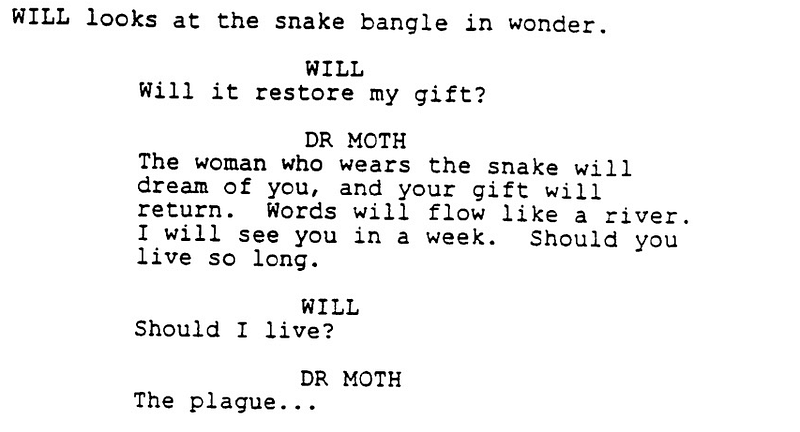
A bangle … a woman … and a bit of “fairy dust” to enable Will to reclaim his creativity. However, the bangle fails to work. Then Will meets his actual muse.
Viola de Lesseps is far different in appearance than Stephen King’s cigar-smoking, bowling-obsessed male muse. But much like King’s muse, Will’s connection with Viola does awaken his creativity. And yet…
The reality is, in order for Will to transform his failed attempt at writing a lighthearted comedy (Romeo and Ethel, the Pirate’s Daughter) into one of the greatest tragedies of all time (Romeo and Juliet), he has to go inside himself.
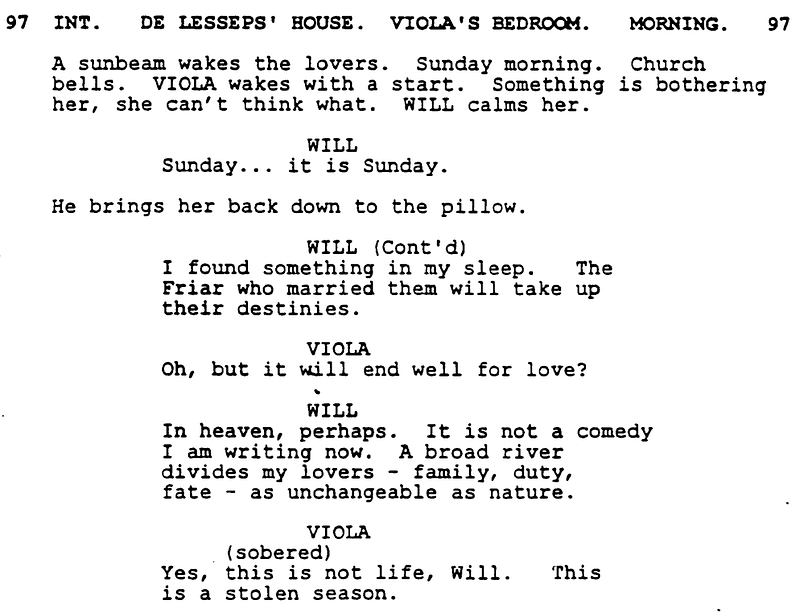
I found something in my sleep. Like King says about his muse: He lives in the ground. He’s a basement guy. You have to descend to his level.
Our muse … your muse … any muse, no matter what shape they take may provide “inspiration,” but to find it, a writer must be willing to go inside. Perhaps it arises from your “sleep,” the work of your subconscious as manifest in dreams. Perhaps it is an intentional conscious effort to “descend” into your “basement,” that deepest part of your psyche where a maelstrom of images, sensations, feelings, associations, even scary things roil around ready at any moment to rise into your mind, then onto your fingertips on keyboard.
But the inspiration of the muse is not likely to happen unless we do the necessary work to prepare the way. As King says, “It’s right that you should do all the work and burn all the midnight oil.”
Our stories … our characters … the material we need to write … it’s all there … inside. Whatever form our muse may take, we cannot just sit and wait for inspiration to appear. We need to do the work to earn those moments where our muse opens the “bag of magic.” Once we discover a path to that magic, it can, indeed, as King says, “change your life.”
Question: Do you have a muse? If so, how does it manifest itself to you? How do you elicit its aid in finding creative inspiration?
Come back next week and many weeks thereafter for more in the Sundays with Stephen King’s “On Writing” series.
Twitter: @StephenKing