Sundays with Stephen King
A new series featuring reflections on writing from the famed writer.
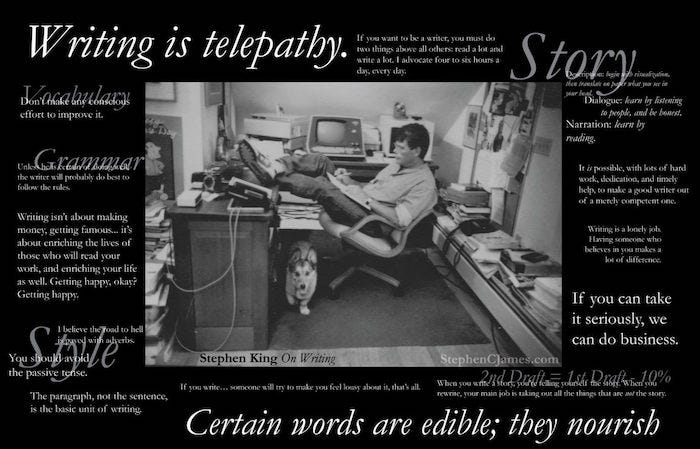
Sundays with Stephen King’s “On Writing”
A new series featuring reflections on writing from the famed writer.
I had not read Stephen King’s memoir On Writing for several years when it occurred to me to do so again. While at it, why not share reflections from the renowned writer in a weekly Sunday series at Go Into The Story?
King is a prolific author. Fair to say that is an understatement. One need only glance at a roster of his written works to determine that. If any contemporary writer has earned the right to reflect on the craft, it would be King. However, that is not the motivation he had in writing his memoir. This excerpt from the ‘First Foreword’ of On Writing explains the genesis of the book, a fateful exchange with Amy Tan, fellow writer and member of an authors’ charity rock music group The Remainders.
One night while we were eating Chinese before a gig in Miami Beach, I asked Amy if there was any one question she was never asked during the Q-and-A that follows almost every writer’s talk — that question you never get to answer when you're standing in front of a group of author-struck fans and pretending you don't put your pants on one leg at a time like everyone else. Amy paused, thinking it over very carefully, and miss said: “No one ever asks about the language.”
I owe an immediate debt of gratitude to her for saying that. I had been playing with the idea of writing a little book about writing for a year or more at that time, but had held back because I didn't trust my own motivations — why did I want to write about writing? What made me think I had anything worth saying?
The easy answer is that someone who has sold as many books of fiction as I have must have something worthwhile to say about writing it, but the easy answer isn’t always the truth. Colonel Sanders sold a hell of a lot of fried chicken, but I’m not sure anyone wants to know how he made it. If I was going to be presumptuous enough to tell people how to write, I felt there had to be a better reason than my popular success. Put another way, I didn’t want to write a book, even a short one like this, that would leave me feeling like a literary gasbag or a transcendental asshole. There are enough of those books — and those writers — on the market already, thanks.
But Amy was right: nobody ever asks about the language. They ask the DeLillos and the Updikes and the Styrons, but they don’t ask popular novelists. Yet many of us proles also care about the language, in our humble way, and care passionately about the art and craft of telling stories on paper. What follows is an attempt to put down, briefly and simply, how I came to the craft, what I know about it now, and how it’s done. It’s about the day job; it’s about the language.
My intention is similar to the Sundays with Ray Bradbury series: Each week as I re-read King’s memoir, print notable excerpts at Go Into The Story to inspire our creativity and conversation about the craft.
Today: From the “Second Foreword” from the twenty-fifth anniversary edition of On Writing, p. 12:
This is a short book because most books about writing are filled with bullshit. Fiction writers, present company included, don't understand very much about what they do — not why it works when it's good, not why it doesn't when it's bad. I figured the shorter the book, the less the bullshit.
One notable exception to the bullshit rule is The Elements of Style, by William Strunk Jr. and E. B. White. There is little or no detectable bullshit in that book. (Of course it's short; at eighty-five pages it's much shorter than this one.) I'll tell you right now that every aspiring writer should read The Elements of Style. Rule 17 in the chapter titled “Principles of Composition” is “Omit needless words.” I will try to do that here.
Omit needless words. Aside from poetry, I can think of no other narrative form where this advice applies more than the screenplay. A primary reason for this is the built-in limitations the screenwriter faces:
- A cap on page count, generally no more than one-hundred-and-twenty pages, depending upon the type of story or genre perhaps one-hundred-and-thirty-five pages. Unlike a novelist, the screenwriter knows they are dealing with a limited space in which to tell the story.
- Scene length which can range up to three pages, maybe more for significant action or a key revelation, but typically more like a meager one-and-a-half pages. Hence, the screenwriting instinct to enter a scene as late possible… and exit it as soon as possible.
- The element of time. As another noted novelist and screenwriter William Goldman observed about writing a screenplay: “Movies keep going. They keep going, they won’t stop. You want to get right to it. You want to keep it as taut as possible. There’s no time.”
In a screenplay, every word choice counts. Thus, the screenwriting mantra: Minimum Words. Maximum Impact.
I came up with something for my film school students to assist them in learning to think like this: The Three E’s of Scene-Writing. Ask three questions of every side of dialogue, every line of scene description:
- Is it Essential?
- Is it Efficient?
- Is it Entertaining?
Clearly, our goal is to create an entertaining read, however, given the limitations screenwriters face — page count, scene length, the pressure of time — we need to bring an efficiency to our writing.
As yet another noted novelist and screenwriter Raymond Chandler observed: “The challenge of screenwriting is to say much in little and still preserve an effect of leisure and natural movement.”
One key to achieve that: Omit needless words.
As to King’s other point about avoiding “bullshit” when it comes to advice about the craft, I am pretty damn sure as we go through On Writing, we will discover there is little to none of that in its pages.
Come back next week and many weeks thereafter for more in the Sundays with Stephen King series.
On Writing: A Memoir on the Craft by Stephen King
P.S.: I know what the next Sunday series will be: The Elements of Style. It’s been decades since I read that. Time to re-read that again as well!