Sundays with Sidney Lumet’s “Making Movies”
A series featuring reflections on filmmaking by one of the truly great movie directors.

A series featuring reflections on filmmaking by one of the truly great movie directors.
Roger Ebert said this about Making Movies: “It has more common sense in it about how movies are actually made than any other I have read.” That alone is enough reason to read this book authored by Sidney Lumet.
Known as an actor’s director, Lumet directed 17 different actors in Oscar-nominated performances: Katharine Hepburn, Rod Steiger, Al Pacino, Ingrid Bergman, Albert Finney, Chris Sarandon, Faye Dunaway, Peter Finch, Beatrice Straight, William Holden, Ned Beatty, Peter Firth, Richard Burton, Paul Newman, James Mason, Jane Fonda and River Phoenix. Bergman, Dunaway, Finch and Straight won Oscars for their performances in a Lumet movie.
Among his filmmaking credits are such stellar movies as 12 Angry Men, The Pawnbroker, Serpico, Dog Day Afternoon, Network, Equus, Prince of the City, The Verdict, and Running on Empty. He also has five screenwriting credits including Q&A and Night Falls on Manhattan.
As I’ve done with Sundays with Ray Bradbury and Sunday’s with Stephen King’s “On Writing,” I will work my way through Lumet’s book focusing on insights applicable to the craft of screenwriting.
Today: From “Making Movies,” Chapter 10, The Sound of Music, pp. 171–172, 174.
The two, music and picture, our indelibly linked: a great sequence, a great score.
I think that that may be one of the indications of good movie music: the immediate recurrence of the visual elements in the picture that the music supports.
— —
I want the score to say somethings that nothing else in the picture is saying.
For instance, in The Verdict, nothing much was ever revealed about Paul Newman's background. At one point there's an indication that he went through a rough divorce and was the fall guy for his father-in-law's shady law for him. But we dealt with nothing in his youth or childhood. I told Johnny Mandel [the composer] that I wanted the deep, buried sound of a religious childhood parochial school, children's church choir. He was possibly an acolyte. Since the picture was about the man's resurrection, he had to have been brought up religiously, so we would have somewhere to fall from. The picture could then be about his return to faith. The score’s function was to provide the state of grace from which to fall.
Unless the writer directs their movie, it’s the director’s choice about who will score the film. But that doesn’t mean the writer can’t choose to ‘score’ the script while writing it. I’ve conducted over two hundred Go Into The Story interviews with screenwriters and filmmakers, and many of them talk about how they create some sort of soundtrack for the movie as they imagine it in their minds. Many listen to the ‘soundtrack’ as they write the script for inspiration.
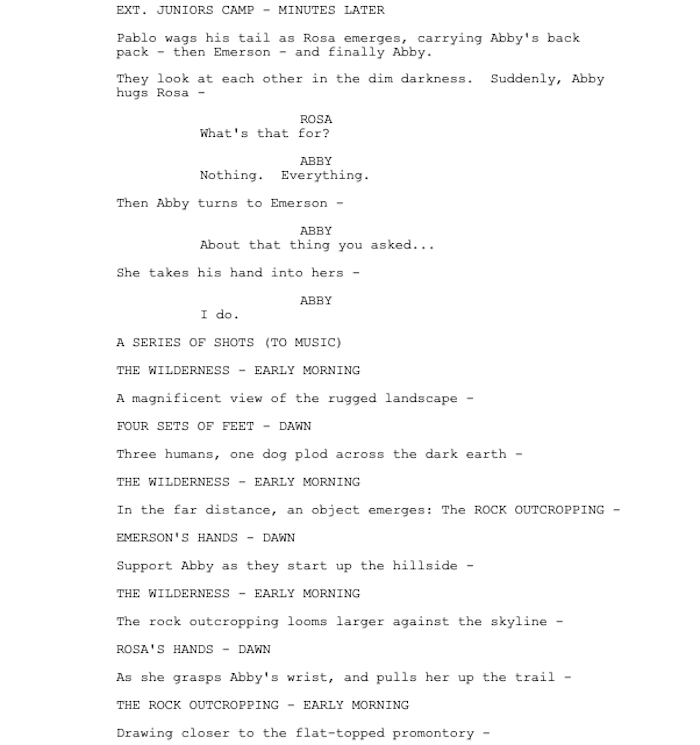
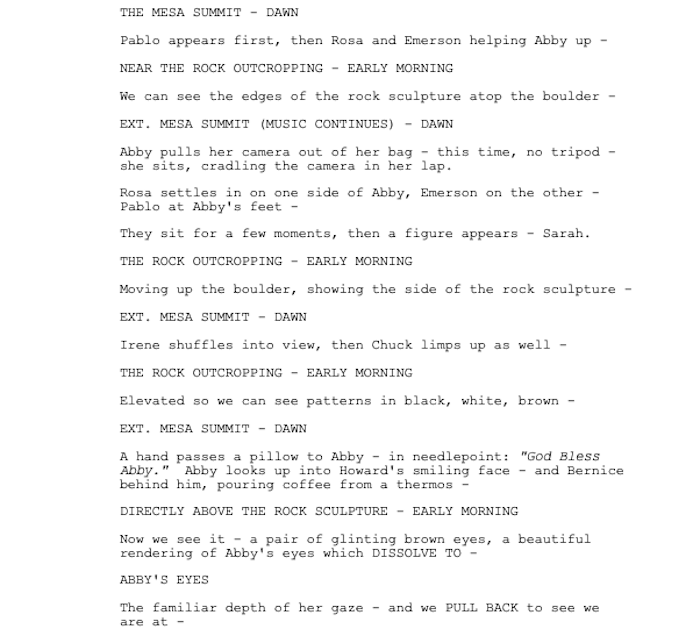
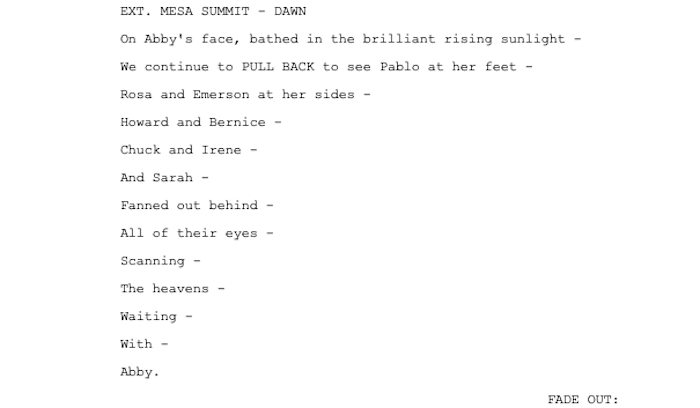
I remember one project I wrote — Snowbirds — where the soundtrack played a key role in writing and rewriting the screenplay. Discovering it was a complete case of serendipity. A friend recommended the album The Intercontinentals by jazz guitarist and composer Bill Frisell. There were several cuts on the album that fit scenes and sequences in Snowbirds like a hand in glove. One of the songs — Listen — was what I imagined for the final scene.
Plot summary: Every winter, three couples, all in their 60s and 70s, gather at a remote New Mexico wilderness location to “boondock” together with their RVs. This year is different. Their annual celebration is interrupted by the arrival of three college art students and their dog. Over the course of a long weekend, these two groups overcome generations of personal and cultural differences to rally around Abby, the youngest of them all. Diagnosed with terminal cancer, she has traveled to this special place with her friends for one final celebration before she returns to face her fate.
Here are the script’s final pages:
And here is the song Listen:
I listened to the album and in particular this song over and over and over again when working on the script.
As writers, we may not control the movie soundtrack. But we can dictate the soundtrack for our scripting process.
By the way, Snowbirds was cast and within a month of commencement of principal photography when the funding fell through. This was in 2005. Snowbirds was a version of Nomadland nearly two decades before that film.
Come back next Sunday for more of Lumet’s thoughts on story and working with screenwriters.
For previous installments, go here.
For more background on Sidney Lumet’s filmmaking career, go here.
My book The Protagonist’s Journey: An Introduction to Character-Driven Screenwriting and Storytelling is an Amazon #1 Best Seller in Film and Television. Endorsed by over thirty professional screenwriters, novelists, and academics, you may purchase it here.