Sundays with Sidney Lumet’s “Making Movies”
A weekly series featuring reflections on filmmaking by one of the truly great movie directors.
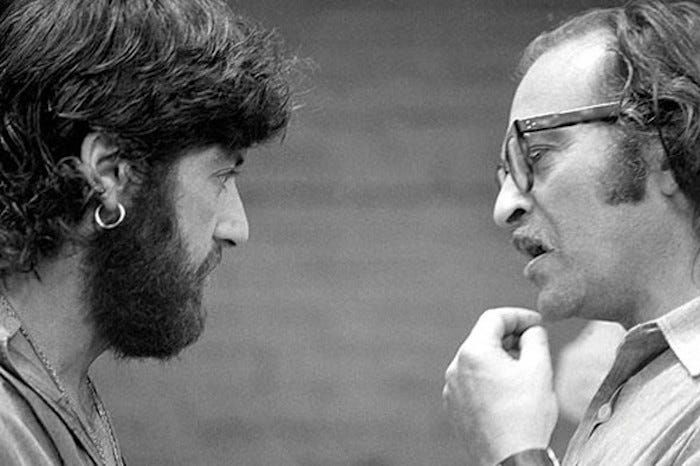
A weekly series featuring reflections on filmmaking by one of the truly great movie directors.
Roger Ebert said this about Making Movies: “It has more common sense in it about how movies are actually made than any other I have read.” That alone is enough reason to read this book authored by Sidney Lumet.
Known as an actor’s director, Lumet directed 17 different actors in Oscar-nominated performances: Katharine Hepburn, Rod Steiger, Al Pacino, Ingrid Bergman, Albert Finney, Chris Sarandon, Faye Dunaway, Peter Finch, Beatrice Straight, William Holden, Ned Beatty, Peter Firth, Richard Burton, Paul Newman, James Mason, Jane Fonda and River Phoenix. Bergman, Dunaway, Finch and Straight won Oscars for their performances in a Lumet movie.
Among his filmmaking credits are such stellar movies as 12 Angry Men, The Pawnbroker, Serpico, Dog Day Afternoon, Network, Equus, Prince of the City, The Verdict, and Running on Empty. He also has five screenwriting credits including Q&A and Night Falls on Manhattan.
As I’ve done with Sundays with Ray Bradbury and Sunday’s with Stephen King’s “On Writing,” I will work my way through Lumet’s book focusing on insights applicable to the craft of screenwriting.
Today: From “Making Movies,” Chapter 3: Style: The Most Misused Word Since Love, p. 53.
Any movie is by definition an artificial creation. It’s made by people coming together to explore a story. Stories take various forms. There are four primary forms of storytelling — tragedy, drama, comedy, and farce. No category is absolute. In City Lights, Chaplin moves from one form to the other with such grace that you’re never aware of which of them you’re in. Furthermore, there are subdivisions in drama and comedy. In drama, there is naturalism (Dog Day Afternoon) and realism (Serpico). In comedy, there is high comedy (The Philadelphia Story) and low comedy (Abbot and Costello Meet You Name It). Some pictures deliberately contain more than one form. The Grapes of Wrath is a combination of realism and tragedy. Blazing Saddles, a combination of low comedy and farce. These are not exact, quantifiable elements, and very often they overlap. What I always try to determine is the general area where I think the picture belongs, because the first step in finding the style is to start narrowing down the choices I’ll have to make.
As a screenwriter, what grabs my attention is how Lumet — as a movie director — frames his take on the film’s style based upon where the story lands relative to four genres: Tragedy, Drama, Comedy, and Farce. Two things intrigue me about this perception:
- Only four genres. While variable, as Lumet notes, nowadays I would say that Hollywood operates with eight genres: Action, Comedy, Drama, Family, Fantasy, Horror, Science Fiction, Thriller. Moreover, it’s interesting Lumet draws a distinction between Tragedy and Drama, and Comedy and Farce, each of which would, I think, fall into the same category (i.e., Tragedy as a subset of Drama, Farce as a subset of Comedy). What this suggests to me is Lumet’s use of these four “genres” reflected his narrow range of interests (not intended in a pejorative way) with regard to the types of stories he to which he was drawn. It makes me wonder what contemporary filmmakers like Tarantino, Cameron, Spielberg, and the like think of in terms of their “genres” of choice.
- No matter how a director typifies the concept of “genre,” the subtext of what Lumet says is this: Movie directors do categorize / frame / brand (whatever word you choose to use) stories. Therefore, as screenwriters, we need to be cognizant of that in how we approach the development and writing of our scripts. For if we see our script as an Action movie and the director sees it as an Action Comedy, there is likely to be some conflict in discussions about the development of that project.
Stories are organic. Characters are unique individuals. And yet, as a movie, they exist within a framework of genres. Style choices may derive from that, but also how a screenwriter handles genre tropes and expectations is a key aspect of the writing process.
Come back next Sunday for more of Lumet’s thoughts on story and working with screenwriters.
For previous installments, go here.
For more background on Sidney Lumet’s filmmaking career, go here.
To purchase my book The Protagonist’s Journey: An Introduction to Character-Driven Screenwriting and Storytelling, go here.