Sundays with Sidney Lumet’s “Making Movies”
A series featuring reflections on filmmaking by one of the truly great movie directors.
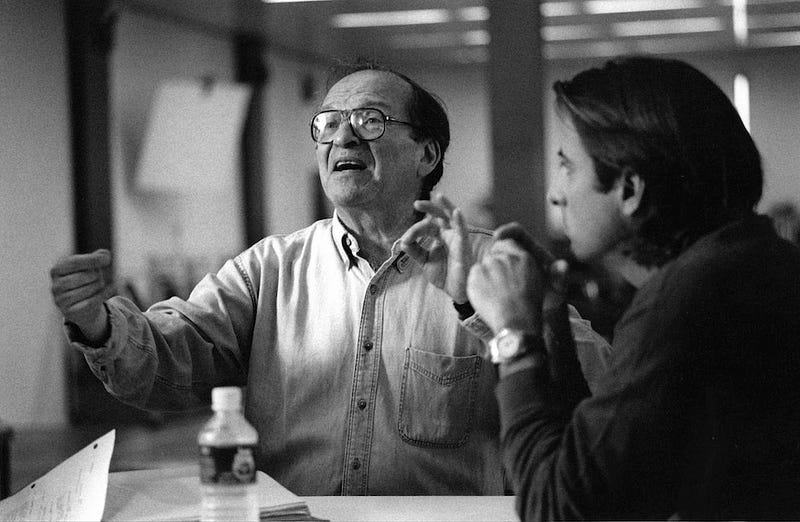
A series featuring reflections on filmmaking by one of the truly great movie directors.
Roger Ebert said this about Making Movies: “It has more common sense in it about how movies are actually made than any other I have read.” That alone is enough reason to read this book authored by Sidney Lumet.
Known as an actor’s director, Lumet directed 17 different actors in Oscar-nominated performances: Katharine Hepburn, Rod Steiger, Al Pacino, Ingrid Bergman, Albert Finney, Chris Sarandon, Faye Dunaway, Peter Finch, Beatrice Straight, William Holden, Ned Beatty, Peter Firth, Richard Burton, Paul Newman, James Mason, Jane Fonda and River Phoenix. Bergman, Dunaway, Finch and Straight won Oscars for their performances in a Lumet movie.
Among his filmmaking credits are such stellar movies as 12 Angry Men, The Pawnbroker, Serpico, Dog Day Afternoon, Network, Equus, Prince of the City, The Verdict, and Running on Empty. He also has five screenwriting credits including Q&A and Night Falls on Manhattan.
As I’ve done with Sundays with Ray Bradbury and Sunday’s with Stephen King’s “On Writing,” I will work my way through Lumet’s book focusing on insights applicable to the craft of screenwriting.
Today: From “Making Movies,” Chapter 6, pp. 105–136.
The call sheet is our Bible. That's what we're going to shoot that day. If it's not on the call sheet, we don't need it.
Here is an example of a call sheet Lumet provides in “Making Movies”:
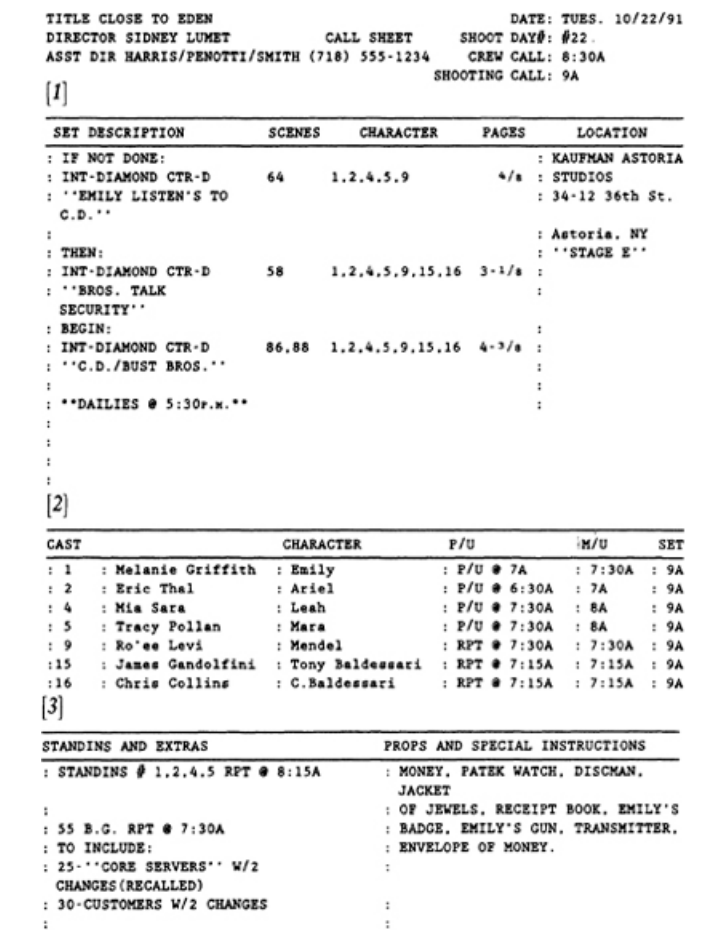
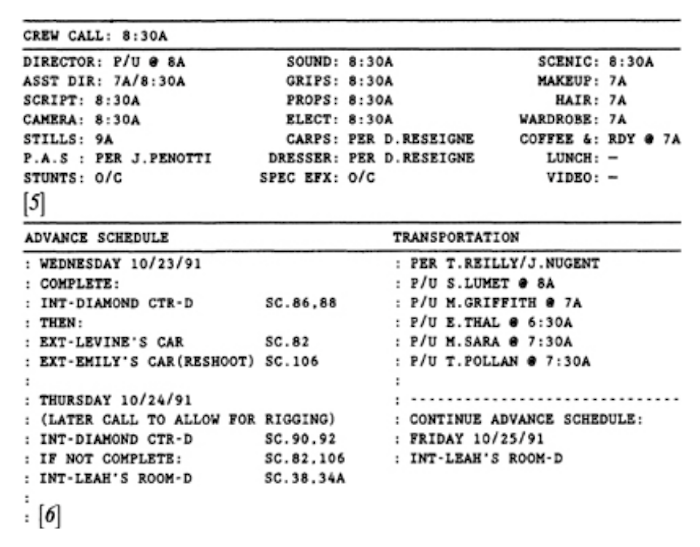
Here are Lumet’s comments about the call sheet as it relates to the shooting script:
Section 2: The Set Description starts with “Interior — Diamond Center — D.” “D” stands for “Day.” (If it were a night scene, it would say “N.”) It's followed by a brief description of the content of the scene. Next to it is the scene number. On the big scheduling board made up before the picture began, each scene was numbered according to the numbers assigned on the final shooting script. The numbers are consecutive. (A long scene may contain several numbers.) Next are the character numbers, also from the scheduling board, a quick reference to the characters who would be working on particular days. Next comes page count. Shooting scripts are broken down into eighths of a page. Generally, you try to shoot three pages a day. — p. 106
This is where the observation that a “screenplay is a blueprint to make a movie” proves to be true. What you write when you craft a scene gets translated into a shooting script, then a call sheet.
But a script is more than a blueprint. As we have seen in previous chapters, as far as Lumet is concerned, the script is the heart and soul of the movie. Indeed in this chapter, as Lumet describes what he does in the final minutes before arriving on set:
The road to the studio is uneventful and quiet. I study my script and think. — p. 110
The very last thing Lumet did as he made his way to the set was get back in touch with the story.
That’s an image to carry with you as you write your screenplay: Imagine the director heading to set … and what they need in that moment is to be grounded in the words you wrote.
Screenplay as blueprint? Yes. Screenplay as story? Truer than true.
Come back next Sunday for more of Lumet’s thoughts on story and working with screenwriters.
For previous installments, go here.
For more background on Sidney Lumet’s filmmaking career, go here.
To purchase my book The Protagonist’s Journey: An Introduction to Character-Driven Screenwriting and Storytelling, go here.