Sundays with Sidney Lumet’s “Making Movies”
A weekly series featuring reflections on filmmaking by one of the truly great movie directors.

A weekly series featuring reflections on filmmaking by one of the truly great movie directors.
Roger Ebert said this about Making Movies: “It has more common sense in it about how movies are actually made than any other I have read.” That alone is enough reason to read this book authored by Sidney Lumet.
Known as an actor’s director, Lumet directed 17 different actors in Oscar-nominated performances: Katharine Hepburn, Rod Steiger, Al Pacino, Ingrid Bergman, Albert Finney, Chris Sarandon, Faye Dunaway, Peter Finch, Beatrice Straight, William Holden, Ned Beatty, Peter Firth, Richard Burton, Paul Newman, James Mason, Jane Fonda and River Phoenix. Bergman, Dunaway, Finch and Straight won Oscars for their performances in a Lumet movie.
Among his filmmaking credits are such stellar movies as 12 Angry Men, The Pawnbroker, Serpico, Dog Day Afternoon, Network, Equus, Prince of the City, The Verdict, and Running on Empty. He also has five screenwriting credits including Q&A and Night Falls on Manhattan.
As I’ve done with Sundays with Ray Bradbury and Sunday’s with Stephen King’s “On Writing,” I will work my way through Lumet’s book focusing on insights applicable to the craft of screenwriting.
Today: From “Making Movies,” Chapter 2: The Script: Are Writers Necessary?, pp. 36–37.
I love long speeches. One of the reasons the studio resisted doing Network was that Paddy Chayefsky had written at least four four-to-six page monologues for Howard Beale, played by Peter Finch. And to top it off, he’d given a very long speech to Ned Beatty as the head of the world’s largest corporation, trying to get Howard Beale on his side. But the scenes were visually arresting and brilliantly acted… Is there anything more moving than Henry Fonda’s last speech in The Grapes of Wrath? For sheer lyric beauty, how about Marlon Brando’s speech in ? And Albert Finney’s summing up of the case in Murder on the Orient Express lasted two reels (about seventeen minutes).
In the early days of television, when the “kitchen sink” school of realism held sway, we always reached a point where we “explained” the character. Around two-thirds of the way through, someone articulated the psychological truth that made the character the person he was. Chayefsky and I used to call this the “rubber-ducky” school of drama: “Someone once took his rubber ducky away from him, and that’s why he’s a deranged killer.” That was the fashion then, and with many producers and studios it still is.
I always try to eliminate the rubber-ducky explanations. A character should be clear from his present actions. And his behavior as the picture goes on should reveal the psychological motivations. If the writer has to state the reasons, something’s wrong in the way the character has been written. Dialogue is like anything else in movies. It can be a crutch, or when used well, it can enhance, deepen, and reveal.
Consider these cinematic monologues:
What intrigues me about Lumet’s observations is the seeming contrast in sentiments: On the one hand, he loves “long speeches.” On the other hand, “rubber-ducky explanations.” But a close reading of Lumet’s words reveals two key dynamics which distinguish desirable monologues … and those which are not preferable:
- Visually arresting: Good monologues play to the strength of visual storytelling. Of course, great dialogue can evoke words that are “brilliantly acted” as Lumet notes, but more than that, the words themselves conjure up strong visuals. Try this: Don’t watch the monologues featured in the clips above. Rather, listen to them. Let your imagination run with the words themselves. Each generates powerful imagery.
- Exposition: By contrast, when a writer used monologues or any sort of dialogue for that matter which “explained” the character, that bumped up against Lumet’s creative sensibilities. He preferred characters revealing “psychological motivations” through “present actions.”
This latter point aligns with the Hollywood aphorism: Show it, don’t say it. But well-crafted dialogue, even lengthy monologues can work as cinematic devices if they avoid personal exposition and create strong visuals.
Check out the writing of Paddy Chayefsky from the Network screenplay:
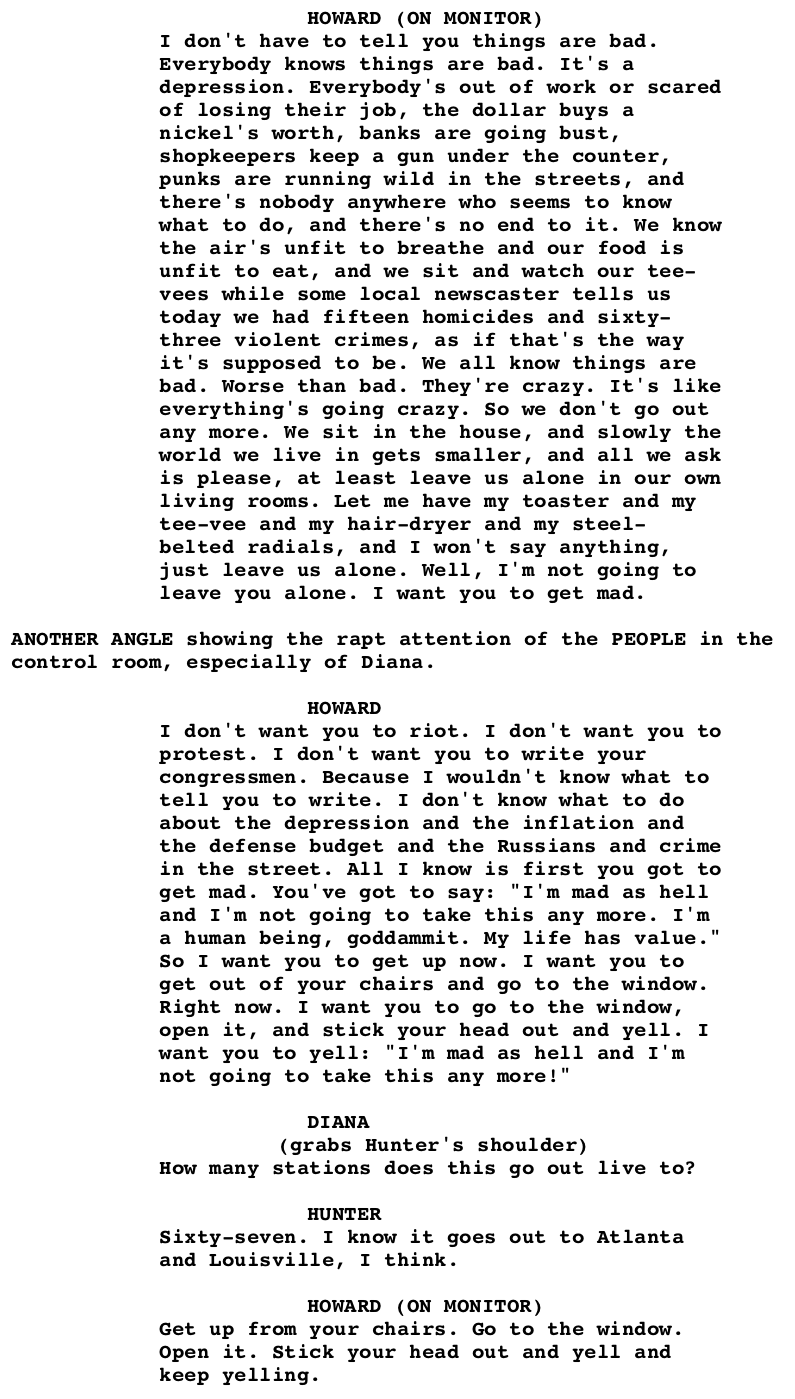
Beale’s monologue checks all of Lumet’s boxes which resulted in this:
Dialogue is like anything else in movies. It can be a crutch, or when used well, it can enhance, deepen, and reveal.
A quote worth remembering.
Come back next Sunday for more of Lumet’s thoughts on story and working with screenwriters.
For previous installments, go here.
For more background on Sidney Lumet’s filmmaking career, go here.
To purchase my book The Protagonist’s Journey: An Introduction to Character-Driven Screenwriting and Storytelling, go here.