Sundays with Sidney Lumet’s “Making Movies”
A series featuring reflections on filmmaking by one of the truly great movie directors.

A series featuring reflections on filmmaking by one of the truly great movie directors.
Roger Ebert said this about Making Movies: “It has more common sense in it about how movies are actually made than any other I have read.” That alone is enough reason to read this book authored by Sidney Lumet.
Known as an actor’s director, Lumet directed 17 different actors in Oscar-nominated performances: Katharine Hepburn, Rod Steiger, Al Pacino, Ingrid Bergman, Albert Finney, Chris Sarandon, Faye Dunaway, Peter Finch, Beatrice Straight, William Holden, Ned Beatty, Peter Firth, Richard Burton, Paul Newman, James Mason, Jane Fonda and River Phoenix. Bergman, Dunaway, Finch and Straight won Oscars for their performances in a Lumet movie.
Among his filmmaking credits are such stellar movies as 12 Angry Men, The Pawnbroker, Serpico, Dog Day Afternoon, Network, Equus, Prince of the City, The Verdict, and Running on Empty. He also has five screenwriting credits including Q&A and Night Falls on Manhattan.
As I’ve done with Sundays with Ray Bradbury and Sunday’s with Stephen King’s “On Writing,” I will work my way through Lumet’s book focusing on insights applicable to the craft of screenwriting.
Today: From “Making Movies,” Chapter 9: The Cutting Room — Alone at Last, pp. 161–162.
The second but equally critical element in editing is tempo. Every splice in a film changes the point of view, because every cut uses a different camera angle. Sometimes it may simply bounce in from a wide shot to a medium shot or close-up on the same angle. Still, the point of view has changed. Think of each cut is the beat of a visual metronome. In fact, quite often entire sequences are cut in a rhythm that will accommodate the musical scoring that will be added later. The more cuts, the faster the tempo will sing. That's why melodramas and chase sequences use so many cuts. Just as in music, fast tempo usually means energy and excitement.
However, an interesting thing happens. In music, everything from a sonata to a symphony uses changes in tempo as a basic part of its form. Typically, a four-movement sonata will change not only its musical themes in each movement, but also its tempo in each movement and sometimes even within each movement. Similarly, if a picture is edited in the same tempo for its entire length, it will feel much longer. It doesn't matter if five cuts per minute or five cuts every ten minutes are being used. If the same pace is maintained throughout, it will start to feel slower and slower. In other words, it's the change we feel, not the tempo itself.
For some reason, I still remember that I made 387 setups and 12 Angry Men. Over half of those setups were to be used in the last half hour of the movie. The cutting tempo was accelerated steadily during the movie but would break into a gallop on the last thirty-five minutes or so. The increasing tempo helped enormously both in making the story more exciting and in raising the audience’s awareness that the picture was compressing further in space and time.
As screenwriters, we can directly influence how a movie is edited and in multiple ways:
- We can break up scene description into paragraphs each of which suggests an individual camera shot (see my article: Action Writing in a Screenplay).
- We can use juxtaposition, visual-to-visual, and audio-to-audio to create transitions between scenes (see my article: Screenwriting “Hats”: Editor).
- We can manage the pace of the narrative in how we structure scene types one after the other (see my article: What type of scene is it?).
- We can shape the psychological flow of the story by making use of “emotion cuts” at the end of a scene leading to the next scene (see my article: Walter Murch and The Rule of Six).
All of these can impact how a director shoots the movie, everything from camera shots to scene transitions … and that can translate into the tempo of the narrative. In fact, just as Lumet noted how he increased the number of setups in the last half-hour of 12 Angry Men, screenwriters can do something similar in the third act of a script by shortening the length of scenes — shorter … shorter … shorter — to give the read a sense of increasing tempo.
Note: None of these screenwriting tools in any way steps on a director’s toes, not the least of which because we don’t need to use camera shot or directing lingo. Rather we can “direct” on the page through our own conscious filmmaking sensibilities and use of words to communicate our take on the narrative on the page.
Some may argue it’s not our role to direct the action in a screenplay. Interesting that just this week, a interview excerpt from Tony Gilroy (The Bourne Identity, The Bourne Supremacy, The Bourne Ultimatum, The Bourne Legacy, Michael Clayton, Rogue One: A Star Wars Story, Andor) made its way around social media:
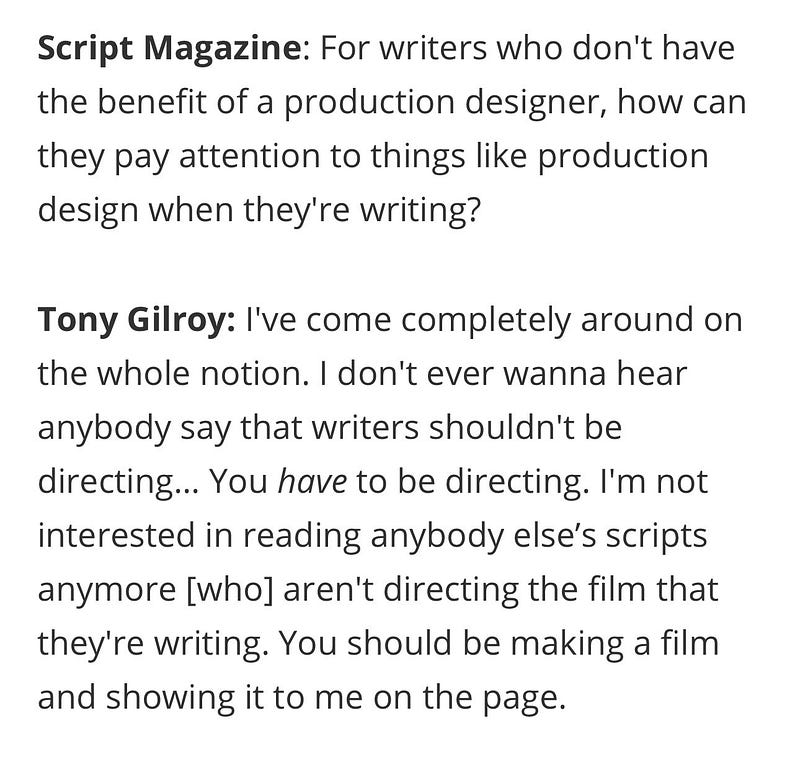
This suggests that screenwriters not only have the option of “directing” the movie on the page, but it is our responsibility to do so.
Again, we can do that — including editing choices — without using camera lingo and directing jargon.
Come back next Sunday for more of Lumet’s thoughts on story and working with screenwriters.
For previous installments, go here.
For more background on Sidney Lumet’s filmmaking career, go here.
My book The Protagonist’s Journey: An Introduction to Character-Driven Screenwriting and Storytelling is an Amazon #1 Best Seller in Film and Television. Endorsed by over thirty professional screenwriters, novelists, and academics, you may purchase it here.