Sundays with Sidney Lumet’s “Making Movies”
A series featuring reflections on filmmaking by one of the truly great movie directors.
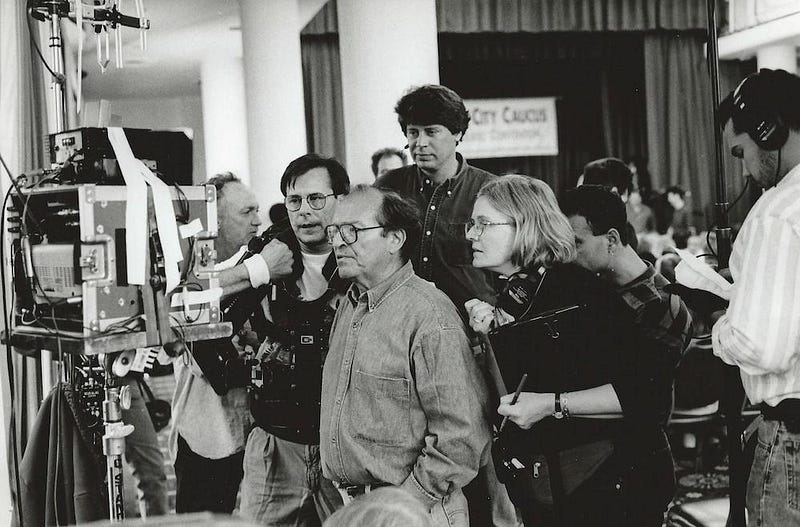
A series featuring reflections on filmmaking by one of the truly great movie directors.
Roger Ebert said this about Making Movies: “It has more common sense in it about how movies are actually made than any other I have read.” That alone is enough reason to read this book authored by Sidney Lumet.
Known as an actor’s director, Lumet directed 17 different actors in Oscar-nominated performances: Katharine Hepburn, Rod Steiger, Al Pacino, Ingrid Bergman, Albert Finney, Chris Sarandon, Faye Dunaway, Peter Finch, Beatrice Straight, William Holden, Ned Beatty, Peter Firth, Richard Burton, Paul Newman, James Mason, Jane Fonda and River Phoenix. Bergman, Dunaway, Finch and Straight won Oscars for their performances in a Lumet movie.
Among his filmmaking credits are such stellar movies as 12 Angry Men, The Pawnbroker, Serpico, Dog Day Afternoon, Network, Equus, Prince of the City, The Verdict, and Running on Empty. He also has five screenwriting credits including Q&A and Night Falls on Manhattan.
As I’ve done with Sundays with Ray Bradbury and Sunday’s with Stephen King’s “On Writing,” I will work my way through Lumet’s book focusing on insights applicable to the craft of screenwriting.
Today: From “Making Movies,” Chapter 7: Shooting the Movie, p. 120.
Just before we roll, I make a quick mental check of what preceded the moment we're about to film and what comes afterward. Then I focus my concentration on with the actors are doing. From the moment the actors start working, I play the scene along with them. I see the lines inside my head, I sense their movements and feel their emotions. I'm putting myself through the scene as if I were them.
This approach should feel quite familiar to a screenwriter. For it echoes the exact same position we take when we write a scene.
— We remind ourselves of what transpired in the scene before.
— We consider the purpose of this scene and how it flows into the next one.
— We concentrate on the characters connecting with what their feeling-state is as they enter the scene and how that impacts their actions.
— We contextualize this scene in terms of this or that character’s arc over the course of the entire story.
— We “play” the scene along with them as we write, especially in early drafts where we allow them to drive what happens, both in action and dialogue.
— We enter the scene as if we were right there as an invisible observer.
When we write each scene, it is important we connect to that moment the same way the director will when shooting it. The way actors will when performing it. The way the cinematographer will when filming it.
But perhaps most important: It is imperative we zero in on the characters and “feel their emotions.” I think this gets at the heart of what writer Ray Bradbury means when he says: “I’ve had a sign over my typewriter for over twenty-five years now, which reads ‘Don’t think!’ You must never think at the typewriter. You must feel.”
Feel what the characters are feeling. For it is in those feelings which play throughout the scene that make the audience care about the story.
Come back next Sunday for more of Lumet’s thoughts on story and working with screenwriters.
For previous installments, go here.
For more background on Sidney Lumet’s filmmaking career, go here.
To purchase my book The Protagonist’s Journey: An Introduction to Character-Driven Screenwriting and Storytelling, go here.