Sundays with Sidney Lumet’s “Making Movies”
A series featuring reflections on filmmaking by one of the truly great movie directors.

A series featuring reflections on filmmaking by one of the truly great movie directors.
Roger Ebert said this about Making Movies: “It has more common sense in it about how movies are actually made than any other I have read.” That alone is enough reason to read this book authored by Sidney Lumet.
Known as an actor’s director, Lumet directed 17 different actors in Oscar-nominated performances: Katharine Hepburn, Rod Steiger, Al Pacino, Ingrid Bergman, Albert Finney, Chris Sarandon, Faye Dunaway, Peter Finch, Beatrice Straight, William Holden, Ned Beatty, Peter Firth, Richard Burton, Paul Newman, James Mason, Jane Fonda and River Phoenix. Bergman, Dunaway, Finch and Straight won Oscars for their performances in a Lumet movie.
Among his filmmaking credits are such stellar movies as 12 Angry Men, The Pawnbroker, Serpico, Dog Day Afternoon, Network, Equus, Prince of the City, The Verdict, and Running on Empty. He also has five screenwriting credits including Q&A and Night Falls on Manhattan.
As I’ve done with Sundays with Ray Bradbury and Sunday’s with Stephen King’s “On Writing,” I will work my way through Lumet’s book focusing on insights applicable to the craft of screenwriting.
Today: From “Making Movies,” Chapter 9: The Cutting Room — Alone at Last, pp. 157–158.
To me, there are two main elements to editing: juxtapositioning images and creating tempo.
Sometimes an image is so meaningful or beautiful that it can capture or illuminate our original question: What is this movie about? In Murder on the Orient Express, the shot of the train leaving Istanbul had that quality. It had all the mystery, glamour, nostalgia, action I wanted the entire movie to have.
But in a movie, every shot is preceded or followed by another shot. That's why the juxtaposition of shots is such a great tool. In the agonizing, soul- baring fights in Long Days Journey Into Night, the shots kept getting wider and wider as father and son found themselves telling each other the cruel, ugly truths about each other. At the culmination of the fight, two extreme close-ups ended the scene; the frames were so tight that foreheads and chins were lost. The impact of the close-ups was doubled because of the wide shots that preceded them. In Prince of the City, when Ciello was considering suicide, the presence of the sky mattered so much because the sky had never appeared before in the movie. In The Verdict, the most important transition in the movie was illuminated by the close-ups of Paul Newman examining a Polaroid photograph. He had taken the picture of the victim, and he watched it develop. As the photograph took on life, he did too. I could feel the present breaking through for a man who, up until then, had been trapped in the detritus of his past life. It was the inter-cutting between the developing Polaroid and the close-ups of Newman that made the transition palpable.
Let’s consider Lumet’s reference to The Verdict. Here is the Polaroid scene from the movie:
Compare to what David Mamet wrote in the script:
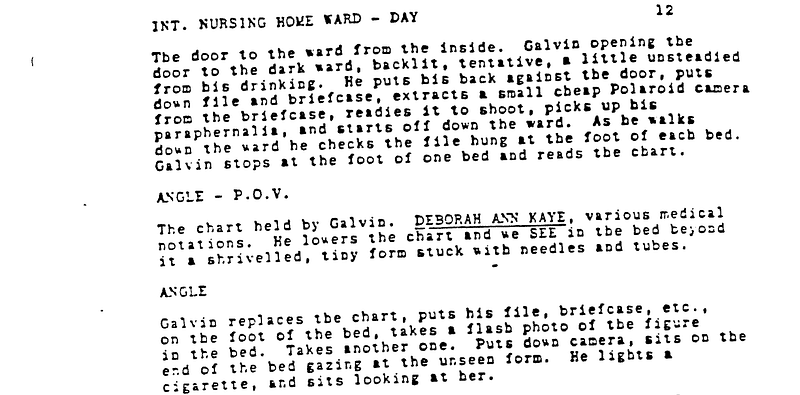
The Polaroid camera is there in the script. Galvin taking two photographs as well. There’s even a reference to him “gazing at the unseen form.” I take that to reference the two photographs. What Lumet decided to do was juxtapose images of Galvin’s face clearly staring at the photographs with a long close-up of the developing images. I timed it out: On screen, that image of the Polaroids is 23 seconds. That is a long shot. As Lumet says of the power of that moment: “As the photograph took on life, he did too.”
Here is the framing of those images:

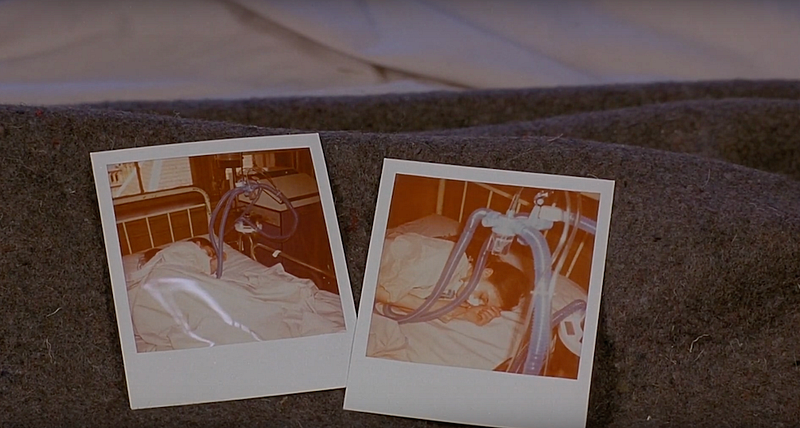
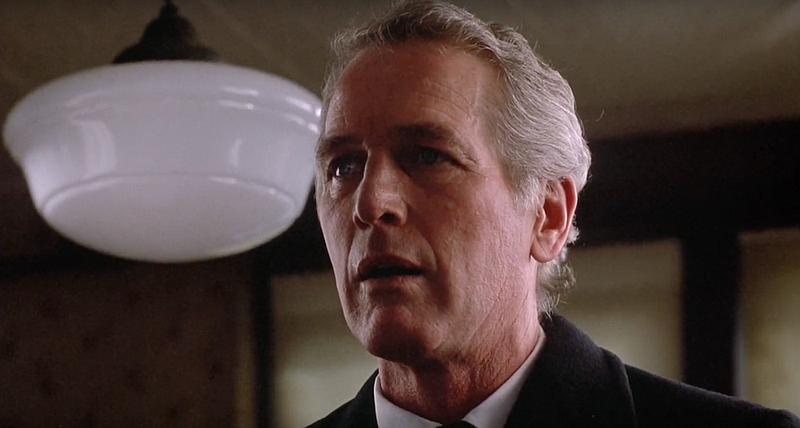
“It was the inter-cutting between the developing Polaroid and the close-ups of Newman that made the transition palpable.”
Here’s the thing: As screenwriters, we can suggest this type of juxtaposition of images. We can even comment in scene description what is transpiring inside a character’s emotional life.
Let’s “rewrite” David Mamet to illustrate this:
Galvin takes a flash photo of the figure in the bed. All business. Sets it down.
Another one. Places it beside the other. He glances at —
The photographs … the figure in the bed emerging from the stark white background of the pictures … lying still … eyes shut … the breathing machine forcing air in and out of her lungs … psst … psst … psst…
Galvin frozen as the images of a lifeless woman come to life before his very eyes… finally, he blinks. Lifts his gaze. Something has changed, but he doesn’t know what … yet.
Perhaps overwritten, but done to drive home the point: We can “direct” what’s on the page without using camera jargon or directly lingo. We can juxtapose images. We can suggest what is transpiring in the inner life of a character. We have to be judicious and use great care when we do it, but the fact is we can do it.
If you think for some reason screenwriters can’t do that, I invite you to compare another scene where a character has an internal change conveyed through a juxtaposition of images that is indicated in the script. From my very favorite movie The Apartment.
Scene setup: Baxter (Jack Lemmon) has a thing for Kubelik (Shirley Maclaine). What he doesn’t know is that she is having an affair with Baxter’s boss: Mr. Sheldrake. Worse, they are conducting their trysts at Baxter’s apartment. Earlier, Baxter discovered a woman’s compact in his couch, one with a broken mirror. He gives it to Sheldrake who returns it to Kubelik. Meanwhile, moments before this scene, Kubelik has discovered that she is the latest of many affairs Sheldrake has had. All of that leads to this dramatic revelation.
Here is the movie version of the scene alongside the script:
Director Billy Wilder uses the same approach to juxtaposing images as Lumet used in The Verdict as described above.
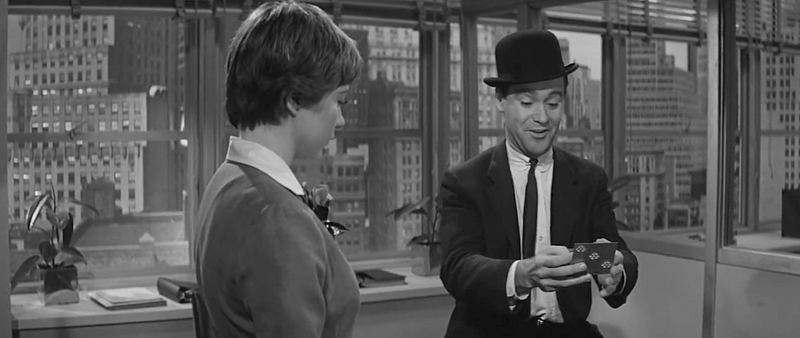
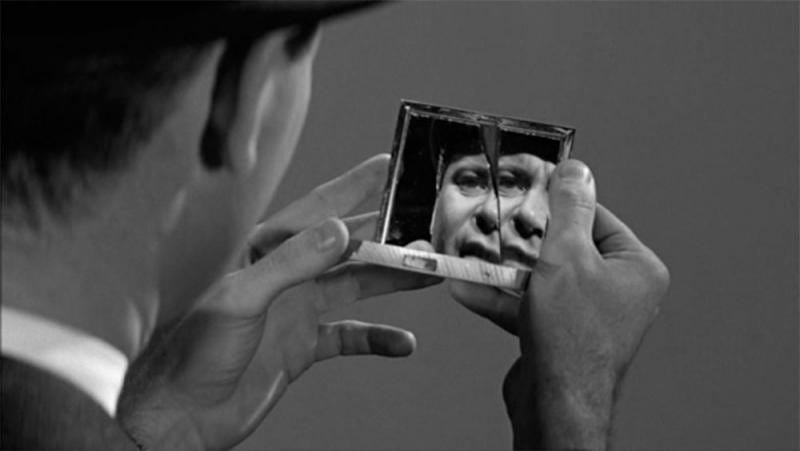
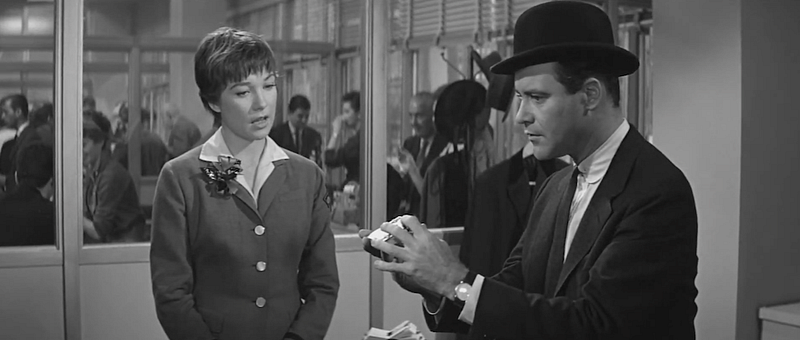
And it’s written right there in the script along with this commentary:

That middle sentence? That’s all internal content describing what Baxter is realizing … his inner thoughts.
Takeaway: Just as a director and editor can use the juxtaposition of images to create an impact on the audience, screenwriters can do something similar on the script reader. Be judicious. Handle with care.
But we have the right to do that.
Come back next Sunday for more of Lumet’s thoughts on story and working with screenwriters.
For previous installments, go here.
For more background on Sidney Lumet’s filmmaking career, go here.
My book The Protagonist’s Journey: An Introduction to Character-Driven Screenwriting and Storytelling is an Amazon #1 Best Seller in Film and Television. Endorsed by over thirty professional screenwriters, novelists, and academics, you may purchase it here.