Sundays with Ray Bradbury
“I can imagine all kinds of worlds and places, but I cannot imagine a world without Bradbury.” — Neil Gaiman
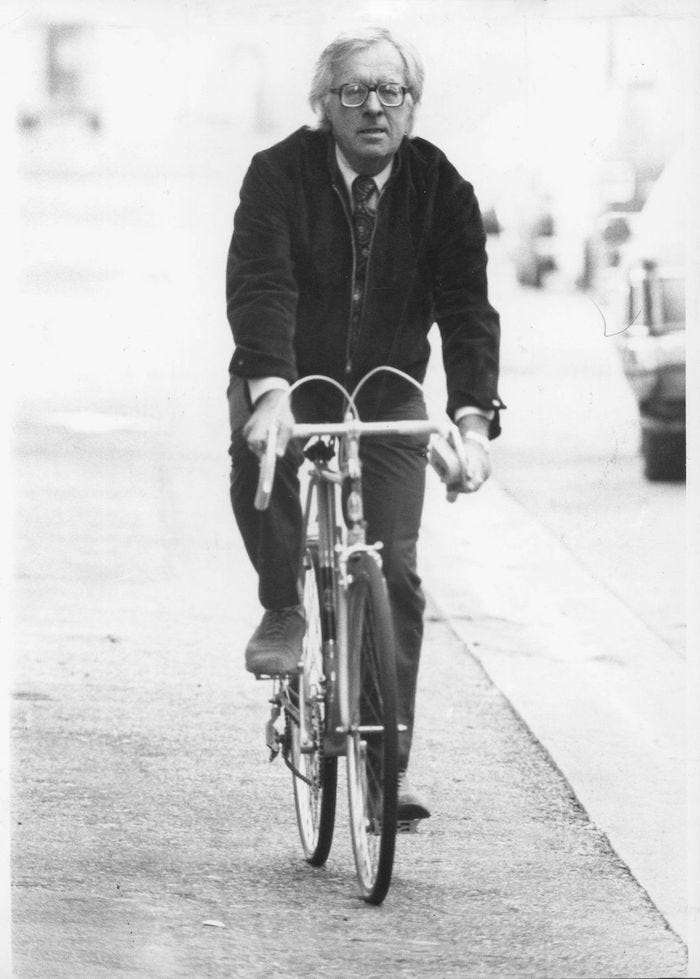
“I can imagine all kinds of worlds and places, but I cannot imagine a world without Bradbury.” — Neil Gaiman
Ray Bradbury (1920–2012) had a remarkable writing career. Author and screenwriter, here is a partial list of his writing projects:
Novels
- 1950 The Martian Chronicles
- 1953 Fahrenheit 451
- 1957 Dandelion Wine
- 1962 Something Wicked This Way Comes
- 1972 The Halloween Tree
- 1985 Death Is a Lonely Business
- 1990 A Graveyard for Lunatics
- 1992 Green Shadows, White Whale
- 2001 From the Dust Returned
- 2003 Let’s All Kill Constance
- 2006 Farewell Summer
Collections
- 1947 Dark Carnival
- 1951 The Illustrated Man
- 1953 The Golden Apples of the Sun
- 1955 The October Country
- 1959 A Medicine for Melancholy
- 1959 The Day It Rained Forever
- 1962 The Small Assassin
- 1964 The Machineries of Joy
- 1965 The Vintage Bradbury
- 1966 Twice 22
- 1969 I Sing The Body Electric!
- 1975 Ray Bradbury
- 1976 Long After Midnight
- 1980 The Last Circus and the Electrocution
- 1980 The Stories of Ray Bradbury
- 1983 Dinosaur Tales
- 1984 A Memory of Murder
- 1988 The Toynbee Convector
- 1990 Classic Stories 1
- 1990 Classic Stories 2
- 1996 Quicker Than The Eye
- 1997 Driving Blind
- 1997 The Golden Apples of the Sun and Other Stories
- 1998 A Medicine For Melancholy And Other Stories
- 1998 I Sing The Body Electric! And Other Stories
- 2002 One More for the Road
- 2003 Bradbury Stories
- 2004 The Cat’s Pajamas: Stories
- 2005 A Sound of Thunder and Other Stories
- 2007 Now and Forever: Somewhere a Band is Playing & Leviathan ’99
- 2007 Summer Morning, Summer Night
- 2009 We’ll Always Have Paris: Stories
- 2010 A Pleasure To Burn
There are a couple of Bradbury quotes I want to include in my book The Protagonist’s Journey: Character Driven Screenwriting and Storytelling:
“Plot is no more than footprints left in the snow after your characters have run by on their way to incredible destinations.”
“Stand aside, forget targets, let the characters, your fingers, body, blood, and heart do.”
You can see why I like those quotes!
Like many Bradbury observations, they float around online without attribution to the original source. Therefore, I recently picked up Zen in the Art of Writing written by Bradbury and am reading through it to see if I can find those two observations on the craft..
As I began with the book, it occurred to me: Why not share Bradbury’s wisdom with Go Into The Story readers? Hence, a new series: Sundays with Ray Bradbury. Today: From Zen in the Art of Writing , “Shooting Haiku in a Barrel,” pp. 98–99.
I've been lecturing at the University of Southern California cinema department for twenty-two years — I go down there a couple of times a year — and various students have come up to me and said, “Can we make films of your short stories?” I say, “Sure, take them. Do it. But there's one restriction I put on you. Shoot the whole story. Just read what I've done and line up the shot by the paragraphs. All the paragraphs are shots. By the way the paragraph reads, you know whether it's a close-up or a long shot.” So, by God, those students, with their little cameras and $500, have shot better films than the big productions I've had, because they’ve followed the story.
All my stories are cinematic. I may be the most cinematic novelist in the country today. All of my short stories can be shot right off the page. Each paragraph is a shot.
When I first talked to Sam Peckinpah years ago about directing Something Wicked, I said to him, “How are you going to shoot the film if we do it?” He said, “Tear the pages out of the book and stuff them into the camera.” I said, “Right.”
The job finally is to pick and choose among all metaphors in the book, put them into a screenplay in just the right proportion were people don't start to laugh at you.
For instance, I saw The Only Game in Town, George Stevens’ film about gambling in Las Vegas, on TV recently. Warren Beatty and Elizabeth Taylor, who was a little bit Porky Pig. About a half hour in, Taylor turns to Beatty and she says, “Carry me into the bedroom.” Well, there's no way to do anything but laugh. I thought, “He's going to throw his back out.” I mean there goes your film.
So when you do a fantasy for the screen, make sure people don't fall off their seats.
Check out this excerpt from a Go Into The Story article I wrote back in 2019 about handling blocks of scene description:
If you think of each paragraph of scene description as an individual camera shot, you will naturally avoid long paragraphs.
Nice to see my thinking aligns with Bradbury! Indeed, this perspective is reflected in the writing style of many contemporary screenwriters.
Here is an example I cited in the article from the 2019 Nicholl-winning script Street Rat Allie Punches Her Ticket written by Walker McKnight:

Let’s break down the camera shots:
- Close Up: Skateboard wheels
- Close Up: Feet
- Medium Shot: Jammer
- Medium Shot: Allie
- Wide Shot: Massive city
- Medium Shot pull back to Wide Shot: Train tracks
- Wide Shot: Bubble Wall
- Wide Shot (tilt up): Vertical image of the Bubble
- Wide Shot (pan): Train
- Medium Shot: The girls
- Medium Shot: Bot Guards
- Wide Shot (pull back): Mass of creatures
NOTE: Do NOT mention a camera. No CLOSE UP, MEDIUM SHOT, ESTABLISHING SHOT, WIDE SHOT, etc. Rather simply describe what the camera sees.
The other takeaway from Bradbury’s comments is a single word: Cinematic. What I gather he means is to not only to suggest camera shots with each paragraph of scene description, but also think visually. After all, movies are primarily a visual medium.
Therefore, when we write a script, follow Bradbury’s advice so a director will want to “tear the pages out… and stuff them into the camera.”
To learn more about Ray Bradbury, check out this website: raybradbury.com.
For previous Sundays with Ray Bradbury articles, go here.