Sundays with Ray Bradbury
“I can imagine all kinds of worlds and places, but I cannot imagine a world without Bradbury.” — Neil Gaiman
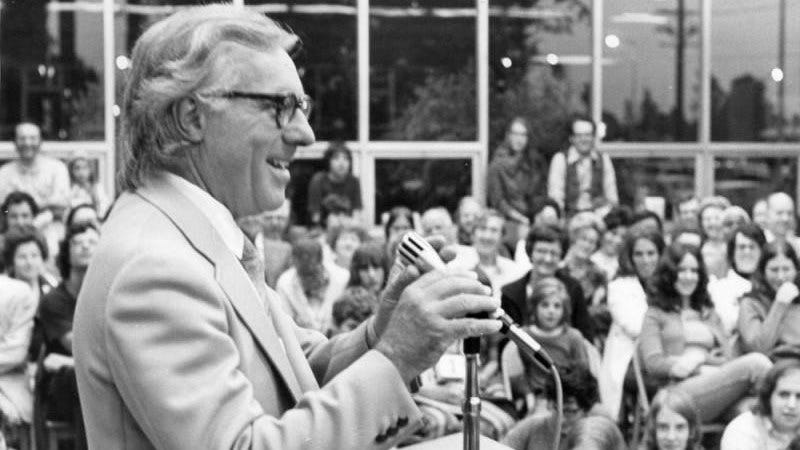
“I can imagine all kinds of worlds and places, but I cannot imagine a world without Bradbury.” — Neil Gaiman
Ray Bradbury (1920–2012) had a remarkable writing career. Author and screenwriter, here is a partial list of his writing projects:
Novels
- 1950 The Martian Chronicles
- 1953 Fahrenheit 451
- 1957 Dandelion Wine
- 1962 Something Wicked This Way Comes
- 1972 The Halloween Tree
- 1985 Death Is a Lonely Business
- 1990 A Graveyard for Lunatics
- 1992 Green Shadows, White Whale
- 2001 From the Dust Returned
- 2003 Let’s All Kill Constance
- 2006 Farewell Summer
Collections
- 1947 Dark Carnival
- 1951 The Illustrated Man
- 1953 The Golden Apples of the Sun
- 1955 The October Country
- 1959 A Medicine for Melancholy
- 1959 The Day It Rained Forever
- 1962 The Small Assassin
- 1964 The Machineries of Joy
- 1965 The Vintage Bradbury
- 1966 Twice 22
- 1969 I Sing The Body Electric!
- 1975 Ray Bradbury
- 1976 Long After Midnight
- 1980 The Last Circus and the Electrocution
- 1980 The Stories of Ray Bradbury
- 1983 Dinosaur Tales
- 1984 A Memory of Murder
- 1988 The Toynbee Convector
- 1990 Classic Stories 1
- 1990 Classic Stories 2
- 1996 Quicker Than The Eye
- 1997 Driving Blind
- 1997 The Golden Apples of the Sun and Other Stories
- 1998 A Medicine For Melancholy And Other Stories
- 1998 I Sing The Body Electric! And Other Stories
- 2002 One More for the Road
- 2003 Bradbury Stories
- 2004 The Cat’s Pajamas: Stories
- 2005 A Sound of Thunder and Other Stories
- 2007 Now and Forever: Somewhere a Band is Playing & Leviathan ’99
- 2007 Summer Morning, Summer Night
- 2009 We’ll Always Have Paris: Stories
- 2010 A Pleasure To Burn
There are a couple of Bradbury quotes I want to include in my book The Protagonist’s Journey: Character Driven Screenwriting and Storytelling:
“Plot is no more than footprints left in the snow after your characters have run by on their way to incredible destinations.”
“Stand aside, forget targets, let the characters, your fingers, body, blood, and heart do.”
You can see why I like those quotes!
Like many Bradbury observations, they float around online without attribution to the original source. Therefore, I recently picked up Zen in the Art of Writing written by Bradbury and am reading through it to see if I can find those two observations on the craft..
As I began with the book, it occurred to me: Why not share Bradbury’s wisdom with Go Into The Story readers? Hence, a new series: Sundays with Ray Bradbury. Today: From Zen in the Art of Writing , “The Secret Mind,” pp. 87–88.
Here is how my theory goes. We writers are up to the following:
We build tensions toward laughter, then give permission, and laughter comes.
We build tensions towards sorrow, and at the last say cry, and hope to see our audience in tears.
We build tensions toward violence, light the fuse, and run.
We build the strange tensions of love, where so many of the other tensions mix to be modified and transcended, and allow that fruition in the mind of the audience.
We build tensions, especially today, towards sickness and then, if we are good enough, talented enough, observant enough, allow our audiences to be sick.
Each tension seeks its own proper end, release, and relaxation.
No tension, it follows, aesthetically as well as practically, must be built which remains unreleased. Without this, any art ends incomplete, halfway to its goal. And in real life, as we know, the failure to relax a particular tension can lead to madness.
Here Bradbury speaks to a dynamic innate to storytelling, both in terms of the macro — a story’s overall tension which plays throughout — and micro — the tension playing in, around, and underneath each scene.
It’s an intriguing collection of narrative arenas Bradbury zeroes in on: Laughter, Sorrow, Violence, Love, Sickness. When considered in their totality, they do cover much, if not most of what the human experience is, certainly as that experience is conveyed in a story. Regardless of genre or form — screenplay, teleplay, novel, short story, play, poem — these are five areas we should be mindful to mine in our writing, these potential sources of tension.
But, as Bradbury notes, it’s not all about generating tension, it’s also about the release of that tension. The tension itself has a built-in “goal” which is its release. It’s where the reader, caught up in tension between characters or arising from within a character, combines in their identification with the characters to propel the narrative toward its resolution.
And this can happen scene to scene to scene, this pattern of mining tension, then finding release, over and over, a powerful use of psychology to lure the reader deeper and deeper into the story, like feeding bits of cheese to a mouse in a maze. They can see the cheese ahead (tension), then eat the cheese (release)… but wait, there’s more cheese up and over there, but how to get there (tension)?
Takeaway: Tension. Release. Consider that story you are writing. What is the macro tension at play in the plot and via each character amidst the transpiring events? What is the micro tension in each scene you write? It can run the gamut from the most subtle disjunction or sense of unease ramped up to overt conflict. Look for the tension in your story. Be especially attuned to it in five areas: Laughter, Sorrow, Violence, Love, Sickness.
To learn more about Ray Bradbury, check out this website: raybradbury.com.
For previous Sundays with Ray Bradbury articles, go here.