Sundays with Ray Bradbury
“I can imagine all kinds of worlds and places, but I cannot imagine a world without Bradbury.” — Neil Gaiman
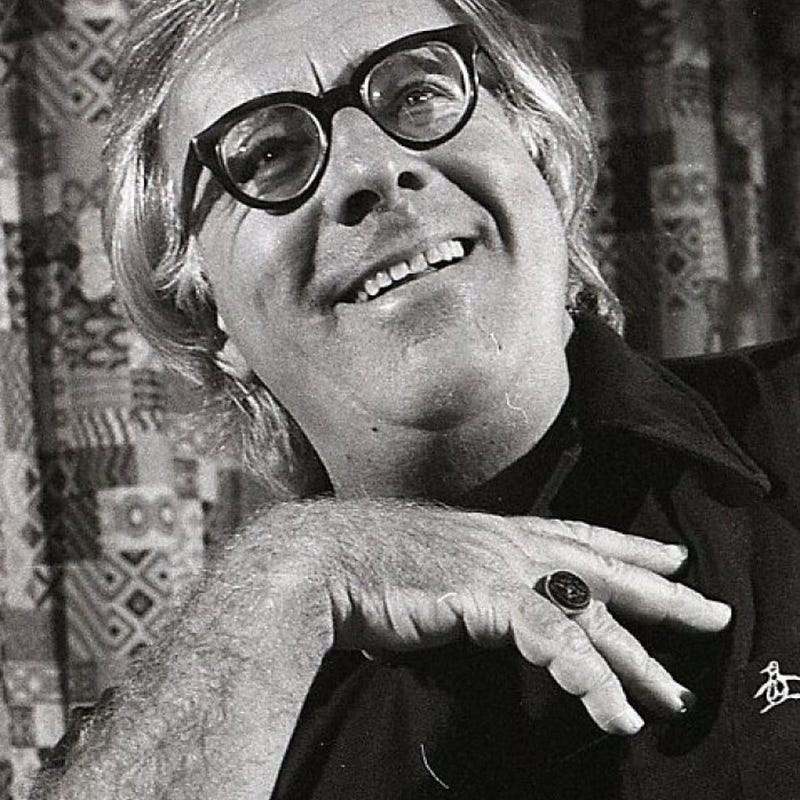
“I can imagine all kinds of worlds and places, but I cannot imagine a world without Bradbury.” — Neil Gaiman
Ray Bradbury (1920–2012) had a remarkable writing career. Author and screenwriter, here is a partial list of his writing projects:
Novels
- 1950 The Martian Chronicles
- 1953 Fahrenheit 451
- 1957 Dandelion Wine
- 1962 Something Wicked This Way Comes
- 1972 The Halloween Tree
- 1985 Death Is a Lonely Business
- 1990 A Graveyard for Lunatics
- 1992 Green Shadows, White Whale
- 2001 From the Dust Returned
- 2003 Let’s All Kill Constance
- 2006 Farewell Summer
Collections
- 1947 Dark Carnival
- 1951 The Illustrated Man
- 1953 The Golden Apples of the Sun
- 1955 The October Country
- 1959 A Medicine for Melancholy
- 1959 The Day It Rained Forever
- 1962 The Small Assassin
- 1964 The Machineries of Joy
- 1965 The Vintage Bradbury
- 1966 Twice 22
- 1969 I Sing The Body Electric!
- 1975 Ray Bradbury
- 1976 Long After Midnight
- 1980 The Last Circus and the Electrocution
- 1980 The Stories of Ray Bradbury
- 1983 Dinosaur Tales
- 1984 A Memory of Murder
- 1988 The Toynbee Convector
- 1990 Classic Stories 1
- 1990 Classic Stories 2
- 1996 Quicker Than The Eye
- 1997 Driving Blind
- 1997 The Golden Apples of the Sun and Other Stories
- 1998 A Medicine For Melancholy And Other Stories
- 1998 I Sing The Body Electric! And Other Stories
- 2002 One More for the Road
- 2003 Bradbury Stories
- 2004 The Cat’s Pajamas: Stories
- 2005 A Sound of Thunder and Other Stories
- 2007 Now and Forever: Somewhere a Band is Playing & Leviathan ’99
- 2007 Summer Morning, Summer Night
- 2009 We’ll Always Have Paris: Stories
- 2010 A Pleasure To Burn
There are a couple of Bradbury quotes I want to include in my book The Protagonist’s Journey: Character Driven Screenwriting and Storytelling:
“Plot is no more than footprints left in the snow after your characters have run by on their way to incredible destinations.”
“Stand aside, forget targets, let the characters, your fingers, body, blood, and heart do.”
You can see why I like those quotes!
Like many Bradbury observations, they float around online without attribution to the original source. Therefore, I recently picked up Zen in the Art of Writing written by Bradbury and am reading through it to see if I can find those two observations on the craft..
As I began with the book, it occurred to me: Why not share Bradbury’s wisdom with Go Into The Story readers? Hence, a new series: Sundays with Ray Bradbury. Today: From Zen in the Art of Writing , “Run Fast, Stand Still, Or, The Thing at the Top of the Stairs, Or, New Ghosts from Old Minds,” pp. 10–12. Here, Bradbury discusses how he evolved from imitating writers he loved to finding his own voice.
Through those years I began to make lists of titles, to put down long lines of nouns. These lists were the provocations, finally, that caused my better stuff to surface. I was feeling my way towards something honest, hidden under the trapdoor on the top of my skull.
The lists ran something like this:
THE LAKE. THE NIGHT. THE CRICKETS. THE RAVINE. THE ATTIC. THE BASEMENT. THE TRAPDOOR. THE BABY. THE CROWD. THE NIGHT TRAIN. THE FOG HORN. THE SCYTHE. THE CARNIVAL. THE CAROUSEL. THE DWARF. THE MIRROR MAZE. THE SKELETON.
I was beginning to see a pattern in the list, in these words that I had simply flung forth on paper, trusting my subconscious to give bread, as it were, to the birds.
Glancing over the list, I discovered my old love and fright having to do with circuses and carnivals. I remembered and then forgot, and then remembered again, how terrified I have been when my mother took me for my first ride on the merry-go-round. With the calliope screaming and the world spinning and the terrible forces leaping, I added my shrieks to the den. I did not go near the carousel again for years. When I really did, decades later, it rode me into the midst of Something Wicked This Way Comes.
But long before that, I went on making the lists. THE MEADOW. THE TOY CHEST. THE MONSTER. TYRANNOSAURUS REX. THE TOWN CLOCK. THE OLD MAN. THE OLD WOMAN. THE TELEPHONE. THE SIDEWALKS. THE COFFIN. THE ELECTRIC CHAIR. THE MAGICIAN.
— —
Where am I leading you? Well, if you are a writer, or would hope to be one, similar lists, dredged out of the lopside of your brain, might well help you discover you, even as I flopped around and finally found me.
I began to run through those lists, pick a noun, and then sit down to write a long prose-poem-essay on it.
Somewhere along about the middle of the page, or perhaps on the second page, the prose poem would turn into a story. Which is to say that a character suddenly appeared and said ‘That's me’; or, ‘That's an idea I like!’ And the character would then finish the tale for me.
It began to be obvious that I was learning from my lists of nouns, and that I was further learning that my characters would do my work for me, if I let them alone, if I gave them their heads, which is to say, their fantasies, their frights.
I often tell my students, “Writing a story is like wrangling magic.” This excerpt from Bradbury’s book speaks to that.
- There is the magic of jotting down whatever nouns come into your mind.
- There is the magic of the memories dredged up by one or more of those nouns, personal associations which may have been buried deep within your mind, yet suddenly emerge… sights, sounds, smells.
- There is the magic of just starting to write something to see where it takes you, a noun-based prose-poem which suddenly begins to take shape as a story.
- There is the magic of a character emerging into being, how we start to see and hear them.
- There is the magic of the character telling us the story through their actions and words.
All this from an arbitrary choice of jotting down a list of nouns.
Takeaway: This exercise strikes me as an excellent way to engender what some writers call subconscious writing, where the words emerge as if… well… by magic. It also brings to mind two other thoughts:
- Since at least some of these nouns will summon up a significant association from our past, that creates a path to write personal stories, not necessarily specific events, but rather the emotional truth of past experiences. As such, we are likely to craft a story which will evoke an emotional response in readers.
- If, as Bradbury suggests through this process, characters suddenly appear, it leads me to wonder: Do the characters arise from within who we are… or have they existed all along and while visiting our subconscious, we manage to lasso them so they may take us for a creative ride?
Rather than try to answer this question, it is perhaps better to simply accept the magical nature of each character’s incarnation… and give thanks for it.
To learn more about Ray Bradbury, check out this website: raybradbury.com.
For previous Sundays with Ray Bradbury articles, go here.