Sundays with Ray Bradbury
“I can imagine all kinds of worlds and places, but I cannot imagine a world without Bradbury.” — Neil Gaiman
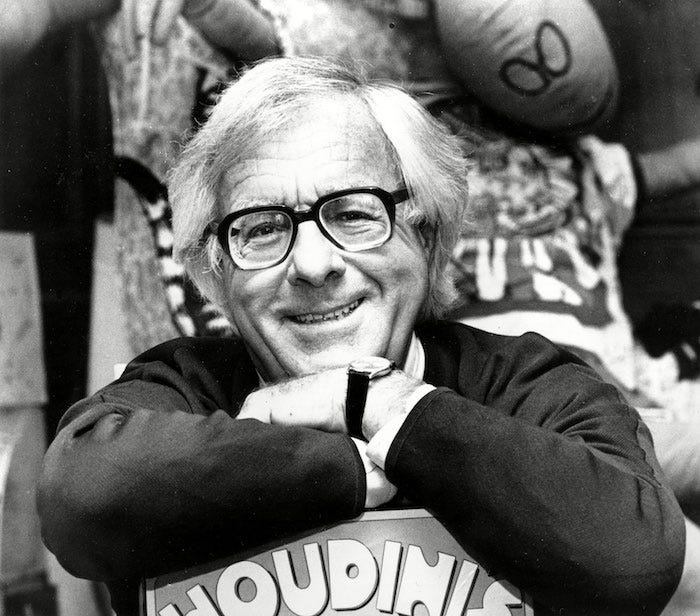
“I can imagine all kinds of worlds and places, but I cannot imagine a world without Bradbury.” — Neil Gaiman
Ray Bradbury (1920–2012) had a remarkable writing career. Author and screenwriter, here is a partial list of his writing projects:
Novels
- 1950 The Martian Chronicles
- 1953 Fahrenheit 451
- 1957 Dandelion Wine
- 1962 Something Wicked This Way Comes
- 1972 The Halloween Tree
- 1985 Death Is a Lonely Business
- 1990 A Graveyard for Lunatics
- 1992 Green Shadows, White Whale
- 2001 From the Dust Returned
- 2003 Let’s All Kill Constance
- 2006 Farewell Summer
Collections
- 1947 Dark Carnival
- 1951 The Illustrated Man
- 1953 The Golden Apples of the Sun
- 1955 The October Country
- 1959 A Medicine for Melancholy
- 1959 The Day It Rained Forever
- 1962 The Small Assassin
- 1964 The Machineries of Joy
- 1965 The Vintage Bradbury
- 1966 Twice 22
- 1969 I Sing The Body Electric!
- 1975 Ray Bradbury
- 1976 Long After Midnight
- 1980 The Last Circus and the Electrocution
- 1980 The Stories of Ray Bradbury
- 1983 Dinosaur Tales
- 1984 A Memory of Murder
- 1988 The Toynbee Convector
- 1990 Classic Stories 1
- 1990 Classic Stories 2
- 1996 Quicker Than The Eye
- 1997 Driving Blind
- 1997 The Golden Apples of the Sun and Other Stories
- 1998 A Medicine For Melancholy And Other Stories
- 1998 I Sing The Body Electric! And Other Stories
- 2002 One More for the Road
- 2003 Bradbury Stories
- 2004 The Cat’s Pajamas: Stories
- 2005 A Sound of Thunder and Other Stories
- 2007 Now and Forever: Somewhere a Band is Playing & Leviathan ’99
- 2007 Summer Morning, Summer Night
- 2009 We’ll Always Have Paris: Stories
- 2010 A Pleasure To Burn
There are a couple of Bradbury quotes I want to include in my book The Protagonist’s Journey: Character Driven Screenwriting and Storytelling:
“Plot is no more than footprints left in the snow after your characters have run by on their way to incredible destinations.”
“Stand aside, forget targets, let the characters, your fingers, body, blood, and heart do.”
You can see why I like those quotes!
Like many Bradbury observations, they float around online without attribution to the original source. Therefore, I recently picked up Zen in the Art of Writing written by Bradbury and am reading through it to see if I can find those two observations on the craft..
As I began with the book, it occurred to me: Why not share Bradbury’s wisdom with Go Into The Story readers? Hence, a new series: Sundays with Ray Bradbury. Today: From Zen in the Art of Writing , “How to Keep and Feed a Muse,” pp. 29–30.
In the run-up to today’s excerpt, Bradbury writes about ways to feed the Muse. Read poetry every day. Essays. Novels. Short stories. It is all fodder for one’s Creativity.
What is the pattern that holds all this together? If I have fed my Muse on the equal parts of trash and treasure, how have I come out at the farther end of life with what some people take to be acceptable stories?
I believe one thing holds it all together. Everything I've ever done was done with excitement, because I wanted to do it, because I loved doing it. The greatest man in the world for me, one day, was Lon Cheney, was Orson Welles in Citizen Kane, was Laurence Olivier in Richard III. The men change, but one thing remains always the same: the fervor, the ardor, the delight. Because I wanted to do, I did. Where I wanted to feed, I fed.
— —
This does not mean to say that one's reaction to everything at a given time should be similar. First off, it cannot be. At ten, Jules Verne is accepted, Huxley rejected. At eighteen, Thomas Wolfe accepted, and Buck Rogers left behind. At thirty, Melville discovered, and Thomas Wolfe lost.
The constant remains: the search, the finding, the admiration, the love, the honest response to materials at hand, no matter how shabby they one day seem, when you looked back on. I sent away for a statue of an African gorilla made of the cheapest ceramics when I was ten, said statue a reward for enclosing the wrapper from a package of Fould’s Macaroni. The gorilla, arriving by mail, got a reception as large as that giving the Boy David at his first unveiling.
The Feeding of the Muse then… seems to me to be the continual running after loves, the checking of these loves against one's present and future needs, the moving on from simple textures to more complex ones, from naïve ones to more informed ones, from non-intellectual to intellectual ones. Nothing is ever lost. If you have moved over vast territories and dared to love silly things, you will have learned even from the most primitive items collected and put aside in your life.
Everything I’ve ever done was done with excitement, because I wanted to do it, because I loved doing it.
Takeaway: These reflections by Bradbury remind me of the thoughts of two other writers:
- Nora Ephron: She approached writing inspired by the family saying “Everything is copy.” That is, anything and everything that happens to you is fair game to write about. Bradbury suggests the same thing, indeed, encourages writers to live as full a life as possible, both “trash and treasure” for one never knows what may be the source of inspiration.
- Joseph Campbell: Author of the influential book “The Hero With a Thousand Faces,” Campbell suggested the central theme of the hero’s journey is to “follow your bliss.” Find that which enlivens you, brings you joy, something you bring a unique talent to and can share with the world, and do THAT!
Look at the words Bradbury uses: excitement, fervor, ardor, delight, search, finding, admiration, “the continual running after loves.” If we can identify our passion and pursue that, we are much more likely to live an authentic and creative life.
Every quarter at DePaul University, I begin and each class with that message: Follow your bliss. Going forward, I’ll include Bradbury’s wisdom.
To learn more about Ray Bradbury, check out this website: raybradbury.com.
For previous Sundays with Ray Bradbury articles, go here.
For my article The Poetry of Screenwriting, go here.