Sundays with Ray Bradbury
“I can imagine all kinds of worlds and places, but I cannot imagine a world without Bradbury.” — Neil Gaiman
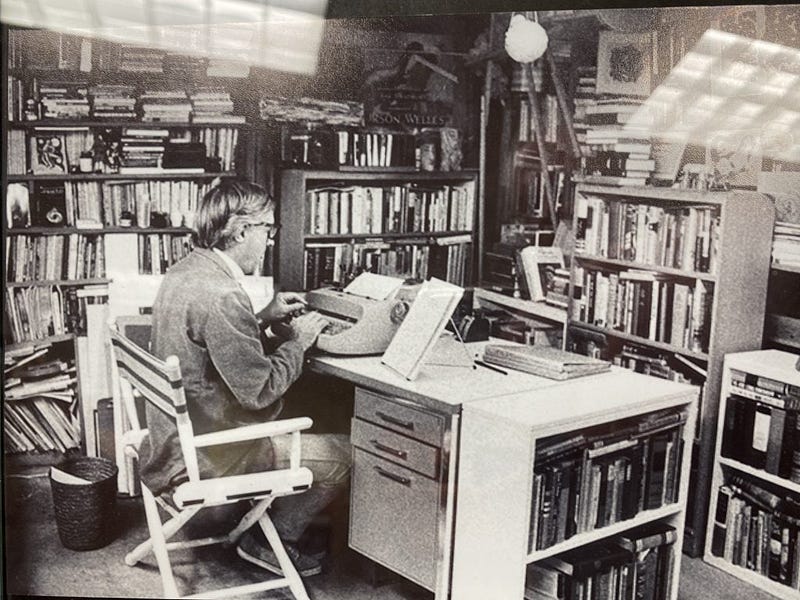
“I can imagine all kinds of worlds and places, but I cannot imagine a world without Bradbury.” — Neil Gaiman
Ray Bradbury (1920–2012) had a remarkable writing career. Author and screenwriter, here is a partial list of his writing projects:
Novels
- 1950 The Martian Chronicles
- 1953 Fahrenheit 451
- 1957 Dandelion Wine
- 1962 Something Wicked This Way Comes
- 1972 The Halloween Tree
- 1985 Death Is a Lonely Business
- 1990 A Graveyard for Lunatics
- 1992 Green Shadows, White Whale
- 2001 From the Dust Returned
- 2003 Let’s All Kill Constance
- 2006 Farewell Summer
Collections
- 1947 Dark Carnival
- 1951 The Illustrated Man
- 1953 The Golden Apples of the Sun
- 1955 The October Country
- 1959 A Medicine for Melancholy
- 1959 The Day It Rained Forever
- 1962 The Small Assassin
- 1964 The Machineries of Joy
- 1965 The Vintage Bradbury
- 1966 Twice 22
- 1969 I Sing The Body Electric!
- 1975 Ray Bradbury
- 1976 Long After Midnight
- 1980 The Last Circus and the Electrocution
- 1980 The Stories of Ray Bradbury
- 1983 Dinosaur Tales
- 1984 A Memory of Murder
- 1988 The Toynbee Convector
- 1990 Classic Stories 1
- 1990 Classic Stories 2
- 1996 Quicker Than The Eye
- 1997 Driving Blind
- 1997 The Golden Apples of the Sun and Other Stories
- 1998 A Medicine For Melancholy And Other Stories
- 1998 I Sing The Body Electric! And Other Stories
- 2002 One More for the Road
- 2003 Bradbury Stories
- 2004 The Cat’s Pajamas: Stories
- 2005 A Sound of Thunder and Other Stories
- 2007 Now and Forever: Somewhere a Band is Playing & Leviathan ’99
- 2007 Summer Morning, Summer Night
- 2009 We’ll Always Have Paris: Stories
- 2010 A Pleasure To Burn
There are a couple of Bradbury quotes I want to include in my book The Protagonist’s Journey: Character Driven Screenwriting and Storytelling:
“Plot is no more than footprints left in the snow after your characters have run by on their way to incredible destinations.”
“Stand aside, forget targets, let the characters, your fingers, body, blood, and heart do.”
You can see why I like those quotes!
Like many Bradbury observations, they float around online without attribution to the original source. Therefore, I recently picked up Zen in the Art of Writing written by Bradbury and am reading through it to see if I can find those two observations on the craft..
As I began with the book, it occurred to me: Why not share Bradbury’s wisdom with Go Into The Story readers? Hence, a new series: Sundays with Ray Bradbury. Today: From Zen in the Art of Writing , “Drunk, and in Charge of a Bicycle,” p. 36.
My stories have you led me through my life. They shout, I follow. They run up and bite me on the leg — I respond by writing down everything that goes on during the bite. When I finish, the idea let's go, and runs off.
That is the kind of life I've had. Drunk, and in charge of a bicycle, as an Irish police report once put it. Drunk with life, that is, and not knowing where off to next. But you're on your way before dawn. And the trip? Exactly one half terror, exactly one half exhilaration.
I take Bradbury’s use of the word drunk to mean intoxicated, so caught up by a story, one is overcome or dominated by strong feelings or emotions. Of course, there is the more obvious meaning, when a person is literally inebriated, but even with that connotation, — is relevant. How a story has such a pull, it can put us — to use a synonym — under the influence. Like the man says, a story can “bite” you on the leg and refuse to let go until you write it. That kind of influence.
When someone asks me what story they should write, choosing between this one or that, after we discuss the commercial merits of the ideas, I always make the point: Write what you’re most passionate about. While true, I think this idea of being drunk with an idea, intoxicated by the possibilities a story offers even in its bare state of being is another angle I will bring into those type of discussions.
Takeaway: The next time a story bites you, write it. The next time you are intoxicated by the potential of a story, write it. If you are fortunate enough to intersect with a story which influences your thinking, day and night…
Write it.
To learn more about Ray Bradbury, check out this website: raybradbury.com.
For previous Sundays with Ray Bradbury articles, go here.
For my article The Poetry of Screenwriting, go here.