Subplots: Part 5
Subplots, Relationships and Character Functions in the movie Up.
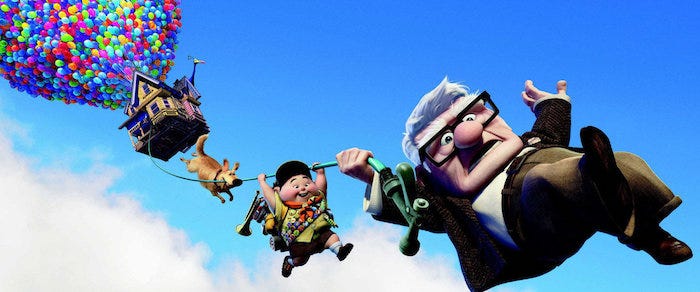
Subplots, Relationships and Character Functions in the movie Up.
In the Prep: From Concept to Outline class I teach, we spend a lot of time talking about and developing subplots. In fact, as part of each writer’s learning experience in the online workshop, I direct them to a set of Go Into The Story posts I’ve written over the years on the subject.
The other day, I read through each of those posts, some of them stretching back to 2008, and it’s interesting to see the evolution in my thinking. Over time, I’ve come to adopt another screenwriting principle:
Subplot = Relationship.
What I propose to do each day this week is re-post my original articles, taking the opportunity to clean them up a bit, and as we go through each one, consider the deeper implications of the above principle.
Today: Subplots, Relationships and Character Functions in the movie Up.
It’s impossible to emphasize enough how important subplots are for… well, I suppose every screenplay. At their most basic level of value, they provide a way for the writer to cut away from the Plotline which is hugely important on many fronts including time management and pace. But their significance is multifaceted.
Here’s how I think of subplots: Relationships. If you want to track down subplots in a screenplay, locate all the primary and even key secondary characters, especially the ones who directly connect with the Protagonist, and you’re almost assuredly looking at a subplot.
Let’s consider the subplots in the Pixar movie Up:
Carl — Ellie
Carl — Russell
Carl — Kevin
Carl — Dug
Carl — Muntz
Carl — Real Estate Developer
Muntz — Kevin
Russell — His Father
Russell — Kevin
Kevin — Her Babies
Dug — Alpha and the Other Dogs
The Plotline: Carl getting the house up to Paradise Falls. All the above relationships represent subplots that tie into and impact the Plotline. For example:
- Carl — Ellie: Carl would not have a Want [Conscious Goal] to get the house to Paradise Falls were it not for his promise to Ellie, and of course the love and affection he has for his late wife, as well as the shadow of guilt about never having fulfilled this shared dream.
- Carl — Real Estate Developer: Carl acts on his goal when the Real Estate Developer manages to get Carl set to move into an old folks home, relinquishing the rights to his house and the valuable land on which it sits.
- Carl — Russell: Once airborne, the surprise appearance of Russell enables Carl to get the house to Paradise Falls [Russell steers the house there while Carl is knocked out], but then the boy’s presence creates disruptions in Carl’s plan.
- Russell — Kevin: The first disruption occurs when Russell finds and befriends Kevin, who then follows the pair until he becomes an ad hoc member of the expedition.
- Carl — Kevin: Kevin creates a secondary goal of getting the bird to her babies.
- Carl — Dug: Dug intersects with Carl, Russell and Kevin because he is searching for the bird, then he joins the traveling troop.
- Doug — Alpha [and the Other Dogs]: Alpha intersects with Carl and company because Dug is with Carl and company.
- Carl — Muntz: Carl intersects with Muntz because of all the previously noted connections.
Note how the subplots in Up create a seamless path from Carl’s home in the city to Carl being chased by Muntz, one group [Carl, Russell, Kevin, Dug] vs. the other [Muntz, Alpha, Other Dogs]. So at one level, that is their character function — to create that narrative path.
But there is much more to the function of characters and their relationships as they help take us from the Plotline into the Themeline and the soul of the story. And that leads us to a fascinating way to view the Plotline and subplots: Look at them through the lens of Character Archetypes.
Here is my take on the character archetypes in Up.
Protagonist — Carl
Nemesis — Muntz, Alpha and the Other Dogs, Real Estate Developer
Attractor — Russell, Ellie
Mentor — Dug
Trickster — Kevin
For a deeper analysis of these archetypes, you can go here to a previous GITS post.
With regard to reading and analyzing a screenplay, the point is this: Another tool at your disposal is to identify and break down the story’s subplots:
- Subplots can be intimately connected to the Plotline.
- Subplots are generally tied to individual characters who have unique relationships with the Protagonist and sometimes with each other.
- Subplots are typically shaped the way they are by virtue of their character’s narrative function.
- Subplots can be explored in terms of primary character archetypes.
- Subplots provide sub-themes that amplify and widen the meaning of the story’s central theme.
In sum, subplots open doorways into the soul of a story, a presence that is intimately connected with a dynamic Joseph Campbell said lies at the center of The Hero’s Journey: Transformation, or as I prefer, Metamorphosis.
For Part 1 in the series on subplots, go here.
For Part 2 in the series on subplots, go here.
For Part 3 in the series on subplots, go here.
For Part 4 in the series on subplots, go here.