Studying Aristotle’s “Poetics” — Parts 20+21: Language and Words
As I’ve been interviewing screenwriters, I typically ask what some of their influences are. One book title comes up over and over again…
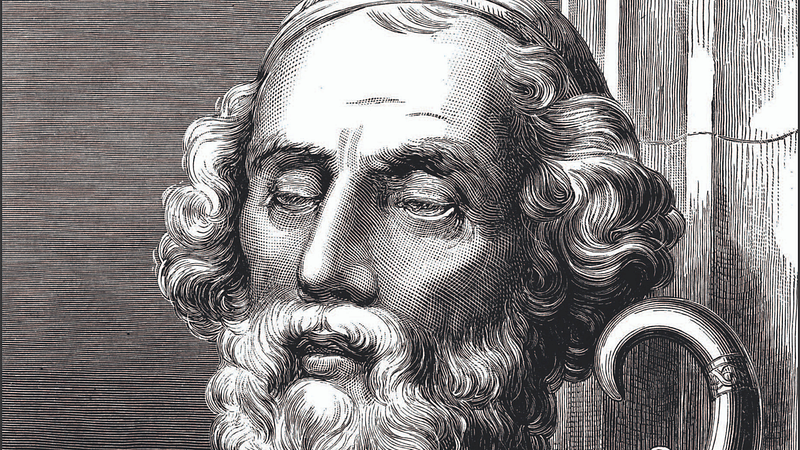
As I’ve been interviewing screenwriters, I typically ask what some of their influences are. One book title comes up over and over again: Aristotle’s “Poetics.” I confess I’ve never read the entire thing, only bits and pieces. So I thought, why not do a daily series to provide a structure to compel me to go through it. That way we’d all benefit from the process.
For background on Aristotle, you can go here to see an article on him in the Stanford Encyclopedia of Philosophy.
To download “Poetics,” you can go here.
Parts 20+21: Language and Words
Part XX
Language in general includes the following parts: Letter, Syllable,
Connecting Word, Noun, Verb, Inflection or Case, Sentence or Phrase.
A Letter is an indivisible sound, yet not every such sound, but only
one which can form part of a group of sounds. For even brutes utter
indivisible sounds, none of which I call a letter. The sound I mean
may be either a vowel, a semivowel, or a mute. A vowel is that which
without impact of tongue or lip has an audible sound. A semivowel
that which with such impact has an audible sound, as S and R. A mute,
that which with such impact has by itself no sound, but joined to
a vowel sound becomes audible, as G and D. These are distinguished
according to the form assumed by the mouth and the place where they
are produced; according as they are aspirated or smooth, long or short;
as they are acute, grave, or of an intermediate tone; which inquiry
belongs in detail to the writers on meter.
A Syllable is a nonsignificant sound, composed of a mute and a vowel:
for GR without A is a syllable, as also with A- GRA. But the investigation
of these differences belongs also to metrical science.
A Connecting Word is a nonsignificant sound, which neither causes
nor hinders the union of many sounds into one significant sound; it
may be placed at either end or in the middle of a sentence. Or, a
nonsignificant sound, which out of several sounds, each of them significant,
is capable of forming one significant sound- as amphi, peri, and the
like. Or, a nonsignificant sound, which marks the beginning, end,
or division of a sentence; such, however, that it cannot correctly
stand by itself at the beginning of a sentence- as men, etoi, de.
A Noun is a composite significant sound, not marking time, of which
no part is in itself significant: for in double or compound words
we do not employ the separate parts as if each were in itself significant.
Thus in Theodorus, ‘god-given,’ the doron or ‘gift’ is not in itself
significant.
A Verb is a composite significant sound, marking time, in which, as
in the noun, no part is in itself significant. For ‘man’ or ‘white’
does not express the idea of ‘when’; but ‘he walks’ or ‘he has walked’
does connote time, present or past.
Inflection belongs both to the noun and verb, and expresses either
the relation ‘of,’ ‘to,’ or the like; or that of number, whether one
or many, as ‘man’ or ‘men’; or the modes or tones in actual delivery,
e.g., a question or a command. ‘Did he go?’ and ‘go’ are verbal inflections
of this kind.
A Sentence or Phrase is a composite significant sound, some at least
of whose parts are in themselves significant; for not every such group
of words consists of verbs and nouns- ‘the definition of man,’ for
example- but it may dispense even with the verb. Still it will always
have some significant part, as ‘in walking,’ or ‘Cleon son of Cleon.’
A sentence or phrase may form a unity in two ways- either as signifying
one thing, or as consisting of several parts linked together. Thus
the Iliad is one by the linking together of parts, the definition
of man by the unity of the thing signified.
Part XXI
Words are of two kinds, simple and double. By simple I mean those
composed of nonsignificant elements, such as ge, ‘earth.’ By double
or compound, those composed either of a significant and nonsignificant
element (though within the whole word no element is significant),
or of elements that are both significant. A word may likewise be triple,
quadruple, or multiple in form, like so many Massilian expressions,
e.g., ‘Hermo-caico-xanthus [who prayed to Father Zeus].’
Every word is either current, or strange, or metaphorical, or ornamental,
or newly-coined, or lengthened, or contracted, or altered.
By a current or proper word I mean one which is in general use among
a people; by a strange word, one which is in use in another country.
Plainly, therefore, the same word may be at once strange and current,
but not in relation to the same people. The word sigynon, ‘lance,’
is to the Cyprians a current term but to us a strange one.
Metaphor is the application of an alien name by transference either
from genus to species, or from species to genus, or from species to
species, or by analogy, that is, proportion. Thus from genus to species,
as: ‘There lies my ship’; for lying at anchor is a species of lying.
From species to genus, as: ‘Verily ten thousand noble deeds hath Odysseus
wrought’; for ten thousand is a species of large number, and is here
used for a large number generally. From species to species, as: ‘With
blade of bronze drew away the life,’ and ‘Cleft the water with the
vessel of unyielding bronze.’ Here arusai, ‘to draw away’ is used
for tamein, ‘to cleave,’ and tamein, again for arusai- each being
a species of taking away. Analogy or proportion is when the second
term is to the first as the fourth to the third. We may then use the
fourth for the second, or the second for the fourth. Sometimes too
we qualify the metaphor by adding the term to which the proper word
is relative. Thus the cup is to Dionysus as the shield to Ares. The
cup may, therefore, be called ‘the shield of Dionysus,’ and the shield
‘the cup of Ares.’ Or, again, as old age is to life, so is evening
to day. Evening may therefore be called, ‘the old age of the day,’
and old age, ‘the evening of life,’ or, in the phrase of Empedocles,
‘life’s setting sun.’ For some of the terms of the proportion there
is at times no word in existence; still the metaphor may be used.
For instance, to scatter seed is called sowing: but the action of
the sun in scattering his rays is nameless. Still this process bears
to the sun the same relation as sowing to the seed. Hence the expression
of the poet ‘sowing the god-created light.’ There is another way in
which this kind of metaphor may be employed. We may apply an alien
term, and then deny of that term one of its proper attributes; as
if we were to call the shield, not ‘the cup of Ares,’ but ‘the wineless
cup’.
A newly-coined word is one which has never been even in local use,
but is adopted by the poet himself. Some such words there appear to
be: as ernyges, ‘sprouters,’ for kerata, ‘horns’; and areter, ‘supplicator’,
for hiereus, ‘priest.’
A word is lengthened when its own vowel is exchanged for a longer
one, or when a syllable is inserted. A word is contracted when some
part of it is removed. Instances of lengthening are: poleos for poleos,
Peleiadeo for Peleidou; of contraction: kri, do, and ops, as in mia
ginetai amphoteron ops, ‘the appearance of both is one.’
An altered word is one in which part of the ordinary form is left
unchanged, and part is recast: as in dexiteron kata mazon, ‘on the
right breast,’ dexiteron is for dexion.
Nouns in themselves are either masculine, feminine, or neuter. Masculine
are such as end in N, R, S, or in some letter compounded with S- these
being two, PS and X. Feminine, such as end in vowels that are always
long, namely E and O, and- of vowels that admit of lengthening- those
in A. Thus the number of letters in which nouns masculine and feminine
end is the same; for PS and X are equivalent to endings in S. No noun
ends in a mute or a vowel short by nature. Three only end in I- meli,
‘honey’; kommi, ‘gum’; peperi, ‘pepper’; five end in U. Neuter nouns
end in these two latter vowels; also in N and S.
I don’t have much to say here other than this: As writers, we are wordsmiths. Words are our tools and as such, we must care about language. Deeply. Aristotle’s in-depth analysis here reminds us of this fact.
As to his dissection of metaphor, I got lost in it twice. However the journey was worth it just to read this: For instance, to scatter seed is called sowing: but the action of the sun in scattering his rays is nameless. Still this process bears to the sun the same relation as sowing to the seed. Hence the expression of the poet ‘sowing the god-created light.’
Just stumbling across the idea of a poet ‘sowing god-created light’ makes me smile. Having become a fan of poetry late in my life, I get this observation, I feel it. A wonderful expression of the power of inspiration words can bring us. Beautiful!
A reminder: I am looking at “Poetics” through the lens of screenwriting, what is its relevance to the craft in contemporary times. And I welcome the observations of any Aristotle experts to set me straight as I’m just trying to work my way through this content the best I can.
See you here tomorrow for another installment of this series, a section that will get us back on track in terms relevance to our task as we delve into word choice and dialogue.
For the entire series, go here.