Studying Aristotle’s “Poetics” — Part 7(B): Beauty, Magnitude and Order
As I’ve been interviewing screenwriters, I typically ask what some of their influences are. One book title comes up over and over again…
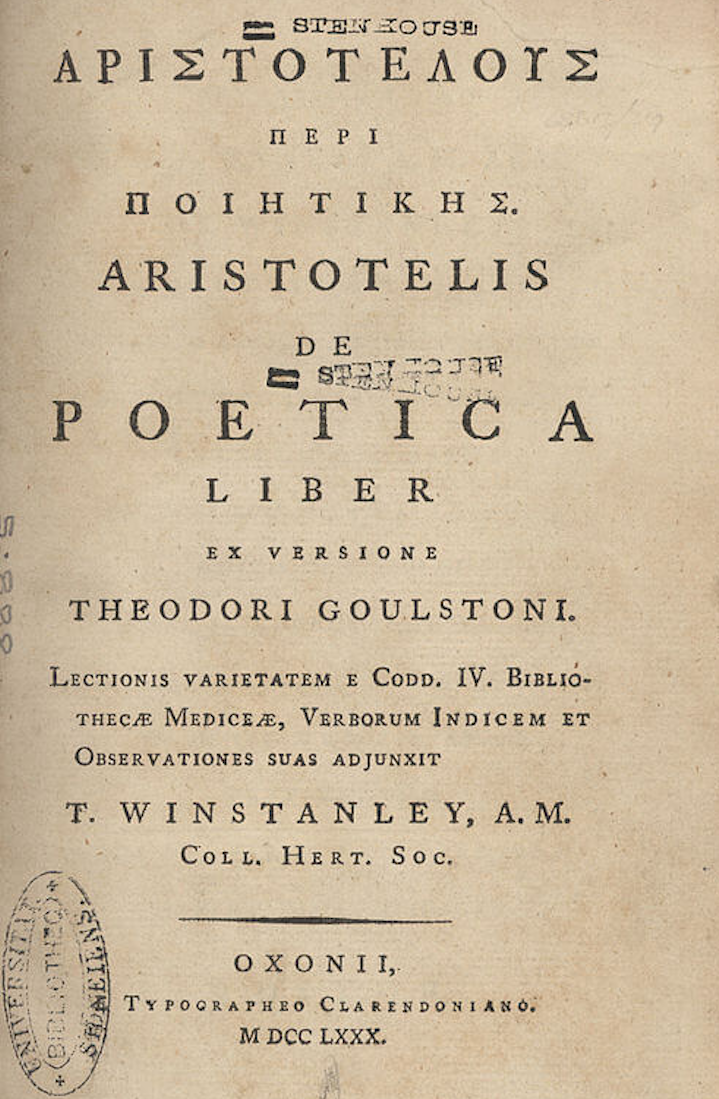
As I’ve been interviewing screenwriters, I typically ask what some of their influences are. One book title comes up over and over again: Aristotle’s “Poetics.” I confess I’ve never read the entire thing, only bits and pieces. So I thought, why not do a daily series to provide a structure to compel me to go through it. That way we’d all benefit from the process.
For background on Aristotle, you can go here to see an article on him in the Stanford Encyclopedia of Philosophy.
To download “Poetics,” you can go here.
Part 7(B): Beauty, Magnitude and Order
Again, a beautiful object, whether it be a living organism or any
whole composed of parts, must not only have an orderly arrangement
of parts, but must also be of a certain magnitude; for beauty depends
on magnitude and order. Hence a very small animal organism cannot
be beautiful; for the view of it is confused, the object being seen
in an almost imperceptible moment of time. Nor, again, can one of
vast size be beautiful; for as the eye cannot take it all in at once,
the unity and sense of the whole is lost for the spectator; as for
instance if there were one a thousand miles long. As, therefore, in
the case of animate bodies and organisms a certain magnitude is necessary,
and a magnitude which may be easily embraced in one view; so in the
plot, a certain length is necessary, and a length which can be easily
embraced by the memory.
For beauty depends on magnitude and order. Three substantive concepts in one short sentence. I trust our Aristotelians will provide more background on each. Here is my quick take from what we’ve read thus far in “Poetics” including this excerpt:
Order: An “orderly arrangements of parts,” such as in a story [as noted last week] Beginning, Middle and End. Presumably not just those three aspects, but a balance between the three parts and the overall appearance or experience of the parts in combination as a coherent whole.
Magnitude: As I read the excerpt above, I was reminded of the Goldilocks fable, how the porridge of the Three Bears was too hot or too cold, their beds too big or too small, the little girl only finding satisfaction with something in the middle. Likewise per Aristotle, an object cannot be beautiful if it is too small — “for the view of it is confused, the object being seen in an almost imperceptible moment of time” — nor too big — “for as the eye cannot take it all in at once, the unity and sense of the whole is lost for the spectator”. It must have sufficient magnitude, a “certain length” at minimum, but one that can be “easily embraced by the memory” so not too large.
Beauty: Dredging into my brain cells housing knowledge implanted there in college, I seem to remember some talk about Aristotle equating Beauty with Truth. However I don’t think he’s using the term in that way here, rather in the context of discussing Tragedy and plays, Beauty is an aesthetic description of a process whereby an artist creates something. And I must say, the use of this concept in relation to writing truly appeals to me. No matter the scope of a creative breakthrough, from a big thing like a key understanding of a character to a small item such as the choice of a perfect descriptive word, I experience Beauty often as I write. Even the balance of black ink and white space on a screenplay page can be Beautiful to the eye. Indeed for all the hardships the creative life involves, the act of writing is fundamentally a beautiful thing, an expression of the Self, making Something from Nothing.
In fact, these three concepts — Beauty, Magnitude, Order — lead me to believe that Aristotle would find a screenplay as a narrative form to be quite pleasing. There is such an emphasis on structure in writing a script, so Order is a priority. The story has to be long enough to allow for a plot to play out and characters to go through their respective transformations, yet not overly long to dilute the power of the narrative, and that implies Magnitude. And like poetry, a screenplay can be a beautiful form to read, at least before it goes into the hands of those involved in the movie’s production.
Indeed if we were to mix up all three concepts, I think we could easily land on a word I mentioned above: Balance. So much of what we do in a screenplay is achieve to find balance — page count, scene length, subplots, dialogue compared to action, act length, exterior and interior scenes, day and night scenes, action and interaction scenes, themes and motifs, and so on.
So these concepts of Beauty, Magnitude and Order would seem to have great applicability for a contemporary screenwriter in plying his/her craft in the creation of a feature length screenplay.
A reminder: I am looking at “Poetics” through the lens of screenwriting, what is its relevance to the craft in contemporary times. And I welcome the observations of any Aristotle experts to set me straight as I’m just trying to work my way through this content the best I can.
See you tomorrow for another installment of this series.
For the entire series, go here.