Studying Aristotle’s “Poetics” — Part 23: Unity of Action
As I’ve been interviewing screenwriters, I typically ask what some of their influences are. One book title comes up over and over again…
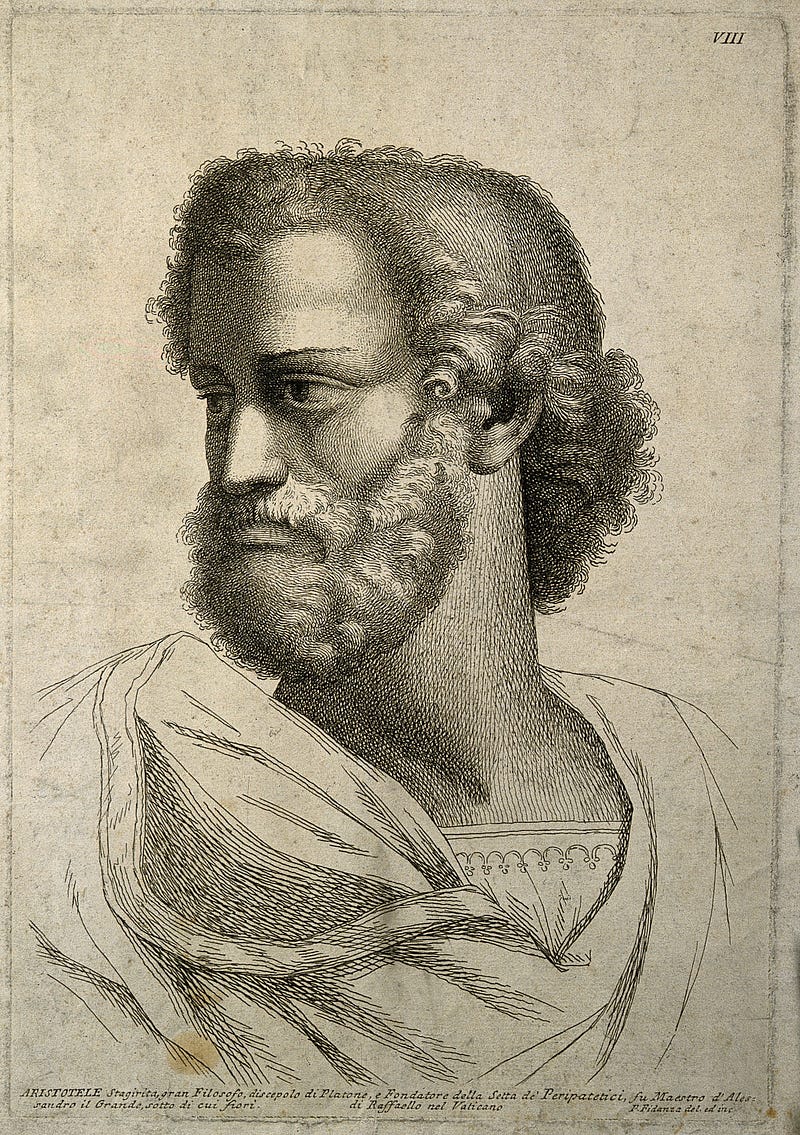
As I’ve been interviewing screenwriters, I typically ask what some of their influences are. One book title comes up over and over again: Aristotle’s “Poetics.” I confess I’ve never read the entire thing, only bits and pieces. So I thought, why not do a daily series to provide a structure to compel me to go through it. That way we’d all benefit from the process.
For background on Aristotle, you can go here to see an article on him in the Stanford Encyclopedia of Philosophy.
To download “Poetics,” you can go here.
Part 23: Unity of Action
As to that poetic imitation which is narrative in form and employs
a single meter, the plot manifestly ought, as in a tragedy, to be
constructed on dramatic principles. It should have for its subject
a single action, whole and complete, with a beginning, a middle, and
an end. It will thus resemble a living organism in all its unity,
and produce the pleasure proper to it. It will differ in structure
from historical compositions, which of necessity present not a single
action, but a single period, and all that happened within that period
to one person or to many, little connected together as the events
may be. For as the sea-fight at Salamis and the battle with the Carthaginians
in Sicily took place at the same time, but did not tend to any one
result, so in the sequence of events, one thing sometimes follows
another, and yet no single result is thereby produced. Such is the
practice, we may say, of most poets. Here again, then, as has been
already observed, the transcendent excellence of Homer is manifest.
He never attempts to make the whole war of Troy the subject of his
poem, though that war had a beginning and an end. It would have been
too vast a theme, and not easily embraced in a single view. If, again,
he had kept it within moderate limits, it must have been over-complicated
by the variety of the incidents. As it is, he detaches a single portion,
and admits as episodes many events from the general story of the war-
such as the Catalogue of the ships and others- thus diversifying the
poem. All other poets take a single hero, a single period, or an action
single indeed, but with a multiplicity of parts. Thus did the author
of the Cypria and of the Little Iliad. For this reason the Iliad and
the Odyssey each furnish the subject of one tragedy, or, at most,
of two; while the Cypria supplies materials for many, and the Little
Iliad for eight- the Award of the Arms, the Philoctetes, the Neoptolemus,
the Eurypylus, the Mendicant Odysseus, the Laconian Women, the Fall
of Ilium, the Departure of the Fleet.
This chapter is worth the price of admission… which is why I italicized and bolded the critical text. I suppose if there is only one thing you’ve ever heard associated with “Poetics,” it would be this idea: Unity of Action. Some observations:
- It seems like Aristotle perceives that a “poetic imitation which is narrative in form” (i.e., epic poem) and a “tragedy” pretty much share the same “dramatic principles” with regard to plot.
- The idea of a plot being “whole and complete” infers that it has “a beginning, a middle, and an end.” Aristotle has previously dealt with this subject here: Part 7(A): Beginning, Middle, End. This makes total sense with any traditional form of narrative, even if the plot is inverted, told in a nonlinear fashion, or jumbled up: As long as there are scenes which constitute a Beginning, a Middle and an End, the plot will have the necessary elements to be whole and complete.
- By focusing the story on a “single action,” the writer puts him/herself on the path to create a narrative that has a sense of “unity”. Again this makes complete sense because that single action becomes a touchstone for all aspects of the narrative — plot, characters, themes, dialogue, scenes, transition. Hence the power of unity of action.
- This idea of how it “will thus resemble a living organism” really appeals to me. I tell my students all the time — and hammer this on the blog as well — a story is an organic entity. Due to the very presence of characters, who live and breathe within the context of their own story universe, there is a innate dynamism to the narrative elements that emerge. Indeed, this lies at the heart of what I teach about Character Based Screenwriting, that by tapping into who a story’s characters are — their Core Essence, respective narrative functions as represented by the five primary character archetypes (Protagonist, Nemesis, Attractor, Mentor, Trickster), backstory — the plot will naturally emerge from that process. Taking this approach is the very antithesis of using formulas and as a result formulaic writing.
- Also this concept that a well-crafted narrative which has a unity of action appeals to me. For it is a pleasurable experience to type THE END, then read a story we have written and see the unity of action at work throughout, each scene flowing organically into each other.
Finally, the distinction Aristotle draws between an epic poem or tragedy and an “historical composition” is reflected in some screenwriters and their approach to what are typically known as “biopics,” movies that tell the story of a specific real-life individual from the past. Whereas we used to have these enormous sweeping sagas such as Lawrence of Arabia or Gandhi, nowadays there is something known as a Snapshot Bio. The idea is to take a specific event or period of time in an individual’s life and use that not only to construct a contained story, but also use that narrative as a lens through which to interpret and assess the character’s life. We saw this in the movie Lincoln which focused on the President’s attempt to get the 13th Constitutional amendment ratified, abolishing slavery. We will see another example when the movie Grace of Monaco comes out as it uses a compressed period of time around a single event to tell the story of Princess Grace and former actress Grace Kelly.
There is a saying in Hollywood: “Never let the facts get in the way of the story.” In a way what Aristotle is saying here supports that approach, although I doubt he would have felt entirely at ease with the sentiment of this statement. But the reality is in adapting a real life event or set of events into a story that can work as a movie, the writer must be willing to find the emotional truth and adhere to that over the literal historical truth as represented by a litany of one occurrence after another.
A reminder: I am looking at “Poetics” through the lens of screenwriting, what is its relevance to the craft in contemporary times. And I welcome the observations of any Aristotle experts to set me straight as I’m just trying to work my way through this content the best I can.
I invite each of you, especially our wonderful group of Aristotelians, to join me in comments to continue our discussion.
See you here tomorrow for another installment of this series.
For the entire series, go here.