Studying Aristotle’s “Poetics” — Part 2: Moral Character, Types, Tragedy and Comedy
As I’ve been interviewing screenwriters, I typically ask what some of their influences are. One book title comes up over and over again…
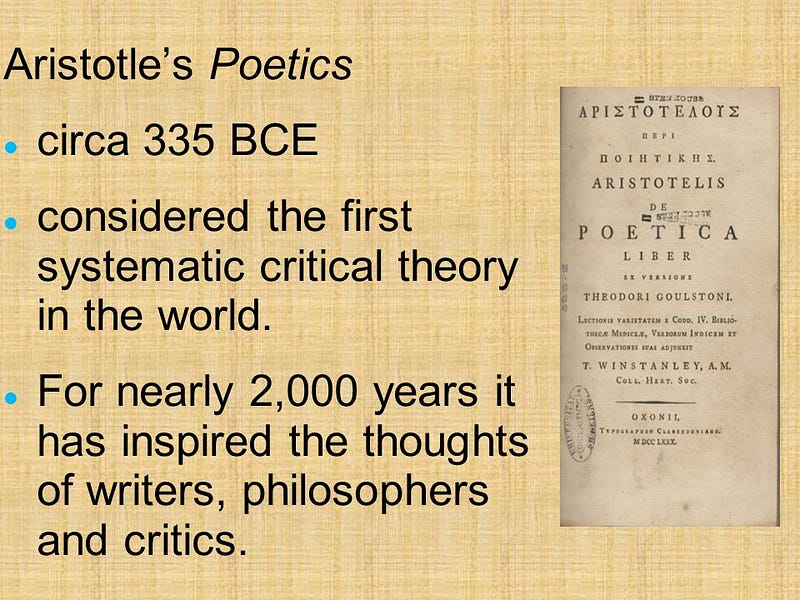
As I’ve been interviewing screenwriters, I typically ask what some of their influences are. One book title comes up over and over again: Aristotle’s “Poetics.” I confess I’ve never read the entire thing, only bits and pieces. So I thought, why not do a daily series to provide a structure to compel me to go through it. That way we’d all benefit from the process.
For background on Aristotle, you can go here to see an article on him in the Stanford Encyclopedia of Philosophy.
To download “Poetics,” you can go here.
Part 2: Moral Character, Types, Tragedy and Comedy
Since the objects of imitation are men in action, and these men must
be either of a higher or a lower type (for moral character mainly
answers to these divisions, goodness and badness being the distinguishing
marks of moral differences), it follows that we must represent men
either as better than in real life, or as worse, or as they are. It
is the same in painting. Polygnotus depicted men as nobler than they
are, Pauson as less noble, Dionysius drew them true to life.
Now it is evident that each of the modes of imitation above mentioned
will exhibit these differences, and become a distinct kind in imitating
objects that are thus distinct. Such diversities may be found even
in dancing, flute-playing, and lyre-playing. So again in language,
whether prose or verse unaccompanied by music. Homer, for example,
makes men better than they are; Cleophon as they are; Hegemon the
Thasian, the inventor of parodies, and Nicochares, the author of the
Deiliad, worse than they are. The same thing holds good of Dithyrambs
and Nomes; here too one may portray different types, as Timotheus
and Philoxenus differed in representing their Cyclopes. The same distinction
marks off Tragedy from Comedy; for Comedy aims at representing men
as worse, Tragedy as better than in actual life.
There is a lot going on here. Looking at these observations from the perspective of a screenwriter, let me take a whack at parsing some of the key concepts:
— Moral Character: “…for moral character mainly answers to these divisions, goodness and badness being the distinguishing marks of moral differences.” What this appears to acknowledge is what screenwriters know as Good Guys and Bad Guys, and there are massive implications as a result, most notably an interface of “goodness” and “badness” as represented by characters that results in conflict.
— Types: “Since the objects of imitation are men in action, and these men must be either of a higher or a lower type… it follows that we must represent men either as better than in real life, or as worse, or as they are.” This is another key assertion because this opens the door to character types. Goodness as represented by Mentors and Attractors. Badness as represented by Nemeses. As they are represented by Protagonists starting a journey which pulls at them to go one way or the other.
— Tragedy and Comedy: “The same distinction marks off Tragedy from Comedy; for Comedy aims at representing men as worse, Tragedy as better than in actual life.” This seems counterintuitive. Wouldn’t Tragedy be about a character ending up in a worse state and Comedy about a character ending up in a better state? But my guess what Aristotle is referring to here is the Tragic Hero who suffers in part as a result of his/her moral rectitude, while the Comic Character is one crafted for purposes of ridicule, their “bad” behavior to be derided and laughed at.
From a screenwriting perspective [or writing in general], the subtext here is that characters have an arc: They ascend or descend on a scale of “goodness” or “badness.” This suggests the dynamic of metamorphosis as essential to story.
Also stories have a “mood,” two key pillars tragedy or comedy. Here we see the very roots of what we know as genre.
Finally, I take this construct as a major validation of working with character archetypes. It’s great that Joseph Campbell used them, inspired in large part by his studies of Carl Jung who emphatically embraced them. But some two thousand years previous, Aristotle was already laying the groundwork of writers working with types as a way of understanding and crafting stories.
What do you see in this part of Aristotle’s “Poetics”? Please post your thoughts in comments.
See you here next time for another installment of this series.
For the entire series, go here.