Studying Aristotle’s “Poetics” — Part 18(C): Multiplicity of Plots
As I’ve been interviewing screenwriters, I typically ask what some of their influences are. One book title comes up over and over again…
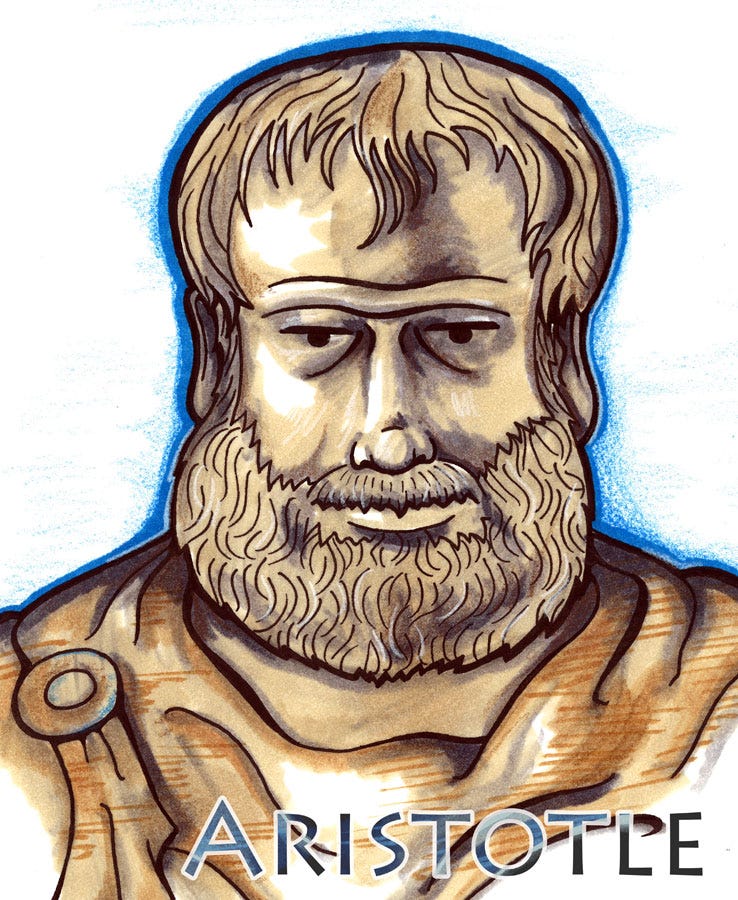
As I’ve been interviewing screenwriters, I typically ask what some of their influences are. One book title comes up over and over again: Aristotle’s “Poetics.” I confess I’ve never read the entire thing, only bits and pieces. So I thought, why not do a daily series to provide a structure to compel me to go through it. That way we’d all benefit from the process.
For background on Aristotle, you can go here to see an article on him in the Stanford Encyclopedia of Philosophy.
To download “Poetics,” you can go here.
Part 18(C): Multiplicity of Plots
Again, the poet should remember what has been often said, and not
make an Epic structure into a tragedy- by an Epic structure I mean
one with a multiplicity of plots- as if, for instance, you were to
make a tragedy out of the entire story of the Iliad. In the Epic poem,
owing to its length, each part assumes its proper magnitude. In the
drama the result is far from answering to the poet’s expectation.
The proof is that the poets who have dramatized the whole story of
the Fall of Troy, instead of selecting portions, like Euripides; or
who have taken the whole tale of Niobe, and not a part of her story,
like Aeschylus, either fail utterly or meet with poor success on the
stage. Even Agathon has been known to fail from this one defect. In
his Reversals of the Situation, however, he shows a marvelous skill
in the effort to hit the popular taste- to produce a tragic effect
that satisfies the moral sense. This effect is produced when the clever
rogue, like Sisyphus, is outwitted, or the brave villain defeated.
Such an event is probable in Agathon’s sense of the word: ‘is probable,’
he says, ‘that many things should happen contrary to probability.’
These observations drive me back to Aristotle’s notion of “unity of action,” how a play should have one main action. Once again, it makes me feel like Aristotle would have bonded with the narrative form of a screenplay because a vast majority of mainstream commercial Hollywood movies are of this paradigm: Single Protagonist, positive transformation.
True, there are movies like Babel, Crash, and Traffic, known as hyperlink cinema, what I call ‘multilinear’ storytelling, however they are in a tiny minority. It is much easier to write — and for an audience to access and comprehend — a single Protagonist story which is one major reason why they are so prevalent.
This phenomenon extends to the traditional biopic, akin to what Aristotle cites as an example: “the entire story of Illiad.” How to tell a person’s life story? So many threads that suggest multiple subplots. Nowadays writers have increasingly chosen not to try to cover the entirety of a real person’s life, but rather spotlight a specific ‘chapter’ in their existence and use that as the basis of a story, a lens through which to interpret the character. I discussed this with screenwriter Arash Amel in our interview about his movie Grace of Monaco:
And the idea of taking a very limited period of somebody’s life — a snapshot — and also a female character, something that I hadn’t actually explored before, was really interesting to me. There’s a long story behind why Princess Grace — but to cut it short, she was the first media princess before the concept had been invented and the last true fairytale princess, to a whole generation she was an icon and totally forgotten and such a great tragic story never really told.
Increasingly, we see these snapshot biographies and that reflects the sentiments of Aristotle’s main point in this section of “Poetics”.
This is not to suggest we should free constrained from pursuing a multilinear story if that’s what emerges in our creative process. However this is a harder path to tread, a sentiment with which both Aristotle and today’s studio executives would agree.
A reminder: I am looking at “Poetics” through the lens of screenwriting, what is its relevance to the craft in contemporary times. And I welcome the observations of any Aristotle experts to set me straight as I’m just trying to work my way through this content the best I can.
See you here tomorrow for another installment of this series.
For the entire series, go here.