Studying Aristotle’s “Poetics” — Part 18(A): Complication and Denouement
As I’ve been interviewing screenwriters, I typically ask what some of their influences are. One book title comes up over and over again…
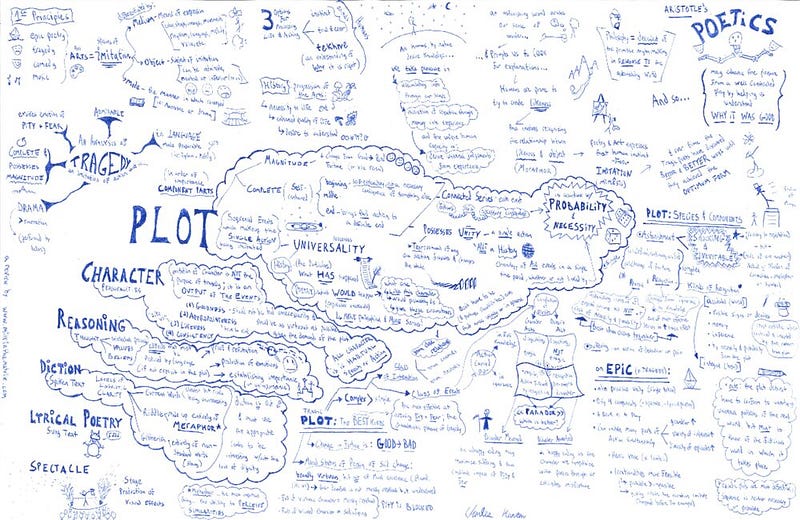
As I’ve been interviewing screenwriters, I typically ask what some of their influences are. One book title comes up over and over again: Aristotle’s “Poetics”. I confess I’ve never read the entire thing, only bits and pieces. So I thought, why not do a weekly series with a post each Sunday to provide a structure to compel me to go through it. That way we’d all benefit from the process.
For background on Aristotle, you can go here to see an article on him in the Stanford Encyclopedia of Philosophy.
To download “Poetics,” you can go here.
Note: The version linked above is incomplete for XVIII, so I copied the text from here.
Part 18(A): Complication and Denouement
There is a further point to be borne in mind. Every tragedy is in part Complication and in part Denouement; the incidents before the opening scene, and often certain also of those within the play, forming the Complication; and the rest the Denouement. By Complication I mean all from the beginning of the story to the point just before the change in the hero’s fortunes; by Denouement, all from the beginning of the change to the end. In the Lynceus of Theodectes, for instance, the Complication includes, together with the presupposed incidents, the seizure of the child and that in turn of the parents; and the Denouement all from the indictment for the murder to the end. Now it is right, when one speaks of a tragedy as the same or not the same as another, to do so on the ground before all else of their Plot, i.e. as having the same or not the same Complication and Denouement. Yet there are many dramatists who, after a good Complication, fail in the Denouement. But it is necessary for both points of construction to be always duly mastered.
Having once mispronounced denouement in a meeting with a studio exec, the term is pretty much seared into my consciousness at this point, having consulted several dictionaries to gain more precision in my understanding of the word’s meaning… and how to say it [day — new — mah].
From the French, its literal meaning is “untying.” So we may think of Complication, as used here by Aristotle, to signify “tying,” as in the various strands of a rope, and the Denouement then the untying of those strands, so that by the end of the story, the knot (the core of the Complication) is undone and the narrative resolved.
I’m also able to amortize some of the cost of my college education as I remember having studied this part of “Poetics” wherein we learned the concepts of rising action and falling action, the former related to Complication, the latter to Denouement.
Going one level deeper into my brain cells, I seem to recall that rising action related primarily to the circumstances surrounding the Protagonist while falling action occurred after a reversal, thus the narrative flow turned against the Antagonist.
As to whether Aristotle’s writings support this perspective specifically or even generally, I leave that to our moveable feast of Aristotelians. I’m just reporting directly from the mush which lies within my cranium.
Speaking from the perspective of contemporary screenwriting, Denouement has come to take on a somewhat different function, if not meaning, representing that scene or scenes which occur after the Final Struggle and Resolution. As was explained to me by a veteran screenwriter once [paraphrased]: “After the climax of the story, you wanna give the audience a glimpse of what it all means to the hero. To the victor goes the spoils. The denouement is seeing the spoils.”
A good example of this is the 1983 comedy Trading Places. Check out this video from about the 1:00 minute mark where Dan Aykroyd explains how his character (Louis) along with Eddie Murphy’s (Billy Ray) outwitted the Duke brothers (Final Struggle/Resolution), then the Denouement featured at the 1:59 mark on: “Looking good, Billy Ray” / “Feeling good, Louis” — champagne, pretty girls, desert isle and all. Spoils, indeed!
So two basic screenwriting takeaways from this first part of Part XVIII:
- Typically, a story builds tension, then ultimately resolves it.
- The resolution of the story — the untying of the knot — is every bit as important as the setup and development of the story — the tying of the knot. “But it is necessary for both points of construction to be always duly mastered.”
A reminder: I am looking at “Poetics” through the lens of screenwriting, what is its relevance to the craft in contemporary times. And I welcome the observations of any Aristotle experts to set me straight as I’m just trying to work my way through this content the best I can.
How about you? What do you take from Part 18(A) of Aristotle’s “Poetics”?
See you here next Sunday for another installment of this series.
For the entire series, go here.