Studying Aristotle’s “Poetics” — Part 11: Reversal, Recognition and Suffering
As I’ve been interviewing screenwriters, I typically ask what some of their influences are. One book title comes up over and over again…
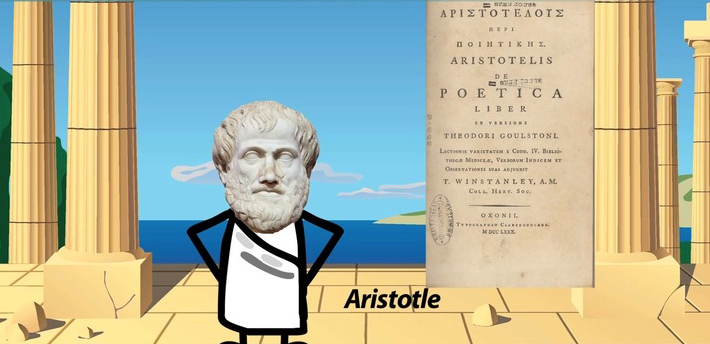
As I’ve been interviewing screenwriters, I typically ask what some of their influences are. One book title comes up over and over again: Aristotle’s “Poetics.” I confess I’ve never read the entire thing, only bits and pieces. So I thought, why not do a daily series to provide a structure to compel me to go through it. That way we’d all benefit from the process.
For background on Aristotle, you can go here to see an article on him in the Stanford Encyclopedia of Philosophy.
To download “Poetics,” you can go here.
Part 11: Reversal, Recognition and Suffering
Reversal of the Situation is a change by which the action veers round
to its opposite, subject always to our rule of probability or necessity.
Thus in the Oedipus, the messenger comes to cheer Oedipus and free
him from his alarms about his mother, but by revealing who he is,
he produces the opposite effect. Again in the Lynceus, Lynceus is
being led away to his death, and Danaus goes with him, meaning to
slay him; but the outcome of the preceding incidents is that Danaus
is killed and Lynceus saved.
Recognition, as the name indicates, is a change from ignorance to
knowledge, producing love or hate between the persons destined by
the poet for good or bad fortune. The best form of recognition is
coincident with a Reversal of the Situation, as in the Oedipus. There
are indeed other forms. Even inanimate things of the most trivial
kind may in a sense be objects of recognition. Again, we may recognize
or discover whether a person has done a thing or not. But the recognition
which is most intimately connected with the plot and action is, as
we have said, the recognition of persons. This recognition, combined
with Reversal, will produce either pity or fear; and actions producing
these effects are those which, by our definition, Tragedy represents.
Moreover, it is upon such situations that the issues of good or bad
fortune will depend. Recognition, then, being between persons, it
may happen that one person only is recognized by the other- when the
latter is already known- or it may be necessary that the recognition
should be on both sides. Thus Iphigenia is revealed to Orestes by
the sending of the letter; but another act of recognition is required
to make Orestes known to Iphigenia.
Two parts, then, of the Plot- Reversal of the Situation and Recognition-
turn upon surprises. A third part is the Scene of Suffering. The Scene
of Suffering is a destructive or painful action, such as death on
the stage, bodily agony, wounds, and the like.
From my reading of this, it appears that Reversal (Peripeteia) and Recognition (Anagnorisis) are linked in at least two ways:
- Both “turn upon surprises.” A Reversal is “a change by which the action veers round to its opposite.” The unanticipated nature of this change would by definition translate into a surprising development. Meanwhile Recognition is “a change from ignorance to knowledge” which in its “best form” is “coincident with a Reversal of the Situation,” and therefore also a surprising turn.
- Whereas Reversal appears to be something that transpires in the External World, the realm of events and happenings, Recognition would seem to be situated primarily in the Internal World, the realm of characters and their inner lives (i.e., feelings, thoughts, impressions). Yet they would seem to be linked as Recognition follows from Reversal. Even in the examples Aristotle notes, there is event that happens in the External World (a character appears), followed by another character’s response (Recognition).
As I was reading this, what I thought was a good example of these two dynamics in tandem came to mind: The conversion experience of Paul as described in the Acts of the Apostles 9:-3–9:
As he [Paul] neared Damascus on his journey, suddenly a light from heaven flashed around him. He fell to the ground and heard a voice say to him, “Saul, Saul, why do you persecute me?”
“Who are you, Lord?” Saul asked.
“I am Jesus, whom you are persecuting,” he replied. “Now get up and go into the city, and you will be told what you must do.”
The men traveling with Saul stood there speechless; they heard the sound but did not see anyone. Saul got up from the ground, but when he opened his eyes he could see nothing. So they led him by the hand into Damascus. For three days he was blind, and did not eat or drink anything.
Two things. First, we have to note that up to this point in his life, Paul [known as Saul], actively persecuted those who professed faith in Jesus as the Christ. After this conversion experience, Paul became an advocate for the faith, even coming to be known as one of the Apostles. Second, his conversion is what precipitated him changing his name from Saul to Paul, signifying a distinction between his new life from his old life. Paul veering around to his “opposite” way of being and believing exemplifies, I think, Reversal and Recognition.
As to the third part — the “Scene of Suffering” (Pathos) — I’m a bit in the gray on this. Is Aristotle suggesting there is some sort of inherent causality within a tragedy that requires this turn at the end of a story? Or is this an awareness the writer brings to the story-crafting process whereby s/he will steer the plot, granting that this turn has to be both probable and necessary?
In screenwriting, whether a story has a happy ending or a tragic one, what transpires during the climax of the narrative resolves stakes at work in the External World of the plot and stakes present in Internal World of the characters’ emotional and psychological experiences, but also what screenwriter Michael Arndt suggests is a third arena: philosophical stakes. Combining all three in a holistic, interconnected manner can translate into catharsis, which suffuses a story’s conclusion with meaning on multiple levels, what Arndt typifies as an “insanely great ending.”
I realize this is not Suffering per se, but the idea of catharsis during the story’s Final Struggle does seem to derive from the interplay of Reversal and Recognition.
Hopefully, our wonderful band of Aristotelians will enlighten us about all three dynamics discussed in Part 11, especially how Suffering is tied to the other two.
A reminder: I am looking at “Poetics” through the lens of screenwriting, what is its relevance to the craft in contemporary times. And I welcome the observations of any Aristotle experts to set me straight as I’m just trying to work my way through this content the best I can.
See you tomorrow for another installment of this series.
For the entire series, go here.