Studies in Voice-Over Narration: “Double Indemnity”
Part 2 of a five-part series on movies where voice-over narration works.
Part 2 of a five-part series on movies where voice-over narration works.
I set this discussion into motion here and here. To wit: Hollywood conventional wisdom is that voice-over narration and flashbacks are a no-no, yet some of the greatest movies ever produced use these narrative devices including Fight Club, Goodfellas, The Silence of the Lambs, and Rashomon.
My conclusion: Voice-over narration and flashbacks are not inherently bad, rather they are tainted by how poorly they get executed by inexperienced writers.
Goal: Find five movies in which each is used well, then analyze those movies to come up with — hopefully — guidelines on how best to handle this pair of narrative devices.
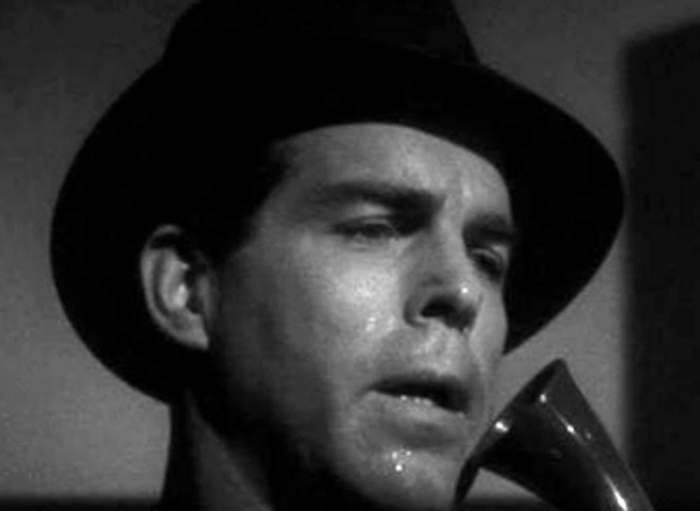
Today the second of five movies using voice-over narration: Double Indemnity, the classic 1944 film noir movie written by Raymond Chandler and Billy Wilder, adapting a novella by James M. Cain. The script sets up the voice-over narration through a physical device: A wounded Walter Neff [Fred MacMurray] staggers into his office and records a confession of his crimes on a dictaphone:
Here is the first example in the script:
He interrupts the dictation, lays down the horn on the desk.
He takes his lighted cigarette from the ash tray, puffs it
two or three times, and kills it. He picks up the horn again.
NEFF
(His voice is now
quiet and contained)
It began last May. About the end of
May, it was. I had to run out to
Glendale to deliver a policy on some
dairy trucks. On the way back I
remembered this auto renewal on Los
Feliz. So I decided to run over there.
It was one of those Calif. Spanish
houses everyone was nuts about 10 or
15 years ago. This one must have
cost somebody about 30,000 bucks —
that is, if he ever finished paying
for it.
As he goes on speaking, SLOW DISSOLVE TO:
A-12 DIETRICHSON HOME — LOS FELIZ DISTRICT
Palm trees line the street, middle-class houses, mostly in
Spanish style. Some kids throwing a baseball back and forth
across a couple of front lawns. An ice cream wagon dawdles
along the block. Neff’s coupe meets and passes the ice cream
wagon and stops before one of the Spanish houses. Neff gets
out. He carries a briefcase, his hat is a little on the back
of his head. His movements are easy and full of ginger. He
inspects the house, checks the number, goes up on the front
porch and rings the bell.
NEFF’S VOICE
It was mid-afternoon, and it’s funny,
I can still remember the smell of
honeysuckle all along that block. I
felt like a million. There was no
way in all this world I could have
known that murder sometimes can smell
like honeysuckle…
Neff’s Voice is how they refer to it. The script returns to Neff’s narration frequently. For example, here is what is going on in Neff’s internal world after he first meets Phyllis Dietrichson [Barbara Stanwyck] wearing nothing but a towel:
NEFF’S VOICE
The living room was still stuffy
from last night’s cigars. The windows
were closed and the sunshine coming
in through the Venetian blinds showed
up the dust in the air. The furniture
was kind of corny and old-fashioned,
but it had a comfortable look, as if
people really sat in it. On the piano,
in couple of fancy frames, were Mr.
Dietrichson and Lola, his daughter
by his first wife They had a bowl of
those little red goldfish on the
table behind the davenport, but, to
tell you the truth, Keyes, I wasn’t
a whole lot interested in goldfish
right then, nor in auto renewals,
nor in Mr. Dietrichson and his
daughter Lola. I was thinking about
that dame upstairs, and the way she
had looked at me, and I wanted to
see her again, close, without that
silly staircase between us.
Then after Neff, now fully smitten by Phyllis, realizes she wants to have her husband killed:
NEFF’S VOICE
(Continuing)
It had begun to rain outside and I
watched it get dark and didn’t even
turn on the light. That didn’t help
me either. I was all twisted up
inside, and I was still holding on
to that red-hot poker. And right
then it came over me that I hadn’t
walked out on anything at all, that
the hook was too strong, that this
wasn’t the end between her and me.
It was only the beginning.
The doorbell rings.
NEFF’S VOICE
(Continuing)
So at eight o’clock the bell would
ring and I would know who it was
without even having to think, as if
it was the most natural thing in the
world.
By virtue of the voice-over narration — remember, it’s Neff’s confession — we can track his slide down the slippery slope straight into Phyllis’ arms.
Here is a quote from author James Ellroy from a documentary about Double Indemnity who makes this important point:
“The first person, narrated movie rests on one dynamic: It is the story of the person reciting the one great event of their life, the one big adventure of their life. In Walter Neff’s case, it’s the story of his dissolution and doom. And it’s very powerful.”
Could Double Indemnity have been produced without voice-over narration? Possibly. But would we be able to delve as deeply into the inner contours of the Protagonist’s descent? I doubt it.
In comparing The Shawshank Redemption and Double Indemnity, we see Red and Neff, a pair of men on different paths, one toward hope and salvation, the other toward “dissolution and doom.” Through the use of voice-over narration, we experience both in a more deeply personal way than we could have without the device.
So perhaps another guideline for using voice-over narration: If by using it, we get the most informative and entertaining version of the “one big adventure of their life,” then we can consider the possibility. But as always, the story needs to tell us this is the way it needs to be told.
For the entire 5-part series, go here.