Studies in Flashback: “Ordinary People”
Part 5 of a five-part series on movies where flashbacks work.
Part 5 of a five-part series on movies where flashbacks work.
I set this discussion into motion here and here. To wit: Hollywood conventional wisdom is that voice-over narration and flashbacks are a no-no, yet some of the greatest movies ever produced use these narrative devices including Fight Club, Goodfellas, The Silence of the Lambs, and Rashomon.
My conclusion: Voice-over narration and flashbacks are not inherently bad, rather they are tainted by how poorly they get executed by inexperienced writers.
Goal: Find five movies in which each is used well, then analyze those movies to come up with — hopefully — guidelines on how best to handle this pair of narrative devices.
Today, the fifth of five movies that use flashbacks: Ordinary People, screenplay by Alvin Sargent, novel by Judith Guest.
Here is a summary of the movie:
The accidental death of the older son of an affluent family deeply strains the relationships among the bitter mother, the good-natured father, and the guilt-ridden younger son.
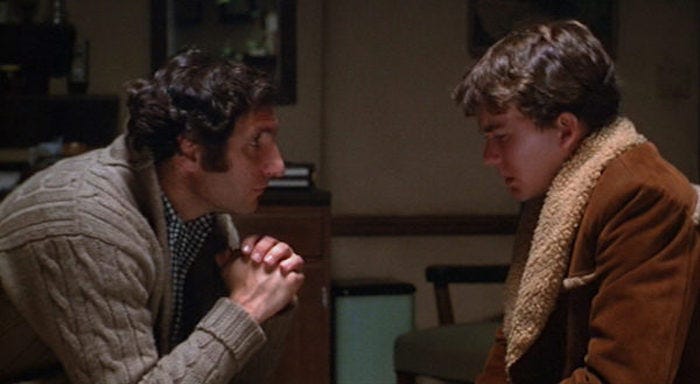
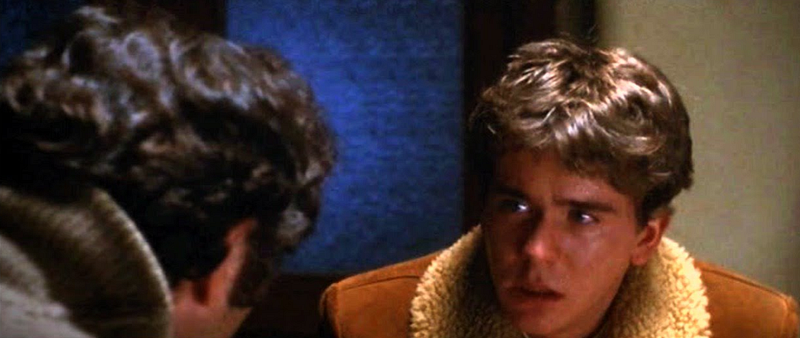
That “guilt-ridden younger son” is Conrad [Timothy Hutton] and he suffers from severe survivor’s guilt from his brother’s drowning. In this dramatic scene with his therapist Dr. Berger [Judd Hirsch], Conrad has a breakthrough about what transpired that fateful day on the lake:
This is a case of show it, don’t say it, as the catharsis Conrad experiences is that much more powerful, both to him and to us, by ‘seeing’ what he remembers of his brother’s drowning.
It’s reminiscent of the catharsis Clarice Starling experiences in The Silence of the Lambs where she recalls the frightful memories of the spring slaughter of the lambs on her uncle’s Montana farm. Interestingly they chose not to shoot that flashback. In this interview, screenwriter Ted Tally explains why:
I could see that if we were going to have flashbacks, they should culminate, there should be some climactic thing, and we should see the child Clarice encountering the slaughter of the lambs and trying to save one of them. Jonathan was willing to shoot them, it was going to be the last thing we shot as we had to wait for the lambing season in spring, and it was going to cost a million dollars to set up the whole thing. Then Jonathan shot the scene where Clarice tells Lecter about the killing of the lambs. He sent the dailies to me and said to watch them and give him a call. So I watched these performances, and they were extraordinarily powerful, and Jonathan, said, “How can I cut away from these performances to a flashback? It’s all there: she’s [Jodi as Clarice] telling us the entire story in her face, in her words, we don’t need to see it as well.” He said it’s just primary rule of filmmaking that if you can show it instead of telling it, you show it, but don’t show it and tell it. He was right, but it was scary to me.”
Whenever you think about using flashbacks, you stand at a fork-in-the-road. You can use them. Sometimes they work really well. But as I’ve said all along, you have to be sure they are the best and only way to tell that story.