Story Types: Disaster
In Hollywood movie circles, there are genres like Horror or Science Fiction, cross genres like Action-Thriller or Drama-Comedy, and…
In Hollywood movie circles, there are genres like Horror or Science Fiction, cross genres like Action-Thriller or Drama-Comedy, and sub-genres like Romantic Comedy or Mystery Thriller.
Then there are story types, a shorthand way to describe a specific narrative conceit that is almost always tied directly to the movie’s central concept. They can be found in any genre, cross genre, or sub-genre.
Knowledge about and awareness of these story types can be a boost not only to your understanding of film history and movie trends, but also as fodder for brainstorming new story concepts. Mix and match them. Invert them. Gender bend them. Genre bend them. Geo bend them.
Story types exist for a reason: Because they work. Hopefully this series will help you make them work for you.
Today: Disaster.
Wikipedia provides this helpful description:
A disaster film is a film genre that has an impending or ongoing disaster (such as a damaged airliner, fire, shipwreck, an asteroid collision or natural calamities) as its subject. Along with showing the spectacular disaster, these films concentrate on the chaotic events surrounding the disaster, including efforts for survival, the effects upon individuals and families, and ‘what-if’ scenarios. These films typically feature large casts of well-known actors and multiple plotlines, focusing on the characters’ attempts to avert, escape or cope with the disaster and its aftermath.
Some examples of disaster movies:
Noah’s Ark (1928): The Biblical story of Noah and the Great Flood, with a parallel story of soldiers in the First World War.
The Last Day’s of Pompeii (1935): In the doomed Roman city, a gentle blacksmith becomes a corrupt gladiator, while his son leans toward Christianity.
The War of the Worlds (1953): The film adaptation of the H.G.Wells story told on radio of the invasion of Earth by Martians.
The Poseidon Adventure (1972): A group of passengers struggle to survive and escape, when their ocean liner completely capsizes at sea.
The Towering Inferno (1974): At the opening party of a collossal, but poorly constructed, office building, a massive fire breaks out that threatens to destroy the tower and everyone in it.
Independence Day (1996): The aliens are coming and their goal is to invade and destroy. Fighting superior technology, Man’s best weapon is the will to survive.
Armageddon (1998): When an asteroid the size of Texas is headed for Earth the world’s best deep core drilling team is sent to nuke the rock from the inside.
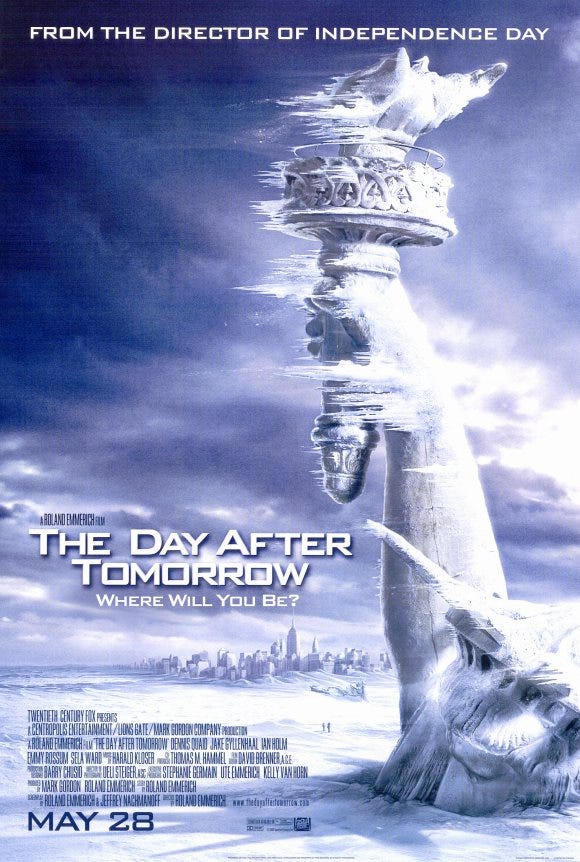
The Day After Tomorrow (2004): A climatologist tries to figure out a way to save the world from abrupt global warming.
Disaster movies play right into the wheelhouse of what Hollywood does best: big concept, big stars, big stakes, big special effects. They are some of the top grossing box office movies of all time including Titanic ($600M domestic), Independence Day ($306M), War of the Worlds ($234M), and Armageddon ($201M).
Why? What is the basis for the popularity of disaster movies?
First, they are visual, huge spectacles that entertain viewers in a visceral way and sweep them up into an enormous story-scape.
Second, there is a real and palpable sense of jeopardy where a mind-rattling “Holy Shit!!!” number of people may die.
But primarily disaster movies bring to the front and center a fear we live with all the time, repressed and set aside by the ticking clock of our everyday lives, but there nonetheless — our knowledge that at any moment, a catastrophe could strike.
We think we are walking on solid ground, yet we live on the thinnest of membranes squashed onto tectonic plates and floating atop oceans of hyperbolic magma. If some geological burp doesn’t get us, there are psychopaths who will take over our airplanes, bomb our skyscrapers, sink our ships.
Those are some of the fears that creep around at the corners of our consciousness — and certainly emerge in our subconscious through our dreams.
Disaster movies are a safe way to process those fears, for us to consider the specter of death. Not just death. Death on a grand scale. If we were to be diagnosed with cancer and informed we would have a year to live, we might organize the rest of our lives one way. Told we have 12 hours [or whatever] left to our meager existence, we must confront a far different way of approaching those last few moments of our time on this earth.
What would we do?
This is the fundamental existential question disaster movies pose. And that speaks to the very deepest fears we have about the terminal nature of life and the dangerous aspects of the world out there.
And of course, it’s just cool to see stuff blow up.
What disaster movies can you add to this list? What other psychological dynamics do you see in play in this movie story type that makes it appealing to audiences?
For other Story Type articles, go here.