Story Types: Biopic
“The process of adapting a real person’s life into a movie is one of the trickiest writing jobs around. The wealth of historical anecdotes…
“The process of adapting a real person’s life into a movie is one of the trickiest writing jobs around. The wealth of historical anecdotes and incidents is both a blessing and a curse: What to include? What to omit?”
There are genres (e.g., Action, Comedy, Drama). Cross genres (e.g., Action-Thriller, Comedy-Science Fiction). Sub-genres (e.g., Romantic Comedy, Action Adventure). And then there are what we may call story types. In Hollywood development circles, people use them as shorthand. If you go here, you will see several that we’ve featured on the blog including Contained Thriller, Road Pictures, and The [Blank] From Hell.
Today: Biopic.
A biopic (pronounced BIO-pic) is a biographical movie of a person’s life. Some notable examples include well known historical figures:
Patton (1970): The World War II phase of the career of the controversial American general.
Ali (2001): A biography of sports legend Muhammad Ali, focusing on his triumphs and controversies between 1964 and 1974.
Relatively unknown people:
My Left Foot (1989): Christy Brown, born with cerebral palsy, learns to paint and write with his only controllable limb — his left foot.
Erin Brockovich (2000): An unemployed single mother becomes a legal assistant and almost single-handedly brings down a California power company accused of polluting a city’s water supply.
They can be stories in a number of genres and sub-genres such as historical dramas:
Marie Antoinette (1936): The tragic life of Marie Antoinette, who became queen of France in her late teens.
Braveheart (1995): When his secret bride is executed for assaulting an English soldier who tried to rape her, William Wallace begins a revolt against King Edward I of England.
Comedy:
Private Parts (1997): The autobiographical story of Howard Stern, the radio rebel who is now also a TV personality, an author and a movie star.
Political:
Nixon (1995): A biographical story of former U.S. President Richard Milhous Nixon, from his days as a young boy, to his eventual Presidency, which ended in shame.
Sports:
Fear Strikes Out (1957): True story of the life of Jimmy Piersall, who battled mental illness to achieve stardom in major league baseball.
Thriller:
Silkwood (1983): A worker at a plutonium processing plant is purposefully contaminated, psychologically tortured and possibly murdered to prevent her from exposing worker safety violations at the plant.
A recent trend has been away from movies covering the length of a character’s life, instead focusing on a narrow period of time like Lincoln (2012), The Imitation Game (2014), and Jackie (2016). Known as snapshot bios, these have become increasingly popular because they use a particular chapter in a character’s life as a lens through which to interpret the entirety of their existence.
The process of adapting a real person’s life into a movie story is one of the trickiest writing jobs around. The wealth of historical anecdotes and incidents is both a blessing and a curse: Generally great material, but too much of it. I’ve read a slew of interviews with screenwriters who echo this basic point: It’s almost more important what elements you choose to omit than what you decide to keep in the final story.
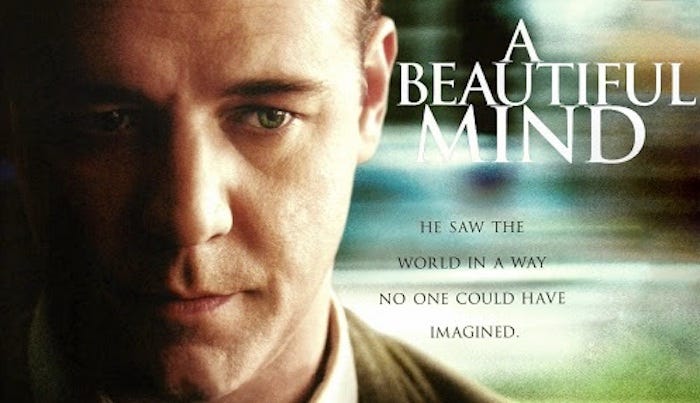
Sometimes a person’s life doesn’t lay out terribly well for narrative structure. Sometimes they do. In an article in “Written By” magazine, screenwriter Akiva Goldsman said that after he finished reading the Sylvia Nasar biography “A Beautiful Mind,” he immediately saw the three-act structure: Genius. Fall. Redemption. In either case, the screenwriter works by the golden rule of adaptation: Never let the facts get in the way of the story, an adage Goldsman followed big-time in adapting A Beautiful Mind. The Wikipedia entry lists some of the key changes in the movie:
The narrative of the film differs considerably from the actual events of Nash’s life. The film has been criticized for this, while the filmmakers insisted that the film was not meant to be a literal representation.
One difficulty was in portraying stress and mental illness within one person’s mind. Sylvia Nasar stated that the filmmakers “invented a narrative that, while far from a literal telling, is true to the spirit of Nash’s story”. The film made his hallucinations visual and auditory when, in fact, they were exclusively auditory. Furthermore, while in real life Nash spent his years between Princeton and MIT as a consultant for the RAND Corporation in California, in the film he is portrayed as having worked for the Pentagon instead. It is true that his handlers, both from faculty and administration, had to introduce him to assistants and strangers. The PBS documentary A Brilliant Madness attempts to portray his life more accurately.
Few of the characters in the film, besides John and Alicia Nash, corresponded directly to actual people. The discussion of the Nash equilibrium was criticized as over-simplified. In the film, schizophrenic hallucinations appeared while he was in graduate school, when in fact they did not show up until some years later. No mention is made of Nash’s supposed homosexual experiences at RAND, which Nash and his wife both denied. Nash also fathered a son, John David Stier (born June 19, 1953), by Eleanor Agnes Stier (1921–2005), a nurse whom he abandoned when informed of her pregnancy. The film also did not include Alicia’s divorce of John in 1963. It was not until Nash won the Nobel Memorial Prize that they renewed their relationship, although she allowed him to live with her as a boarder beginning in 1970. They remarried in 2001.
Nash is shown to join Wheeler Laboratory at MIT, but there is no such lab. He was appointed as C.L.E. Moore Instructor at MIT. The pen ceremony tradition at Princeton shown in the film is completely fictitious. The film has Nash saying around the time of his Nobel prize in 1994: “I take the newer medications”, when in fact Nash did not take any medication from 1970 onwards, something Nash’s biography highlights. Howard later stated that they added the line of dialogue because it was felt as though the film was encouraging the notion that all schizophrenics can overcome their illness without medication. Nash also never gave an acceptance speech for his Nobel prize because laureates do not do that as portrayed in the film; the award ceremony is conducted without any such speeches.
When John Nash himself attended the movie’s premiere, he said afterward, “That was my life.” Not his literal life perhaps, but the emotional truth of his life. In that respect, we can say that Goldsman nailed the adaptation.
For more of the Story Type series, go here.