Story Type: Ticking Clock
In Hollywood movie circles, there are genres like Horror or Science Fiction, cross genres like Action-Thriller or Drama-Comedy, and…
In Hollywood movie circles, there are genres like Horror or Science Fiction, cross genres like Action-Thriller or Drama-Comedy, and sub-genres like Romantic Comedy or Mystery Thriller.
Then there are story types, a shorthand way to describe a specific narrative conceit that is almost always tied directly to the movie’s central concept. They can be found in any genre, cross genre, or sub-genre.
Knowledge about and awareness of these story types can be a boost not only to your understanding of film history and movie trends, but also as fodder for brainstorming new story concepts. Mix and match them. Invert them. Gender bend them. Genre bend them. Geo bend them.
Story types exist for a reason: Because they work. Hopefully this series will help you make them work for you.
Today: Ticking Clock.
Ticking Clock movies are those where there is a definitive event positioned to happen in the near future which will lead to dramatic, even dire results.
Some movie examples:
D.O.A. (1950): Frank Bigelow, told he’s been poisoned and has only a few days to live, tries to find out who killed him and why.
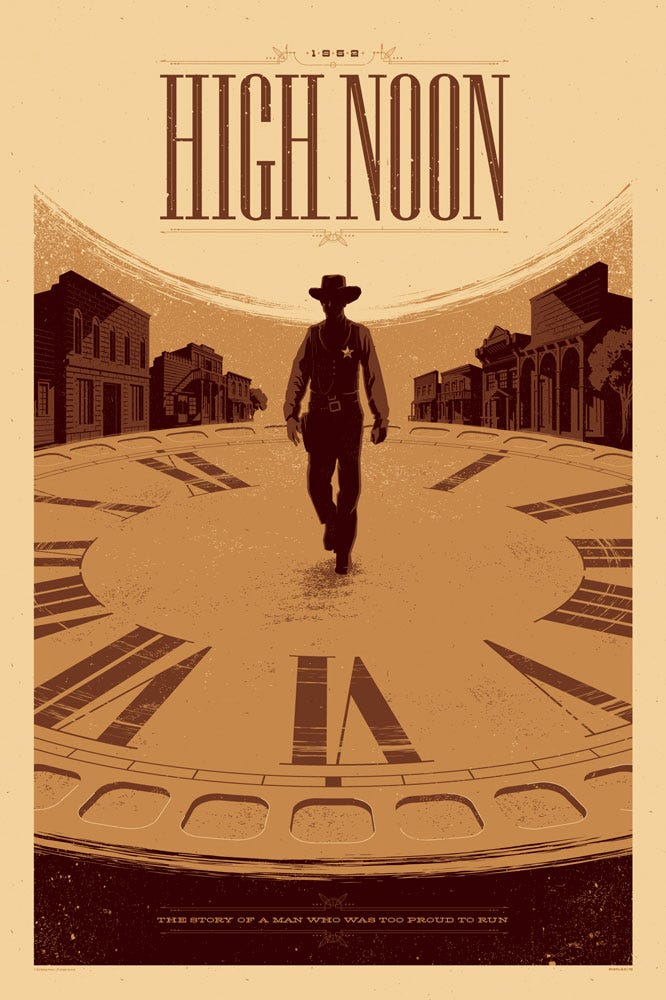
High Noon (1952): A marshall, personally compelled to face a returning deadly enemy, finds that his own town refuses to help him.
Dr. Strangelove or: How I Learned to Stop Worrying and Love the Bomb (1962): An insane general starts a process to nuclear holocaust that a war room of politicians and generals frantically try to stop.
Escape from New York (1981): In 1997, when the US President crashes into Manhattan, now a giant maximum security prison, a convicted bank robber is sent in for a rescue.
War Games (1983): A young man finds a back door into a military central computer in which reality is confused with game-playing, possibly starting World War III.
Back to the Future (1985): In 1985, Doc Brown invents time travel; in 1955, Marty McFly accidentally prevents his parents from meeting, putting his own existence at stake.
Run Lola Run (1988): A young woman in Germany has twenty minutes to find and bring 100,000 Deutschmarks to her boyfriend before he robs a supermarket.
Speed (1994): A young cop must prevent a bomb exploding aboard a city bus by keeping its speed above 50 mph.
Nick of Time (1995): A six year-old girl is kidnapped with the criminals giving the father 90 minutes to assassinate the Governor in order to get his daughter back.
Phone Booth (2002): Stuart Shepard finds himself trapped in a phone booth, pinned down by an extortionist’s sniper rifle.
Crank (2006): Professional assassin Chev Chelios learns his rival has injected him with a poison that will kill him if his heart rate drops.
One of the most obvious advantages to a writer working with a ticking clock dynamic is an overt, sustained and building pressure as the time gets closer and closer. This also comes into play with the psychological experience of the script reader and can help generate a powerful sense of pace.
It’s also a great way to lure the moviegoer into the story universe: What if I was in a situation like that? What if the clock was ticking down on me?
Adding pressure to almost any situation helps the writer make the experience ‘more.’ If makes drama more dramatic… comedy more humorous… thrillers more suspenseful. And if the ticking clock is a key aspect of the story’s central conceit, it can also be a great marketing hook.
What other qualities and dynamics do you think are present in ticking clock movies? What other films of note belong in the list?
For more articles in the Story Types series, go here.