Story Type: Contained Thriller
In Hollywood movie circles, there are genres like Horror or Science Fiction, cross genres like Action-Thriller or Drama-Comedy, and…
In Hollywood movie circles, there are genres like Horror or Science Fiction, cross genres like Action-Thriller or Drama-Comedy, and sub-genres like Romantic Comedy or Mystery Thriller.
Then there are story types, a shorthand way to describe a specific narrative conceit that is almost always tied directly to the movie’s central concept. They can be found in any genre, cross genre, or sub-genre.
Knowledge about and awareness of these story types can be a boost not only to your understanding of film history and movie trends, but also as fodder for brainstorming new story concepts. Mix and match them. Invert them. Gender bend them. Genre bend them. Geo bend them.
Movie story types exist for a reason: Because they work. Hopefully this series will help you make them work for you.
Today: Contained Thriller.
Some examples of contained thriller movies:
Lifeboat (1944): Several survivors of a torpedoed ship find themselves in the same boat with one of the men who sunk it.
Rear Window (1954): A wheelchair bound photographer spies on his neighbors from his apartment window and becomes convinced one of them has committed murder.
Wait Until Dark (1967): A recently blinded woman is terrorized by a trio of thugs while they search for a heroin stuffed doll they believe is in her apartment.
When a Stranger Calls (1979): A psychopathic killer terrorizes a babysitter, then returns seven years later to menace her again.
Dead Calm (1989): A mass-murderer kidnaps and seduces a young woman after leaving her husband to die on the vessel whose crew he’s just slaughtered.
Cube (1997): Seven complete strangers of widely varying personality characteristics are involuntarily placed in an endless kafkaesque maze containing deadly traps.
Panic Room (2002): A woman and her teenage daughter become imprisoned in the panic room of their own house by 3 criminals.
Phone Booth (2002): Stuart Shepard finds himself trapped in a phone booth, pinned down by an extortionist’s sniper rifle.
Open Water (2003): Based on the true story of two scuba divers accidentally stranded in shark infested waters after their tour boat has left.
Saw (2004): With a dead body lying between them, two men wake up in the secure lair of a serial killer who’s been nicknamed “Jigsaw”. The men must follow various rules and objectives if they wish to survive and win the deadly game set for them.
Hard Candy (2005): A teenage girl raids a man’s home, suspecting he is a pedophile, in order to expose him.
Disturbia (2007): A teen living under house arrest becomes convinced his neighbor is a serial killer.
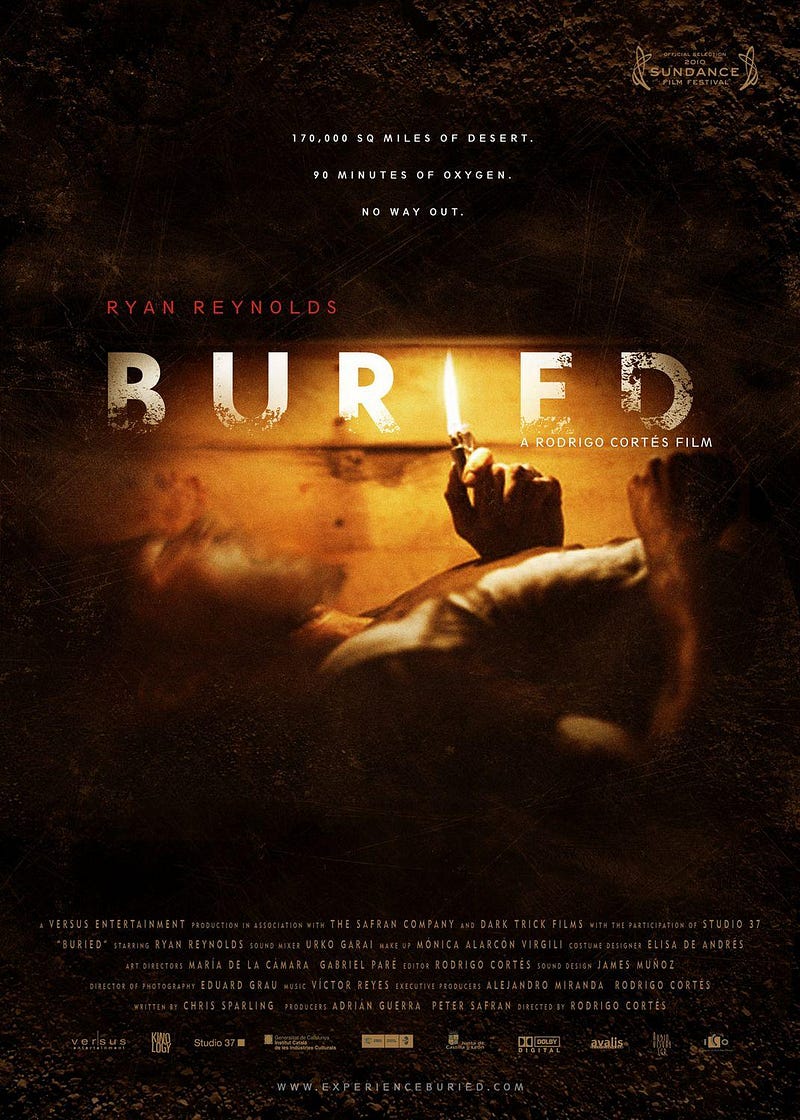
Buried (2010): After an attack by a group of Iraqis, Paul wakes to find he is buried alive inside a coffin. With only a lighter and a cell phone it’s a race against time to escape this claustrophobic death trap.
What are some of the common elements of a contained thriller? Obviously the contained part is key. If one of our goals as writers is to lock a Protagonist in a situation, what better way than to — literally — lock them to a specific location. The suffocating closeness of the locale can prove claustrophobic for a moviegoer. Combine that with a Nemesis figure who knows the ins and outs of the location, then you up the underdog status for the Protagonist.
But heads-up: Writing a contained thriller can be a challenge precisely because of the limited locations. In my 2011 interview with Chris Sparling, screenwriter of the contained thrillers Buried and ATM (2012), I asked this exact question:
SM: Having made that choice to stay inside the coffin with the Protagonist Paul Conroy, what did you find to be some of the most difficult aspects of crafting a viable story because of the physical limitations you set on yourself?
CS: I suppose it was trying to make sure the story didn’t seem redundant. It needed to always be changing, despite the physical limitations imposed by the setting. Primarily, this meant the risk/stakes had to keep escalating, just as the “set” itself had to evolve, which was accomplished with the various light sources and even Paul’s body position.
That said, if you can conquer that issue, a contained thriller can be a strong selling point for a spec script for two primary reasons: (1) The studios can use the restricted location as part of the hook in their marketing strategy, playing upon people’s fears about being stranded in a location. (2) More importantly: Cost. By virtue of the fact contained thrillers have as few as one location, that can result in a low or even microbudget project. Think Paranormal Activity (2007). Costing a reported $15,000, the movie grossed $9.1M its opening weekend, and the entire series of movies (5 total) has generated nearly $1B in box office revenues. All for a movie Oren Peli shot entirely inside his own house.
What other qualities and dynamics do you think are present in contained thriller movies? What other films of note belong in the list?
For more Story Types articles, go here.