Spec Script Formatting Primers
An amazing resource for TV writers provided by the Writers Guild Foundation.
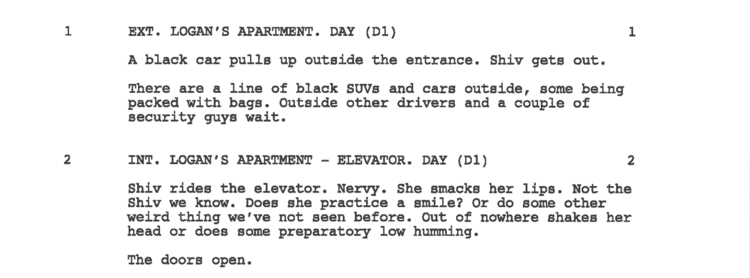
An amazing resource for TV writers provided by the Writers Guild Foundation.
I have been a member of the Writers’ Guild of America, west since 1987 and have supported the Writers Guild Foundation ever since. Over the years at Go Into The Story, I have featured many videos from their YouTube channel which is an amazing resource in and itself.
Today, however, I want to put the spotlight on the remarkable work done by Lauren O’Connor. A librarian at the Writers Guild Foundation, Lauren decided to be proactive during the pandemic lockdown and create an incredibly helpful resource for those interested in writing for television.
Even though the quarantine coincided with fellowship season and the library has been closed since March 2020, the WGF library can still provide remote assistance. We can’t send you scripts in their entirety. We aren’t the copyright holders and we don’t have the right to distribute them beyond the physical library. Bur for those people writing specs, we put together a series of blog posts that break down the formatting of over 80 TV shows from the WB Accepted Shows list and Nickelodeon list. Keep in mind, we don’t have every show — this list is drawn from our library collection. We hope these are helpful in your writing process.
Here is an example of what Lauren did for just one TV script in the series of primers:
THE MARVELOUS MRS. MAISEL (Amazon)
Average page count: 75
Average number of scenes: 45
Broken into acts? No
Other things to consider:
- Mrs. Maisel scripts are a bit longer because they consist of so much rapid-fire dialogue. Description is used sparingly.
- How do scripts begin? Often with “FADE IN:” (much like you are reading a feature script.)
- Occasionally, the script specifies the title card. “CUT TO: THE MARVELOUS MRS. MAISEL.”
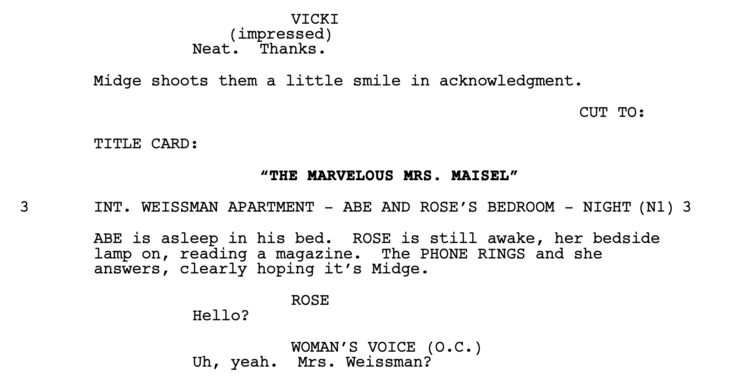
- There’s no special way that comedy routines are written — just lots of blocky text, much like a late-night comedian’s monologues.

- Most scripts end with “FADE OUT.” on the right side of the page, then “END OF SHOW” centered and sometimes underlined, sometimes not.
Access the Mrs. Maisel pilot here.
I was so impressed by how Lauren went “into the weeds” about script format and style elements — precisely the level of specificity which can help a writer taking on a spec script — I reached out to her via email with some questions about this initiative. Here is that Q&A:
What is your current position with the Writers Guild Foundation and what is your creative background?
I’m a Librarian at the Writers Guild Foundation. In this role, I help build and provide access to our massive collection of scripts and other items. Normally, when the library is open, I can be found behind the reference desk or helping our archivist process the papers of notable writers. I also occasionally moderate panels and talks. I studied Screenwriting at the University of North Carolina School of the Arts then got my Masters in Moving Image Archive Studies from UCLA, so this job is the perfect intersection of my major interests. In my spare time, I write stage plays and am a member of the Dramatists Guild.
What inspired you to take on the Formatting Your Spec Script While Social Distancing series?
First, it might be helpful for me to explain a bit how the WGF Library works. We have nearly 40,000 film and TV scripts in our collection, but almost all of them are unpublished. Since we’re not the copyright owners, we can’t freely distribute them or put them online.
Fellowship applicants often find it indispensable to come to our library to read scripts for the TV shows they’re spec-ing. When the pandemic hit, we had to close the library just as fellowship application season was heating up! To try to make up for it, we promoted that people could e-mail us in the library with their questions about certain shows and we’d send formatting information and script screenshots. As you can imagine, we got inundated. I felt we could cut down on the many e-mails we got by anticipating peoples’ spec questions in advance in the form of a blog series and voila! Formatting Your Spec Script While Social Distancing was born!
How have you gone about deciding which TV scripts to focus on for each installment in the series?
We decide what we’ll cover in each post based on the e-mails we get from library patrons. If someone asks about a show and it’s also on the Warner Bros. Television Workshop or Nickelodeon Writing Program’s list of accepted shows, we cover it. There’s a level of curation that goes into each post as well. We want to make sure we’re covering comedies, dramas, network TV shows, streamers, single cam, multi-cam, etc. and that any one post doesn’t include too much of one thing. A lot of times if we haven’t covered a popular show, it’s because we don’t have scripts for it yet. That’s part of it too. In the library, we have to ask for every script that we get. Most of the time, we’re able to procure things, but sometimes it takes a while. There are a lot of shows on the air!
Are there some insights from doing this series you have made about the current state of TV writing? Any changes or trends?
Writing these blog posts has re-affirmed for me the importance and educational value of writing spec scripts. Some people will tell you that writing a spec script for an existing show is an archaic practice, but I completely disagree. Even if the people staffing shows want to read strictly original pilots, this doesn’t make the exercise of writing a spec episode any less helpful. Rather, this is how you learn to format the kind of TV show that you want to write. If you want to write network TV dramas, you’ll find no better way to teach yourself the formatting, the terminology, the feeling of the text on the page… than by researching and writing a spec. Period. You’ll also build the muscle you need to come up with a story and write an episode quickly, which is vital for when you get a TV writing job. After doing this series, I am an ambassador of spec scripts!
How important do you think it is for aspiring screenwriters and television writers to read movie and TV scripts?
Notice how nobody says, “Hey! I think I’m really qualified to be a 5-star Michelin chef because I EAT a lot!” Watching lots of movies and TV doesn’t hurt, but if you want to write professionally, READING SCRIPTS will give you the best instruction on how to write a feature or a pilot… or a spec. Continuing to read throughout your career will help you to internalize what you like, what moves you, what works, what doesn’t work — all of which will help to inform your style. The other half of the equation is to keep writing.
Do you intend to continue the Formatting series and if so, what may we look forward to seeing in the future?
Yes, we have to keep doing this series. It’s opened up our collections and allowed us to help people outside of the Los Angeles area who, until this point, haven’t had much access. I’m curious about how we can involve our library patrons in the creation of these blog posts. Someone who watches a particular show is going to ask much more targeted questions about the formatting than a librarian whose mandate is to cover as many shows as possible. Stay tuned for more developments on this front.
Finally, what other resources does the Writers Guild Foundation offer which aspiring screenwriters and television writers can take advantage of?
I generally recommend poking around our website wgfoundation.org to see the breadth of things going on at the WGF and to sign-up for our weekly newsletter which you can do right from our homepage. This way you’ll be the first to hear about upcoming zoom discussions, blog posts and other opportunities.
If you’re a fan of Formatting Your Spec Script While Social Distancing, we actually have a new, upcoming discussion series called WGF Library Script Breakdown. During this series, my colleague Javier Barrios and I will sit down with a writer/show creator and painstakingly break down a script with pages on screen. Our first guest is Alena Smith, creator of the AppleTV+ series Dickinson. You can sign-up here.
Lastly, I’ll put a reminder that every installment of Formatting Your Spec Script While Social Distancing lives here in our resource center. Also in the resource center is a blog series called Writing Your Screenplay While Social Distancing. This series looks at various topics within writing features and draws on a wealth of script examples from the library. We don’t want people who write movies to feel left out on the blog!
There are currently 16 primers in the series. Here are the rosters for just a few of them:
Primer #1
Shows covered:
Big Mouth
The Chilling Adventures of Sabrina
The Crown
The Marvelous Mrs. Maisel
Mindhunter
PEN15
Shrill
Succession
Will & Grace
You
Primer #2
Shows covered:
Atlanta
Evil
The Good Doctor
Legacies
Superstore
Primer #3
Shows covered:
Bob’s Burgers
Dead to Me
Power
The Rookie
Russian Doll
Younger
I have featured links to a bunch of Hollywood fellowships, mentor and training programs, particularly for TV writers — Hollywood Writing Fellowships — and what the good folks at the Writers Guild Foundation, spearheaded by Lauren’s efforts, have provided for the online screenwriting community is a wonderful resource, particularly for those applying to those initiatives.
Speaking for myself as a film school professor, I am circulating these primers to my teaching colleagues and students, both undergraduate and graduate.
You can check out all 16 primers by going here.
Thanks, Lauren! And thanks, Writers Guild Foundation for everything you do for screenwriters, aspiring and professional!