Sonata Form and Three-Act Structure
Musical echoes of story structure.
Musical echoes of story structure.
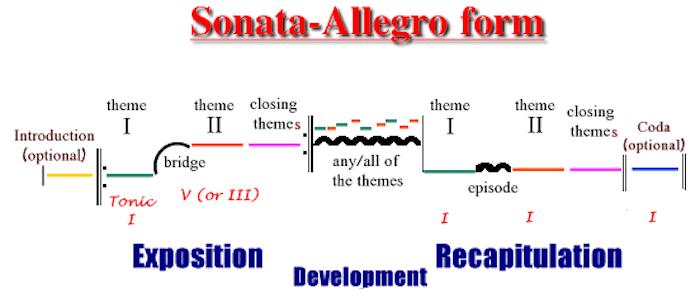
During the early-18th to mid-19th centuries, orchestral music in Europe was dominated by sonata form. This approach evolved over a period of many decades as orchestral music in the West moved from the dense counterpoint and fugues of the Baroque era to what is known as the Classical Era wherein lyrical melodies developed and flourished. Mozart is generally perceived to be the first, best talent at using sonata form. For my money, his 40th symphony is the quintessential example of sonata form.
What is sonata form? It involves three sections:
Exposition: Introduces the movement’s main melody in the tonic key, then moves to another key, which may include a number of different melodic themes.
Development: The middle section of the movement develops material from the exposition in a variety of ways, moving through a number of keys.
Recapitulation: This final section restates the melodic themes of the exposition, usually in the same order; the second group is now heard in the tonic key.
Even if you have never studied classical music, I ask you to look at those three sections and ask yourself: don’t they bring to mind 3-Act Structure? There are striking similarities, if you think of:
EXPOSITION DEVELOPMENT RECAPITULATION
ACT ONE ACT TWO ACT THREE
You can even extend the metaphor further by thinking of Melodies as Characters, and Transitions from one section to the next as major plot points.
Indeed, the core idea of the main melody (Protagonist), set up in the Exposition section (Act I), taken through a series of key changes (twists-and-turns) in the Development section (Act II), usually a sequence with considerable tonal instability, and rhythmic and melodic tension (mucking up the Plotline), then the main melody (Protagonist) brought back ‘home’ in the Recapitulation section (Act III), but played only in the tonic key (the “Protagonist” transformed), you can really see the parallel to 3-act structure:
Music is another means of storytelling, and the fact that master composers such as Mozart, Beethoven, Mahler, Brahms, and many more used sonata form, that it ruled orchestral music for 150 years, that pieces based upon sonata form are still performed and enjoyed by millions to this day is yet another example of why structural theories about screenplays work — because they reflect a three act/movement pattern which seems to underlie the basics of all stories, all forms of storytelling, all manner of story-crafting.
- Aristotle: Beginning — Middle — End
- Hegelian Dialectic: Thesis — Antithesis — Synthesis
- Hero’s Journey: Separation — Initiation — Return
- Sonata Form: Exposition — Development — Recapitulation
For more on sonata form and a breakdown of Mozart’s 40th symphony per its structure, go here.