So-Called Screenwriting ‘Rules’: Part 7
There are conventions. There are expectations. There are patterns. But the simple fact is… THERE ARE NO SCREENWRITING RULES!
There are conventions. There are expectations. There are patterns. But the simple fact is… THERE ARE NO SCREENWRITING RULES!
Awhile back, I posted this about an occurrence that happens with irritating regularity in the online screenwriting universe: The contentious specter of so-called screenwriting ‘rules’. More below.
What happens is pretty much this:
- Somebody posts something about how there is a rule against doing this or that.
- That circulates as people bat around the idea.
- Professional writers catch wind of it, then lambaste the shit out of the thesis in question.
- The ‘debate’ fades away…
- Until the next time it arises.
- Again…
- And again…
So it occurred to me, why not just deal with it once and for all! Get every single supposed screenwriting rule out on the table, then go through them, one by one, to see if we can take all the heat that typically gets generated when one of these online snits breaks out and collectively create some actual light.
In other words, let’s make this a real learning experience and hopefully in the process, put some of this nonsense to bed for good.
I asked for your help in aggregating these ‘rules’ and as always, the GITS community responded. I’ve gone through them all, thought about it, and here is my plan: Do a 3-week series on “So-Called Screenwriting ‘Rules’”.
Week 1: As long as we’re going to take the time to go through this stuff, I figured we might as well put it all into some perspective: historical, theoretical, and practical. I’m going to start that process today:
Part 1: The Organic Nature of the Screenplay
Part 2: The Emergence of the Selling Script
Part 3: The Evolution of Screenplay Format and Style
Part 4: There are no screenwriting ‘rules’
Part 5: There are expectations
Week 2: I’ve sorted out five real nuts-and-bolts items which I will analyze and discuss one per day in our second week:
Part 6: We See / We Hear
Part 7: Unfilmables
Part 8: Action Paragraphs — 3 Lines Max
Part 9: CUT TO (Transitions)
Part 10: Parentheticals
Week 3: Readers made several suggestions that are about larger narrative choices, so let’s take those on as well:
Part 11: Flashbacks
Part 12: Voiceover Narration
Part 13: Sympathetic Protagonist
Part 14: Protagonist and Shifting Goals
Part 15: Certain Events By Certain Pages
Before we jump into this, a caveat: Everything I post in this series is my opinion. I think it’s safe to say it’s a pretty well-informed take seeing as I’ve been writing scripts since 1986 and teaching since 2002. But again, I’m simply expressing my perspective. It’s incumbent upon you to sort out your own approach to screenwriting style and the single best thing you can do in that regard is read scripts, especially screenplays written within the last 5 years as they represent the latest trends.
With that, forward into the breach!
Part 7: Unfilmables
NOTE: At the end of this post, I have included a link to a great, insightful article written by the Bitter Script Reader on this very subject. We are strikingly in accord in these matters. Frankly his opinion may matter more than mine because he represents the very people — readers — who presumably hold these screenwriting ‘rules’ like the sword of Damocles over any script they cover.
The ‘rule’ here is you cannot write in scene description anything an actor can’t act or a moviegoer can’t see. Examples of this in scripts are sometimes called unfilmables because they are — supposedly — you guessed it… unfilmable.
I dealt with this subject in a post dated June 4, 2012, so let me reproduce that here in its entirety:
I don’t know who came up with this term — unfilmables — but please stop! How much proof does one have to see to know it is a wrongheaded approach to screenwriting.
This came up in a thread last week re (500) Days of Summer. In it, Vic Tional noted this:
mention unfilmables, but actually that’s probably unfair. They were all filmable, because they got filmed. Every damn one of them. For reasons unclear to me, I seem to have an extremely good recollection of that movie, and the script to page comparison here is so near-identical it’s hardly worth bothering. ‘CLOSE on Tom, looking at Summer the way every woman wants to be looked at’. Nailed it. She’s ‘pretty enough to get away with’ her kooky hair. Gotcha. ‘It should look like the dandelions originated with Tom’s breath. That sort of thing. Anyway…’ Hate to say, but damn that’s good. Because this should really angry up my blood, but it doesn’t. It works. It just does.
To which I responded with this:
This is all part of the choices the writer takes with “Narrative Voice,” an extension of that invisible character’s personality.
And a quick aside about so-called ‘unfilmables’: Your point is well-taken about there being debates on this front, but here’s my deal: There should be NO debates anymore. Ever. The idea that we can’t write what actors can’t act or what someone in a movie theater can’t see is completely wrong. I just taught a semester-long course called “The History of American Screenwriting” and part of that research involved tracking script evolution since the 1890s. I found so-called ‘unfilmables’ stretching back to the silent era. For decades screenwriters have done whatever they could to tell stories the best way they can and this extends to what I call ‘editorializing’ in scene description, commenting on the atmosphere of the moment, or the inner feelings of a character, and on and on and on. Yes, we have to be judicious — a screenplay is not a novel after all — but can we once and for all lay to rest this crazy idea that there are certain things we can not write in a screenplay. It’s proven wrong over and over in contemporary screenplays, and so-called ‘unfilmables’ have been in use for almost the entire time there have been formalized screenplays. [Vic, this is not at all directed at you because clearly you get it, but rather to unnamed figures on the other side of the divide who have a narrow-minded, literalistic approach to screenplay form and style].
Sorry, got off on a rant there!
Actually I’m not sorry. This whole mentality about what you can and can’t do in terms of screenplay format and style is completely off-base. All we need to do is look at… gee, I don’t know… how about (500) Days of Summer to see that notion of ‘unfilmables’ is flat-out wrong, disproved by a script that was nominated for the WGA Best Original Screenplay Award. Some more examples from the script:
- P. 7: Tom watches her eat like this is the worst travesty in the history of mankind.
- P. 8: He may never eat again.
- P. 25: He’s really into it and, well, it’s kinda sad.
- P. 26: Even her uncoolness is cool.
- P. 32: The wheels are spinning in Tom’s head. What’s the right answer here?
- P. 33: Tom makes copies. Making copies sure is dull.
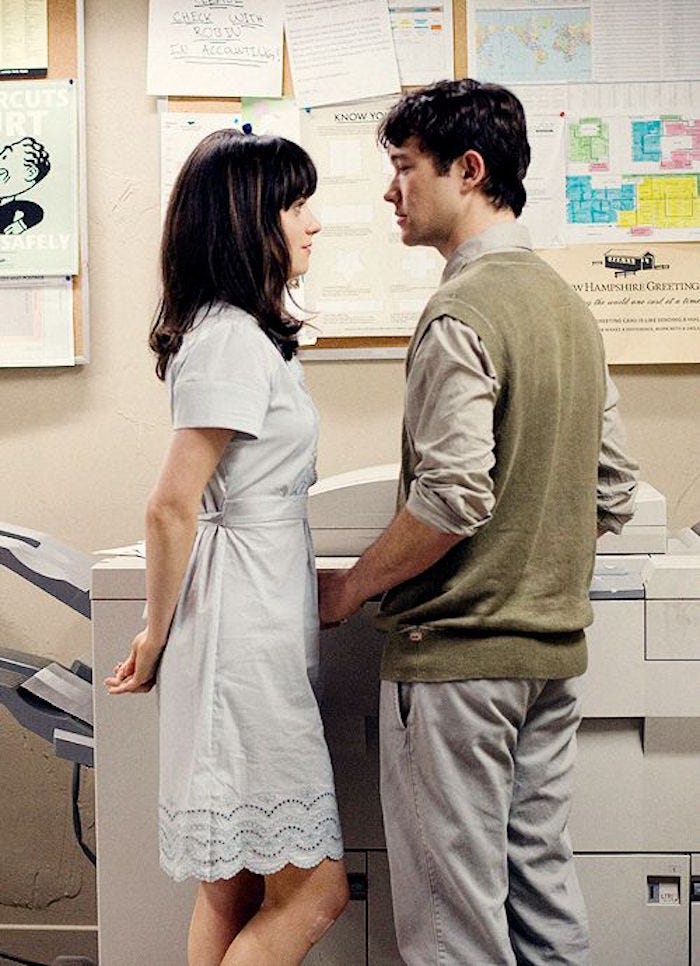
And on and on and on and on. By subscribing to an inaccurate supposition that screenwriters can only write what a moviegoer can see cuts at the very heart of Narrative Voice. Here is a quote from screenwriter Larry Ferguson (The Hunt for Red October) precisely about this point:
The first thing you gotta do is sit down and ask, who’s telling this story? Who grabs hold of you and says, Listen I’m gonna tell you something that’ll knock your socks off. He’s a character. He speaks in a particular way, sometimes uses profanity, sometimes he’s a poet.
Skeptics say, Hey, you can’t take a picture of that… maybe not, but you know what Don Simpson said to me on Beverly Hills Cop II? He said, Jerry [Bruckheimer] and I love the style of your stage description. We know we can’t shoot them, but we can shoot the tone.
That is straight from the mouth of a professional screenwriter, a working screenwriter. They may not be able to shoot the scene description, the ‘unfilmables,’ but they can shoot the tone.
Look, it’s up to you. There is the world of whoever it is that is spreading this nonsense you can’t write something that is unfilmable in scene description, or there is the real world of screenwriting with actual screenwriters and actual movie projects where scripts include unfilmables all the time. Yes, you have to be judicious, you are not writing a novel and you have to be aware of that. But your number one priority is to your story. And if that silent character in your story, its Narrative Voice, pipes up with a line like, “Making copies sure is dull,” then you have not only the freedom, but the responsibility to write that scene description. Because at the end of the day, your job is to tell the story in the most entertaining way possible.
Period!
I call this use of one’s Narrative Voice — commenting on the moment — editorializing and it has been around since the very beginning of the film industry. More proof: The 1969 movie Butch Cassidy and the Sundance Kid, written as a spec script by William Goldman, selling for several hundred thousand dollars. Here is how Goldman introduces Butch Cassidy:
A MANidly walking around a corner of the building. He is
BUTCH CASSIDY and hard to pin down. Thirty-five and bright,
he has brown hair, but most people, if asked to describe
him, would remember him blond. He speaks well and quickly,
and has been all his life a leader of men; but if you asked
him, he would be damned if he could tell you why.
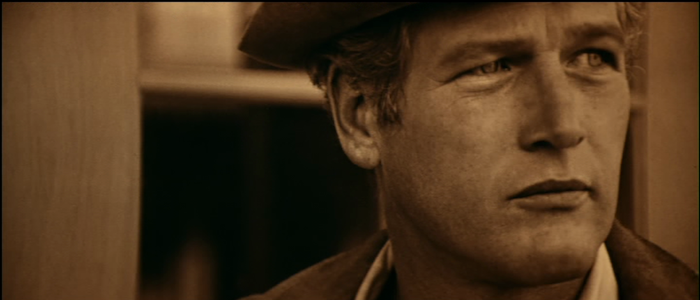
At least half of this scene description qualifies as ‘unfilmable.’ But what does William Goldman know? He’s only written dozens of movies and the best book on the craft ever (“Adventures in the Screen Trade”).
Three points of caution:
- A screenplay differs from a novel in many ways, one of the most significant being it is primarily an externalized reality. So the fundamental way we, as writers, communicate characters to the reader is through their actions and dialogue, what we can see and what we can hear. That is our default venue for writing.
- Just like other so-called ‘rules,’ I suspect this one has arisen because too many writers have editorialized badly or too much or most likely both. So some readers may carry with them an expectation that if they see a script with a lot of unfilmables, that is a sign of an amateur writer.
- You do not have to editorialize in scene description. It should be a choice tied to your Narrative Voice, that invisible character in your story [Genre + Style = Narrative Voice]. The attitude this character takes to the narrative should impact how much or how little editorializing you do. Some stick to the straight and narrow, only describing the action. But many engage in a certain amount of editorializing about the mood, tone, what’s going on inside character’s minds, their inner feelings, and so forth.
Once again, it’s best to think of the mantra: Tools, not rules.
Instead of this: You must never write an unfilmable!
How about this: You have the freedom to editorialize on the moment as long as you do it judiciously and in concert with the Narrative Voice you establish.
The former is negative in nature and restricts creativity.
The latter is positive and encourages creativity.
Finally this: The single best thing you can do to wrangle this subject as you go about determining what your own writing style is: Read scripts. Lots of them. Mostly contemporary ones. The more you read, the better you will grasp the subtleties of the practice of editorializing in scene description.
As promised, here is the link to the Bitter Script Reader’s thoughts on the subject of “Unfilmables”. It’s a must-read because you will get the honest, unvarnished opinion of someone who actually reads scripts for buyers.
If you have any questions or observations, please head to comments. Again, as long as we are taking such a comprehensive approach to this content, let’s do it to the max. I want to hear your thoughts and am glad to make this an extended conversation with a goal of putting this subject into a more helpful perspective.
Next: Action Paragraphs — 3 Lines Max.