So-Called Screenwriting ‘Rules’: Part 5
There are conventions. There are expectations. There are patterns. But the simple fact is… THERE ARE NO SCREENWRITING RULES!
There are conventions. There are expectations. There are patterns. But the simple fact is… THERE ARE NO SCREENWRITING RULES!
Awhile back, I posted this about an occurrence that happens with irritating regularity in the online screenwriting universe: The contentious specter of so-called screenwriting ‘rules’. More below.
What happens is pretty much this:
- Somebody posts something about how there is a rule against doing this or that.
- That circulates as people bat around the idea.
- Professional writers catch wind of it, then lambaste the shit out of the thesis in question.
- The ‘debate’ fades away…
- Until the next time it arises.
- Again…
- And again…
So it occurred to me, why not just deal with it once and for all! Get every single supposed screenwriting rule out on the table, then go through them, one by one, to see if we can take all the heat that typically gets generated when one of these online snits breaks out and collectively create some actual light.
In other words, let’s make this a real learning experience and hopefully in the process, put some of this nonsense to bed for good.
I asked for your help in aggregating these ‘rules’ and as always, the GITS community responded. I’ve gone through them all, thought about it, and here is my plan: Do a 3-week series on “So-Called Screenwriting ‘Rules’”.
Week 1: As long as we’re going to take the time to go through this stuff, I figured we might as well put it all into some perspective: historical, theoretical, and practical. I’m going to start that process today:
Part 1: The Organic Nature of the Screenplay
Part 2: The Emergence of the Selling Script
Part 3: The Evolution of Screenplay Format and Style
Part 4: There are no screenwriting ‘rules’
Part 5: There are expectations
Week 2: I’ve sorted out five real nuts-and-bolts items which I will analyze and discuss one per day in our second week:
Part 6: We See / We Hear
Part 7: Unfilmables
Part 8: Action Paragraphs — 3 Lines Max
Part 9: CUT TO (Transitions)
Part 10: Parentheticals
Week 3: Readers made several suggestions that are about larger narrative choices, so let’s take those on as well:
Part 11: Flashbacks
Part 12: Voiceover Narration
Part 13: Sympathetic Protagonist
Part 14: Protagonist and Shifting Goals
Part 15: Certain Events By Certain Pages
Before we jump into this, a caveat: Everything I post in this series is my opinion. I think it’s safe to say it’s a pretty well-informed take seeing as I’ve been writing scripts since 1986 and teaching since 2002. But again, I’m simply expressing my perspective. It’s incumbent upon you to sort out your own approach to screenwriting style and the single best thing you can do in that regard is read scripts, especially screenplays written within the last 5 years as they represent the latest trends.
With that, forward into the breach!
Part 5: There are expectations
I thank you for bearing with me with these five posts, but I hope you can see that any serious discussion of so-called screenwriting ‘rules’ requires some historical and theoretical perspective. Armed with this background, any time you run into anyone who whacks you over the head with a ‘rule,’ you can tell them:
1. The history of screenwriting proves that screenplays are organic in nature. They are malleable and continue to change over time. This is a fact, a provable truth which I demonstrated in Part 1.
2. While there was a formalized approach to screenplays during the days of the studio system, once that fell apart and screenwriters began to write original stories, writers took selling scripts out of the hands of production and explored a multitude of creative ways to craft narrative — what we know as spec scripts. We explored this in Part 2.
3. As a result over the last three decades, there has been a shift toward a more literary style of screenwriting, stripped of camera shots and directing jargon. Screenwriters today put a premium on readability, but at all times, format and style concerns are subservient to our top priority: Write the story in the most entertaining way possible, as long as what’s on the page is clear to a reader. We went into this in Part 3.
4. Finally, there’s this: To have rules, there would need to be a rulebook. There is none. There are guidelines, conventional wisdom, principles, patterns. But bottom line: There are no screenwriting rules. That was the focus of Part 4.
I am going to suggest a simple three word mantra toward the end of this post which sums up my basic take on this subject. But before we get to that, we have to switch the point of reference. Up to this point, I have been approaching the subject from the vantage point of the writer. Now let’s talk about the other side of the equation: The reader.

When I say ‘reader,’ I mean anyone whose job in Hollywood involves them reading scripts. This can be interns, assistants, professional script readers, producers, managers, agents, actors, directors, and so on.
Each reader is different. Some have a wealth of experience in the business and come at a read with a deep understanding of screenplays and stories. On the other hand, you’d be surprised how many scripts that get disgorged through Hollywood’s virtual transom receive an initial read from interns, some of whom literally have zero professional experience as readers.
Despite this enormous gap that may exist between readers, they all have one thing in common: They bring expectations to the read.
Even if an intern has no formal training, they will have been exposed to on average 10,000 stories by the time they graduate from college. Everyone who reads a script brings that innate personal sense of Story to the process.
Once readers receive training, formal or informal, about how to do coverage or what to look for in a script, they combine their instinctual grasp of Story with all of these so-called ‘rules’ that float around. Next week and the week after, we will examine 10 of them as listed above:
- Do not use “we see” or “we hear”.
- Do not write ‘unfilmable’ scene description.
- Action paragraphs must not have more than 3 lines.
- Avoid using transitions (CUT TO, DISSOLVE TO).
- Avoid using parentheticals.
- Using flashbacks is a sign of weak writing.
- Using voiceover narration is a sign of weak writing.
- You must have a sympathetic Protagonist.
- A Protagonist should not shift goals.
- Certain events need to happen by certain pages.
This is not a hard and fast list, these are not formalized into any universal codex, rather these have bubbled up as suggestions from Go Into The Story readers as things they have run into with their own writing.
The first five are more format-oriented whereas the second group of five are more about larger narrative choices.
I think it’s safe to say that any time a Hollywood reader sits down to plow through a script, they will bring at least some of these expectations with them to that reading experience.
So I can exclaim, “Hey, you are free to do anything you want in terms of style, format and narrative choices.” And in a purely creative sense, that is true. However there is the very real world of the script acquisition and development, which means a lot of people can be reading your words — and they all will be accompanied by their own expectations.
Therefore to ground this discussion in reality, I would make this suggestion:
If you want to be perfectly safe and not risk raising a yellow or red flag in the eyes of a script reader, you should carry with you an awareness of these conventions because many readers will have at least some of them as expectations.
If, however, your story absolutely requires you to write in such a way that you will go against this convention or that, you have to raise your game and make sure that is a necessary choice.
Pragmatically what this means is if you are new screenwriter, you might hew closer to conventions, at least until you have written several scripts, read dozens and dozens more, and feel like you have settled into your own voice as expressed through your style and approach to crafting a narrative.
Yes, this is a nuanced position. But someone needs to say this.
Circling back to where this all started, we have teachers and screenwriting ‘gurus’ promoting these so-called ‘rules’. And whenever these proclamations intersect with professional Hollywood screenwriters, they unload their venom on the ‘rules’ and the ‘rule’-sayers.
Both camps’ invocations — gurus and pros — can result in scaring the shit out of any aspiring writer.
What I’m suggesting — if you’re at all nervous about these style and narrative concerns — is understand the broad options you have available.
On the one hand, you are free to do any damn thing you want. You should always have a deep, abiding and fundamental commitment to your creativity wherever it takes you.
On the other hand, scripts are not read in a vacuum, but rather by human beings who do bring an amorphous, yet influential set of expectations and assumptions into any script read.
The choice is yours. You can always play it safe and stick to conventions. Nothing wrong with that. That represents the line of least resistance, giving a reader no surface level reason to crap on your script in coverage.
But if all you do is play it safe, that is if your focus is there and not tapping into your creativity and giving full voice to your story, chances are it won’t matter how well you follow the ‘rules’ anyhow because your story likely won’t be imaginative or distinctive enough to garner the necessary attention to move it forward in the evaluation process.
And that’s another bottom line: You could write a script in the past tense… with no sluglines… 175 pages long… written in purple crayon… and if the story is great, chances are that script will find a buyer.
Which brings me to the simple mantra I would like to offer to you to carry forward into our discussion the next 2 weeks and beyond:
Tools, not rules.
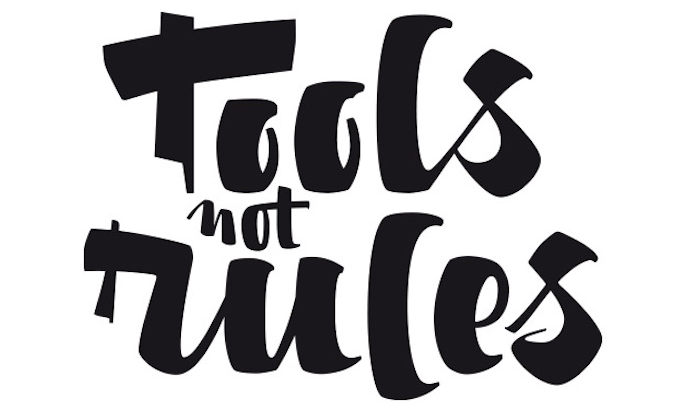
This simple phrase re-frames the discussion.
When we talk about rules, we are coming from a place that is about restriction and denial, a negative place.
When we talk about tools, we are coming from a place that is about creativity and construction, a positive place.
In the course of these next 2 weeks, I’m going to provide some examples how we can turn some of the rules into tools, showing alternate ways to accomplish the same goal, but by inverting or adapting the narrative device in question.
Therefore if you carry nothing else away from this first week’s discussion, I humbly suggest it be that mantra: Tools, not rules.
Once again, these are all just my opinions. If they make sense, feel free to use them. If not, feel free to lose them. I have no ego in these matters.
If you have any questions or observations, please head to comments. Again, as long as we are taking such a comprehensive approach to this content, let’s do it to the max. I want to hear your thoughts and am glad to make this an extended conversation with a goal of putting this subject into a more helpful perspective.
Next week, we dig into 5 of these ‘rules,’ beginning on Monday with the whole no ‘we see’ / ‘we hear’ brouhaha.
See you then!