So-Called Screenwriting ‘Rules’: Part 3
There are conventions. There are expectations. There are patterns. But the simple fact is… THERE ARE NO SCREENWRITING RULES!

There are conventions. There are expectations. There are patterns. But the simple fact is… THERE ARE NO SCREENWRITING RULES!
Awhile back, I posted this about an occurrence that happens with irritating regularity in the online screenwriting universe: The contentious specter of so-called screenwriting ‘rules’:
What happens is pretty much this:
- Somebody posts something about how there is a rule against doing this or that.
- That circulates as people bat around the idea.
- Professional writers catch wind of it, then lambaste the shit out of the thesis in question.
- The ‘debate’ fades away…
- Until the next time it arises.
- Again…
- And again…
So it occurred to me, why not just deal with it once and for all! Get every single supposed screenwriting rule out on the table, then go through them, one by one, to see if we can take all the heat that typically gets generated when one of these online snits breaks out and collectively create some actual light.
In other words, let’s make this a real learning experience and hopefully in the process, put some of this nonsense to bed for good.
I asked for your help in aggregating these ‘rules’ and as always, the GITS community responded. I’ve gone through them all, thought about it, and here is my plan: Do a 3-week series on “So-Called Screenwriting ‘Rules’”.
Week 1: As long as we’re going to take the time to go through this stuff, I figured we might as well put it all into some perspective: historical, theoretical, and practical. I’m going to start that process today:
Part 1: The Organic Nature of the Screenplay
Part 2: The Emergence of the Selling Script
Part 3: The Evolution of Screenplay Format and Style
Part 4: There are no screenwriting ‘rules’
Part 5: There are expectations
Week 2: I’ve sorted out five real nuts-and-bolts items which I will analyze and discuss one per day in our second week:
Part 6: We See / We Hear
Part 7: Unfilmables
Part 8: Action Paragraphs — 3 Lines Max
Part 9: CUT TO (Transitions)
Part 10: Parentheticals
Week 3: Readers made several suggestions that are about larger narrative choices, so let’s take those on as well:
Part 11: Flashbacks
Part 12: Voiceover Narration
Part 13: Sympathetic Protagonist
Part 14: Protagonist and Shifting Goals
Part 15: Certain Events By Certain Pages
Before we jump into this, a caveat: Everything I post in this series is my opinion. I think it’s safe to say it’s a pretty well-informed take seeing as I’ve been writing scripts since 1986 and teaching since 2002. But again, I’m simply expressing my perspective. It’s incumbent upon you to sort out your own approach to screenwriting style and the single best thing you can do in that regard is read scripts, especially screenplays written within the last 5 years as they represent the latest trends.
With that, forward into the breach!
Part 3: The Evolution of Screenplay Format and Style
If you go back to Part 1, you can see four script examples I posted there dating from 1902, 1920, 1951 and 2009. Those provide a macro view of the evolution of screenplay format and style.
For purposes of this series, let’s focus on the shift from the formalized ‘blueprint’ approach to what we are likely to see in contemporary selling scripts. As an example of the former, here is an excerpt from the famous chase scene in the 1959 movie North by Northwest:
He gets to his feet, looks about, sees a cornfield
about fifty yards from the highway, glances up at
the plane making its turn, and decides to make a
dash for the cover of the tall-growing corn.SHOOTING DOWN FROM A HELICOPTER about one hundred
feet above the ground, we SEE Thornhill running
towards the cornfield and the plane in pursuit.SHOOTING FROM WITHIN THE CORNFIELD, we SEE Thornhill
come crashing in, scuttling to the right and lying
flat and motionless as we HEAR THE PLANE ZOOM OVER
HIM WITH A BURST OF GUNFIRE and bullets rip into
the corn, but at a safe distance from Thornhill.
He raises his head cautiously, gasping for breath,
as he HEARS THE PLANE MOVE OFF AND INTO ITS TURN.SHOOTING DOWN FROM THE HELICOPTER, we SEE the plane
levelling off and starting a run over the corn-
field, which betrays no sign of the hidden Thorn-
hill. Skimming over the top of the cornstalks, the
plane gives forth no burst of gunfire now. Instead,
it lets loose thick clouds of poisonous dust which
settle down into the corn.WITHIN THE CORNFIELD, Thornhill, still lying flat,
begins to gasp and choke as the poisonous dust
envelops him. Tears stream from his eyes but he
does not dare move as he HEARS THE PLANE COMING
OVER THE FIELD AGAIN. When the plane zooms by and
another cloud of dust hits him, he jumps to his
feet and crashes out into the open, half blinded
and gasping for breath. Far off down the highway
to the right, he SEES a huge Diesel gasoline-tanker
approaching. He starts running towards the highway
to intercept it.SHOOTING FROM THE HELICOPTER, we SEE Thornhill
dashing for the highway, the plane levelling off
for another run at him, and the Diesel tanker
speeding closer.SHOOTING ACROSS THE HIGHWAY, we SEE Thornhill run-
ning and stumbling TOWARDS CAMERA, the plane closing
in behind him, and the Diesel tanker approaching
from the left. He dashes out into the middle of
the highway and waves his arms wildly.
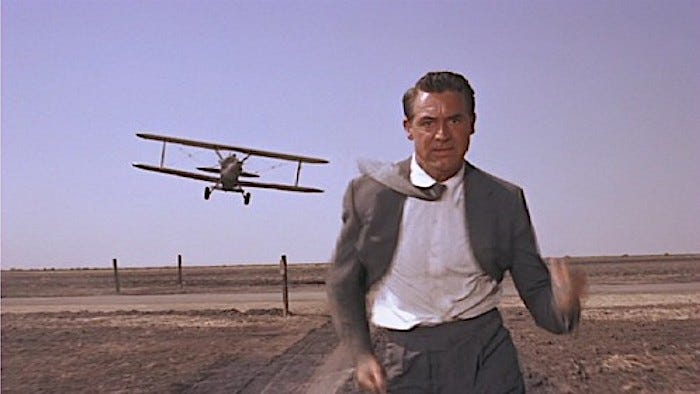
By contrast, here is another action scene, an excerpt from the 1999 movie The Matrix:
INT. CHASE HOTELThe Big Cop flicks out his cuffs, the other cops holding a
bead. They've done this a hundred times, they know
they've got her, until the Big Cop reaches with the cuffs
and Trinity moves --It almost doesn't register, so smooth and fast, inhumanly
fast.The eye blinks and Trinity's palm snaps up and his nose
explodes, blood erupting. Her leg kicks with the force of
a wrecking ball and he flies back, a two-hundred-fifty
pound sack of limp meat and bone that slams into the cop
farthest from her.Trinity moves again, BULLETS RAKING the WALLS, flashlights
sweeping with panic as the remaining cops try to stop a
leather-clad ghost.A GUN still in the cop's hand is snatched, twisted and
FIRED. There is a final violent exchange of GUNFIRE and
when it's over, Trinity is the only one standing.A flashlight rocks slowly to a stop.----INT. HALLShe bursts out of the room as Agent Brown enters the hall,
leading another unit of police. Trinity races to the
opposite end, exiting through a broken window onto the
fire escape.EXT. FIRE ESCAPEIn the alley below, Trinity sees Agent Smith staring at
her. She can only go up.EXT. ROOFOn the roof, Trinity is running as Agent Brown rises over
the parapet, leading the cops in pursuit.Trinity begins to jump from one roof to the next, her
movements so clean, gliding in and out of each jump,
contrasted to the wild jumps of the cops.Agent Brown, however, has the same unnatural grace.The metal SCREAM of an elevated TRAIN is heard and Trinity
turns to it, racing for the back of the building.The edge falls away into a wide back alley. The next
building is over 40 feet away but Trinity's face is
perfectly calm, staring at some point beyond the other
roof.The cops slow, realizing they are about to see something
ugly as Trinity drives at the edge, launching herself into
the air.From above, the ground seems to flow beneath her as she
hangs in flight --Then hitting, somersaulting up, still running hard.
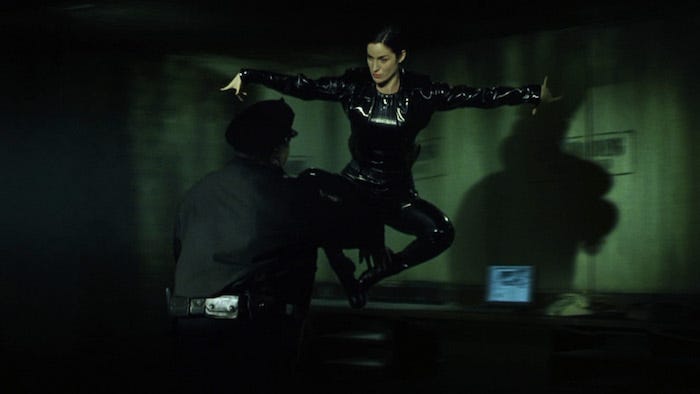
Separated by four decades, what changes can we discern between the two?
The most obvious difference is the number of lines in each paragraph. In Northwest, there is one paragraph that is 3 lines and two that are 4 lines with the others 5 lines or more including one that is 11 lines long. In Matrix, there are no paragraphs longer than 5 lines and the average length is 3 lines.
This reflects a trend in contemporary scripts to have shorter paragraphs. Frankly by current standards, The Matrix may come across as a bit thick. Compare to this excerpt from the 2012 script for Looper:
Joe fires again, close enough now to draw blood off Old Joe’s
chest and knock him back.Out of nowhere a SLAT BIKE careens around the van, which has
until now blocked our line of sight down the highway.Kid Blue.The bike clips Joe’s leg, sending him spinning violently to
the dusty pavement.The bike shoots off down the highway, a cloud of dust in its
wake. It takes a hundred yards for the Kid to pull it to a
stop and spin it around.Joe is hurt bad. He grapples for his blunderbuss.Kid Blue guns the engine, gat in hand. Levels it, steady as
a rock.Joe shoots at the Kid, but he’s out of range, the gun fires
scattershot.Kid Blue fires, a bullet hits dangerously close to Joe.Panicked, Joe begins firing at the pavement around him, round
after fiery round.Kicking up dust. Lots of dust. Raising a cloud.
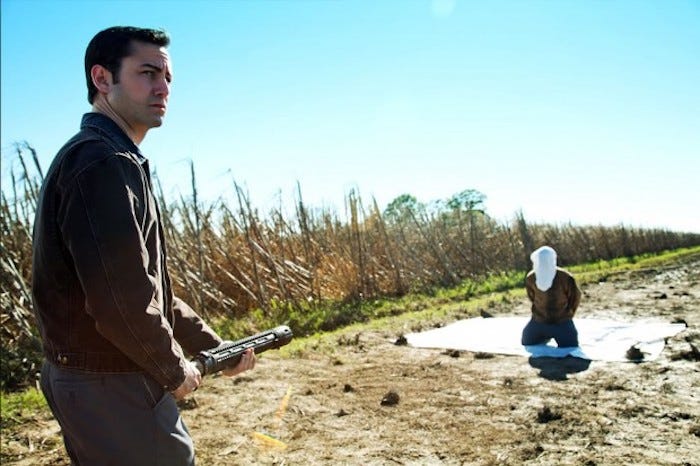
Most paragraphs are 2 lines or less. Why? One reason: Shorter blocks of scene description can be more readable than longer ones, especially for action sequences.
Another distinction: In Northwest, the action description includes specific camera shots:
SHOOTING DOWN FROM A HELICOPTERSHOOTING FROM WITHIN THE CORNFIELDSHOOTING DOWN FROM THE HELICOPTERWITHIN THE CORNFIELDSHOOTING FROM THE HELICOPTERSHOOTING ACROSS THE HIGHWAY
In The Matrix and Looper, there is no camera lingo, no directing jargon. This reflects two dynamics.
First, as screenwriters began to write selling scripts, untethered from the necessities of production, directors decided they didn’t like being told by screenwriters how to shoot the movie.
Concurrently screenwriters embraced the move of screenplays toward a more literary style — the focus on story, not production. So out went specific camera shots…
Or did they?
Look at the script excerpt from The Matrix. Notice how almost every sentence translates into a distinct camera shot. This dynamic is even more pronounced when we look at the excerpt from Looper. Here each paragraph is like one camera shot. Compare to this from North by Northwest:
WITHIN THE CORNFIELD, Thornhill, still lying flat,
begins to gasp and choke as the poisonous dust
envelops him. Tears stream from his eyes but he
does not dare move as he HEARS THE PLANE COMING
OVER THE FIELD AGAIN. When the plane zooms by and
another cloud of dust hits him, he jumps to his
feet and crashes out into the open, half blinded
and gasping for breath. Far off down the highway
to the right, he SEES a huge Diesel gasoline-tanker
approaching. He starts running towards the highway
to intercept it.
There are at least 5 camera shots in this scene description. If it were translated into a more modern, literary approach — each paragraph signifying a camera shot — it might look like this:
WITHIN THE CORNFIELD, Thornhill, still lying flat,
begins to gasp and choke as the poisonous dust
envelops him.Tears stream from his eyes but he does not dare
move as he HEARS THE PLANE COMING OVER THE FIELD
AGAIN.When the plane zooms by and another cloud of
dust hits him --He jumps to his feet and crashes out into the
open, half blinded and gasping for breath.Far off down the highway to the right, he SEES
a huge Diesel gasoline-tanker approaching.He starts running towards the highway to
intercept it.
This approach is not only more readable, it also affords a writer the opportunity to ‘direct’ the story without (A) stepping on a director’s toes by inserting specific camera shots and (B) make the script a more literary document.
We should note that consistent through all three script excerpts is the use of visual language — strong verbs, vivid descriptors. Professional writers from all eras have recognized that movies are primarily a visual medium.
That said, two significant shifts in the evolution of screenplay format and style as detailed here:
- Contemporary screenwriting places a premium on a script’s readability. It’s not surprising that one of the highest compliments someone can offer about a script in today’s world is this: “It’s a good read.”
- Directors don’t want screenwriters instructing them in selling scripts how to shoot the movie? Fine. Screenwriters have embraced the dismissal of directing lingo by using individual lines of scene description to suggest camera shots. It is a nifty way to make for a more literary script while enabling us to translate the move we see in our minds onto the page.
Those are two big pieces of the screenplay’s evolution over the last half-century or so. But do they qualify as rules?
We will discuss that tomorrow in Part 4 of the series.
If you have any questions or observations, please head to comments. Again, as long as we are taking such a comprehensive approach to this content, let’s do it to the max. I want to hear your thoughts and am glad to make this an extended conversation with a goal of putting this subject into a more helpful perspective.