So-Called Screenwriting ‘Rules’: Part 1
There are conventions. There are expectations. There are patterns. But the simple fact is… THERE ARE NO SCREENWRITING RULES!
There are conventions. There are expectations. There are patterns. But the simple fact is… THERE ARE NO SCREENWRITING RULES!
Awhile back, I posted this about an occurrence that happens with irritating regularity in the online screenwriting universe: The contentious specter of so-called screenwriting ‘rules’:
What happens is pretty much this:
- Somebody posts something about how there is a rule against doing this or that.
- That circulates as people bat around the idea.
- Professional writers catch wind of it, then lambaste the shit out of the thesis in question.
- The ‘debate’ fades away…
- Until the next time it arises.
- Again…
- And again…
So it occurred to me, why not just deal with it once and for all! Get every single supposed screenwriting rule out on the table, then go through them, one by one, to see if we can take all the heat that typically gets generated when one of these online snits breaks out and collectively create some actual light.
In other words, let’s make this a real learning experience and hopefully in the process, put some of this nonsense to bed for good.
I asked for your help in aggregating these ‘rules’ and as always, the GITS community responded. I’ve gone through them all, thought about it, and here is my plan: Do a 3-week series on “So-Called Screenwriting ‘Rules’”.
Week 1: As long as we’re going to take the time to go through this stuff, I figured we might as well put it all into some perspective: historical, theoretical, and practical. I’m going to start that process today:
Part 1: The Organic Nature of the Screenplay
Part 2: The Emergence of the Selling Script
Part 3: The Evolution of Screenplay Format and Style
Part 4: There are no screenwriting ‘rules’
Part 5: There are expectations
Week 2: I’ve sorted out five real nuts-and-bolts items which I will analyze and discuss one per day in our second week:
Part 6: We See / We Hear
Part 7: Unfilmables
Part 8: Action Paragraphs — 3 Lines Max
Part 9: CUT TO (Transitions)
Part 10: Parentheticals
Week 3: Readers made several suggestions that are about larger narrative choices, so let’s take those on as well:
Part 11: Flashbacks
Part 12: Voiceover Narration
Part 13: Sympathetic Protagonist
Part 14: Protagonist and Shifting Goals
Part 15: Certain Events By Certain Pages
Before we jump into this, a caveat: Everything I post in this series is my opinion. I think it’s safe to say it’s a pretty well-informed take seeing as I’ve been writing scripts since 1986 and teaching since 2002. But again, I’m simply expressing my perspective. It’s incumbent upon you to sort out your own approach to screenwriting style and the single best thing you can do in that regard is read scripts, especially screenplays written within the last 5 years as they represent the latest trends.
With that, forward into the breach!
Part 1: The Organic Nature of the Screenplay
Screenplay structure. Screenplay format. Screenplay style. Nothing associated with a movie script is static. Rather this narrative form has been in a constant state of change ever since its earliest roots.
Here is the first example of anything remotely resembling a script: The complete scenario for the 1902 movie “A Trip to the Moon” by Georges Méliès:
1) The scientific congress at the Astronomic Club.
2) Planning the trip. Appointing the explorers and servants. Farewell.
3) The workshops. Constructing the projectile.
4) The foundries. The chimney-stacks. The casting of the monster gun.
5) The Astronomers enter the shell.
6) Loading the gun.
7) The monster gun. March past the gunners. Fire!! Saluting the flag.
8) The flight through space. Approaching the moon.
9) Landed right in the eye!!!
10) Flight of the shell into the moon. Appearance of the earth from the moon.
11) The plain of craters. Volcanic eruption.
12) The dream (the Solies, the Great Bear, Phoebus, the Twin Sisters, Saturna).
13) The snowstorm.
14) 40 degrees below zero. Descending a lunar crater.
15) Into the interior of the moon. The giant mushroom grotto.
16) Encounter with the Selenites. Homeric flight.
17) Prisoners!!!
18) The kingdom of the moon. The Selenite army.
19) The flight.
20) Wild pursuit.
21) The astronomers find the shell again. Departure from the moon.
22) Vertical drop into space.
23) Splashing into the open sea.
24) At the bottom of the ocean.
25) The rescue. Return to port.
26) The great fete. Triumphal march past.
27) Crowning and decorating the heroes of the trip.
28) Procession of Marines and the Fire Brigade.
29) Inauguration of the commemorative statue by the manager and the council.
30) Public rejoicings
You may see the movie online here.
Even though we can recognize in the scenario certain elements similar to a modern shooting script, such as scene locations and numbered scenes, anyone with even a cursory understanding of contemporary screenplays will note the many profound differences, not the least of which… no dialogue!
Jumping ahead a few decades, some of you may remember the year-long series I did on the 1920 book “How to Write Photoplays” by scriptwriters Anita Loos and her husband John Emerson. You may read that entire series here. I have included here an actual script page Loos and Emerson wrote:
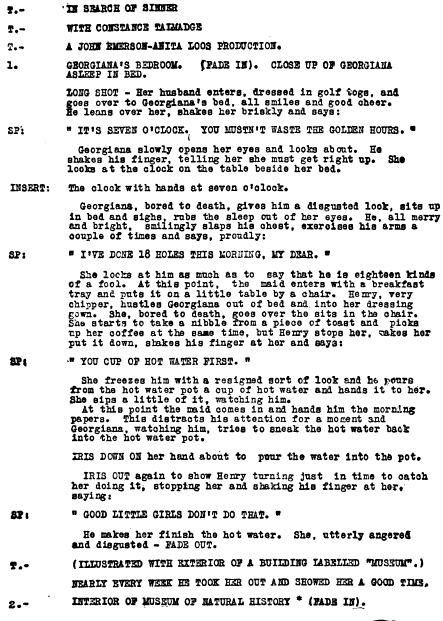
The technical term at the time for this was a continuity. Over time it became photoplay. Then screen play. Then screenplay. In the example above, we can see more changes happening including the use of sub-titles to convey dialogue and more elaborate stage direction.
Now let’s jump all the way to 1951 with this excerpt from the script for the movie The African Queen, adapted from the C.S. Forrester novel by James Agee and John Huston:
EXT. A NATIVE VILLAGE IN A CLEARING BETWEEN THE JUNGLE AND
THE RIVER. LATE MORNINGLONG SHOT -- A CHAPELIntense light and heat, a stifling silence. Then the SOUND
of a reedy organ, of two voices which make the words distinct,
and of miscellaneous shy, muffled, dragging voices, beginning
a hymn: VOICES
(singing)
"Guide me O Thou Great Jehovah..."INT. CHAPEL -- LONG SHOT -- THE LENGTH OF THE BLEAK CHAPEL
PAST THE CONGREGATION, ON BROTHER, AT THE LECTERN, AND ROSE,
AT THE ORGANBROTHER, a missionary, faces CAMERA near center; ROSE, his
sister, is at side, her face averted. Everybody is singing."Pilgrim through this barren land..."MEDIUM SHOT -- BROTHER:middle-aged, rock-featured, bald, sweating painfully, very
much in earnest. He is very watchful of his flock. He sings
as loud as he can, rather nasally, and tries to drive the
meaning of each word home as if it were a nail. He is beating
with his hand, and trying hard to whip up the dragging tempo:"I am weak, but Thou art mighty..."CLOSER SHOT -- ROSEearly thirties, tight-featured and tight-haired, very hot
but sweating less than Brother.She is pumping the pedals vigorously, spreading with her
knees the wings of wood which control the loudness, utilizing
various stops for expressiveness of special phrases, and
rather desperately studying the open hymnal, just managing
to play the right notes -- a very busy woman. She, too, is
singing her best and loudest, an innocent, arid, reedy
soprano; and she, too, is very attentive to the meanings of
words:"Hold me with Thy powerful hand."INSERT -- HALF-WAY THROUGH THE FOREGOING LINE, AN EXOTIC AND
HORRIBLE CENTIPEDE-LIKE CREATURE SLITHERS INTO VIEW BETWEEN
TWO OF THE ORGAN KEYS. WITHOUT INTERRUPTING HER PLAYING, AS
METHODICALLY AS SHE WOULD PULL OUT A NEW STOP, ROSE SWIPES
IT AWAY.ROSE -- AS BEFORE --completes "Thy Powerful Hand"; o.s. Voices of singers.
Unperturbed, Rose finishes her casual disposal of the bug
and pulls out a new stop.
What we’re reading here looks much more like a contemporary script, now including dialogue, however note all those camera shots. Compare to the opening scene in the script for the 2009 movie Zombieland written by Rhett Reese and Paul Wernick:
We begin with a SONG: WOODY GUTHRIE'S 'THIS LAND IS YOUR'
LAND.' CATCHY. PATRIOTIC. WARM. Recorded in mono, played
on a scratchy old phonograph...The following is shot gritty. Kinetic. Fast. Scary. Very
'28 Days Later,' 'Saving Private Ryan,' 'Children of Men.'FADE UP ON:An AMERICAN FLAG, filling the screen, flapping. A male
voice, belonging to FLAGSTAFF, a witty, anxiety-ridden
EVERYMAN, late-twenties, (THINK SETH GREEN), narrates: FLAGSTAFF (V.O.)
This land is your land.The camera rotates on its axis until the flag is UPSIDE DOWN,
then pulls back to reveal that it is one of those flags
flying on the hood of a PRESIDENTIAL LIMOUSINE, which itself
is upside-down, crashed and overturned ON TOP of another car.The further we pull back, the more we see of a destroyed,
burning Washington D.C. FLAGSTAFF (V.O.)
This land is my land.Suddenly, rapid FOOTSTEPS! The camera jiggles nervously,
trying to find their source. Rapidly, the footsteps become
LOUD, like someone running on sheet-metalBOOM-BOOM-BOOM! A ZOMBIE, bleeding from the eyes, runs UP
the other side of the tangled mess of automobiles, plants a
foot on the underside of the limo, and LONG-JUMPS, arms
flailing, down onto the ground in the direction of the
camera.It lands on its STOMACH, then scrambles up to its hands and
knees.The camera jiggles, backing up quickly. The ZOMBIE regains
its footing and sprints spastically, aggressively toward the
lens.The CAMERAMAN has seen enough. He turns and RUNS, his P.O.V.
bouncing wildly. Then the camera WHIP-PANS to face the
Zombie as it WAILS and ATTACKS.The zombie engulfs the screen, TACKLING the Cameraman.The camera FALLS to the ground, askew, shooting nothing but
treetops and sky. Offscreen, the CAMERAMAN SCREAMS and
SCREAMS and SCREAMS, accompanied by ripping, cracking,
CRUNCHING.Something just God-awful is happening to this guy. Then he
gacks and falls SILENT.We hear munching.The zombie's superbly frightening FACE comes into frame
again, at an angle, staring into the camera lens as though
it's a bathroom mirror. The zombie curiously looks at its
reflection, twitching, trembling, smacking its lips.The zombie BELCHES, long, loud, and animal-like, FOGGING the
LENS with its breath.
There is a camera reference, but it’s more of a found footage feel with no specific designations for MEDIUM SHOTS or CLOSE UPS. That is just one of several key differences in screenplay style and format compared to previous iterations of a screenplay.
I give you this quick jaunt through the history of scripts to underscore my initial point: The very nature of a screenplay is organic. It is not static. It is malleable. It changes.
There have been all sorts of influences on the form since its birth — the advent of sound technology spawning the need for dialogue, the impact of playwrights and journalists, the emergence of directors as auteurs and scenes broken down by camera shots, and on and on.
As a result, anyone who makes a claim about this being the way to write a script, or you can or can’t do this or that is speaking based upon a false assumption — that there is a set screenplay form.
There isn’t. Screenplay format and style is in a constant state of metamorphosis, it is organic in nature.
Yes, there are conventions and, as we will discuss, expectations on the part of readers. You would be wise to learn them. But they are not rules and you are not bound by them.
The primary subtext of this entire series is this: Your focus should be on the story. Always the story. Whatever it takes to tell it in the most entertaining, engaging, and evocative way — as long as what’s happening on the page is clear to a reader — that is what you should be spending your energy on.
One of the primary reasons why screenplay style has changed as significantly as it has the last 30 years is the emergence of the selling script. That is the topic of tomorrow’s post.
If you have any questions or observations, please head to comments. Again, as long as we are taking such a comprehensive approach to this content, let’s do it to the max. I want to hear your thoughts and am glad to make this an extended conversation with a goal of putting this subject into a more helpful perspective.
Tomorrow: Part 2: The Emergence of the Selling Script.