So-Called Screenwriting ‘Rules’: Don’t use “we see” or “we hear”
There are conventions. There are expectations. There are patterns. But the simple fact is… THERE ARE NO SCREENWRITING RULES!
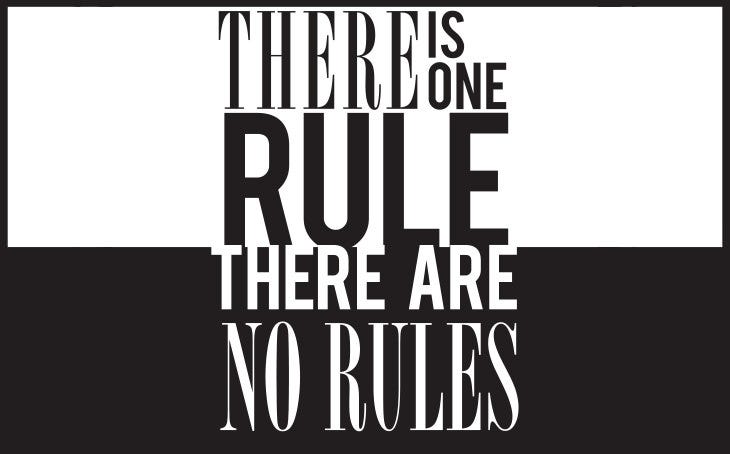
There are conventions. There are expectations. There are patterns. But the simple fact is… THERE ARE NO SCREENWRITING RULES!
Awhile back, I posted this about an occurrence that happens with irritating regularity in the online screenwriting universe: The contentious specter of so-called screenwriting ‘rules’. More below.
What happens is pretty much this:
- Somebody posts something about how there is a rule against doing this or that.
- That circulates as people bat around the idea.
- Professional writers catch wind of it, then lambaste the shit out of the thesis in question.
- The ‘debate’ fades away…
- Until the next time it arises.
- Again…
- And again…
Here is one of these so-called screenwriting ‘rules’: Don’t use “we see” or “we hear.” My thoughts on the matter below
NOTE: At the end of this post, I have included a link to a great, insightful article written by the Bitter Script Reader on this very subject. We are strikingly in accord in these matters. Frankly his opinion may matter more than mine because he represents the very people — readers — who presumably hold these screenwriting ‘rules’ like the sword of Damocles over any script they cover.
The narrative form we call a screenplay is an organic entity, changing radically over the years. As we have discussed, during the era of the ‘studio system,’ there was a more or less formalized approach to screenplay format and style. Obviously there were differences from studio to studio, writer to writer, but as a script was almost always a work-for-hire tied to production, they were fundamentally a blueprint to make a movie.
Example: An excerpt from the script for the 1951 movie War of the Worlds, written by Barre Lyndon:
33. EXT. CLAYTON'S CAR - CLOSE SHOT - MOVING SHOT CAMERA is CLOSE and ANGLED DOWN in the back of the
car. Tucked along fishing and camping gear alongside
a box of iced trout is an impressive Geiger counter,
chattering furiously. A signal light is flashing
rapidly. The Sheriff's hands reach for it. CAMERA
MOVES BACK and his face comes into SCENE, looking
down at the counter. SHERIFF
(Yelling off)
What you got in here, feller?...It's
ticking like a bomb! The SHOT WIDENS as Clayton enter with Pastor Collins,
Sylvia, the Ranger and others. Clayton reaches into
the car and picks up a short pole-meter attached to
the counter. He swings it around. The clicking
slows. He lifts the counter out, points the pole-
meter at the gully. The light flashes become a rapid
blur, brilliant. The chattering increases to a high-
pitched buzz. CLAYTON
(To Sheriff)
This is a Geiger counter for detecting
radio-activity. We did a little sur-
veying while we were up in the hills.
(Above SOUND of the counter -
looking o.s.)
It's that meteor. PASTOR COLLINS
It's radio-active? SHERIFF
Look at this thing -- goin' crazy! He reaches for the Geiger. Clayton lets him have it
and remains looking toward the gully. The SOUND of
the Geiger counter continues over SCENE.
Note the significant presence of the CAMERA and SOUND EFFECTS. While screenplays of this era — obviously — told a story, their functionality as a guide for the day-to-day production of a movie was omnipresent.
However, as we have noted, once the studio system broke down in combination with several other factors, writers began to evolve screenplays into a more literary style. At first, it was about directors not wanting writers to include specific camera shots because that felt like the writer was trying to direct the movie. That created a problem: How could we suggest what we saw in our minds in a given scene if we couldn’t use shots and directing lingo?
Enter WE SEE. Instead of writing “CAMERA is CLOSE and ANGLED DOWN in the back of the car,” we could do this [edits italicized]:
We SEE the back of the car. Tucked along fishing
and camping gear alongside a box of iced trout
is an impressive Geiger counter, chattering
furiously. A signal light is flashing
rapidly. The Sheriff's hands reach for it.
We SEE his face, looking down at the counter.
The problem here is two-fold:
- It is pretty obvious that “we SEE” or “WE SEE” is nothing more than a different way to say ANGLE ON or CLOSE UP. It is a camera shot without directly saying it’s a camera shot.
- With the advent of the spec script and the tsunami of original material that began to swamp Hollywood in the 80s and 90s, many aspiring and novice screenwriters would use WE SEE without much discretion. Imagining the scene in their heads — “I see this, I see that” — scripts would often be filled with “we SEE,” dozens and dozens of them.
So the value of using “WE SEE” as a substitute for MEDIUM SHOT or ZOOM OUT was not only largely negated by the overuse of the phrase, it became downright annoying to script readers.
My theory is that over time, this solidified into the view that writers who used “we SEE” to any significant degree in a script were perceived to be amateurs, which in turn led to the so-called ‘rule’: Don’t use WE SEE.
As I have stated, I don’t believe there are any screenwriting rules, so in my opinion you are free to write “we SEE.”
The reality is sometimes, a scene may absolutely call for the use of “we SEE.” For example, if we really want to drive home the impact of a visual and bring it ‘closer’ to a reader, we may choose to use “WE SEE”. Also you may remember the script excerpt from Zombieland which I included in the very first post in this series, the writers use “we see” when indicating what is being shown through the limited perspective of a video camera:
The camera rotates on its axis until the flag is UPSIDE DOWN,
then pulls back to reveal that it is one of those flags
flying on the hood of a PRESIDENTIAL LIMOUSINE, which itself
is upside-down, crashed and overturned ON TOP of another car.The further we pull back, the more we see of a destroyed,
burning Washington D.C.
So there are, in fact, times when “WE SEE” is not only appropriate, it may be the very best choice we have to convey the story in that moment.
And yet, readers do carry with them an expectation, even a bias that if they read a script where “WE SEE” is used more than on an occasional basis, that conveys a certain lack of maturity and professionalism on the writer’s part.
What to do?
Remember that mantra I suggested at the end of Part 5:
Tools, not rules.
This simple phrase re-frames the discussion.
When we talk about rules, we are coming from a place that is about restriction and denial, a negative place.
When we talk about tools, we are coming from a place that is about creativity and construction, a positive place.
In the course of these next 2 weeks, I’m going to provide some examples how we can turn some of the rules into tools, showing alternate ways to accomplish the same goal, but by inverting or adapting the narrative device in question.
This is a very simple tool professional screenwriters use all the time nowadays: Just describe what is in the shot. Period. No need to frame the shot. No need to take note of the shot. Just write what is in the shot.
Here is some scene description from the script for the hit 2013 movie Prisoners, written by Aaron Guzikowski, a key scene where the RV gets introduced into the story:
That old RV is parked up ahead on the side of the road,
the girls are racing each other to it. Joy leaves Anna
in the dust -- SLAPS the RV's bumper victoriously.Ralph and Eliza pick up the pace and catch up to them.
The RV is parked in front of a house with a FOR SALE
sign.Eliza walks along the RV peering up at opaque windows
smeared with filth.Anna starts to climb a little ladder on the back of the
RV, when Ralph pulls her off --Eliza grabs Joy’s hand and shooshes Ralph.They all stop and listen. A radio just came on inside
the RV: some 1970s Christian folk song.Anna chucks a piece of ice and it SMASHES LOUD on the
side of the RV. Ralph grabs her hand.Eliza takes Joy’s hand and the four of them continue on
around the block...The rear windshield of the RV. A shadow appears behind
the filthy glass, watching them go...
Just describe what’s in the shot. If you want to go the extra step in terms of ‘directing’ the action, you can break up what’s happening into separate paragraphs, each one suggesting a specific camera shot. As you can see, this is precisely what Guzikowski does — on both accounts.
This reflects current stylistic sensibilities, a more literary approach, stripped of camera shots and directing lingo, yet enabling us to ‘direct’ the action in a way that tells the story within the story, not breaking the mood with ‘scripty’ jargon.
And probably 99% of the whole “we see” debate gets resolved with this simple narrative device.
Tools, not rules, my friends.
Same goes with “We HEAR.” In the days of formalized scripts, writers would indicate noises either by CAPPING them or even using SFX to signify “Sound Effect”. That was then, when screenplays were largely perceived as being blueprints to make a movie.
Just as writers began to write “we SEE” instead of CAMERA SHOT, they used “WE HEAR” in lieu of SFX — GUNFIRE or SFX — A SIREN.
Here, too, we have the freedom to write “we HEAR”. Once again from Zombieland:
We hear munching.
But the more typical approach is the same thing as noted above: Just describe what’s in the shot. Again Zombieland:
...the CAMERAMAN SCREAMS and SCREAMS and SCREAMS, accompanied by ripping, cracking, CRUNCHING.Something just God-awful is happening to this guy. Then he
gacks and falls SILENT.
Yet another circumstance whereby we don’t have to expend any energy whatsoever debating whether WE SEE or WE HEAR is a ‘rule’. They are not. We can use them. But beware: Script readers have their antennae up about them, attuned to the prejudice they can, when used frequently, betray an amateur writer.
If you approach the subject from a ‘Tools, not rules’ perspective, and ‘Just describe what’s in the shot,’ you not only avoid this issue altogether, you will likely end up writing a cleaner, tighter, and more visual script.
As promised, here is the link to the Bitter Script Reader’s thoughts on the subject of “We See”. It is an absolute must-read because you will get the honest, unvarnished opinion of someone who actually reads scripts for buyers.
If you have any questions or observations, please head to comments. Again, as long as we are taking such a comprehensive approach to this content, let’s do it to the max. I want to hear your thoughts and am glad to make this an extended conversation with a goal of putting this subject into a more helpful perspective.
[Originally posted January 2014]